
That's what 4-axis wire EDM makes possible.
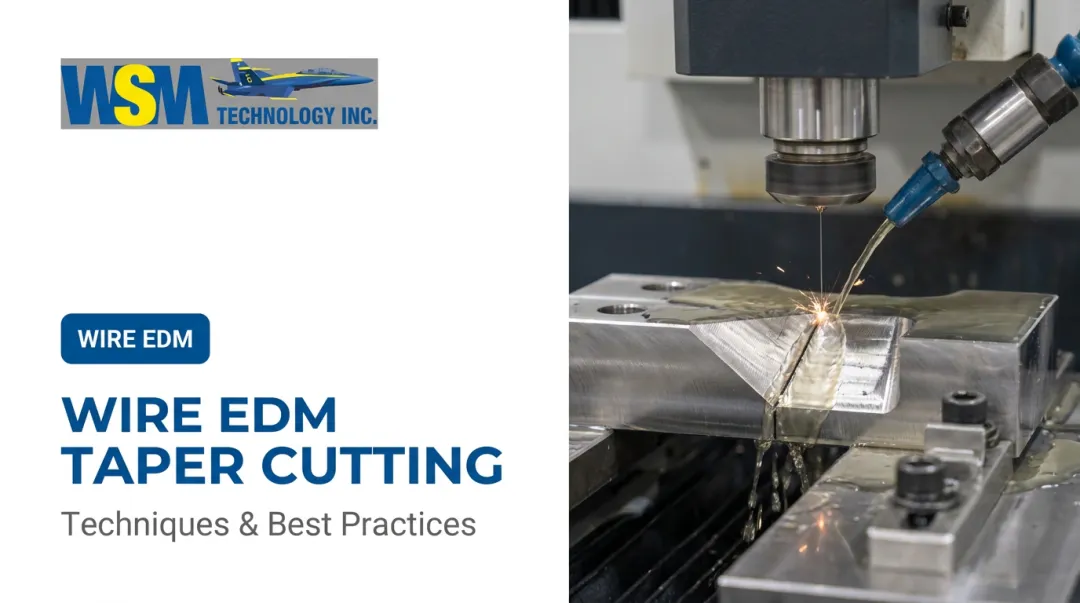
Standard 2-axis wire EDM cuts precise vertical walls all day long, but it can't produce that kind of geometric transition. Add two more axes, and suddenly shops can cut tapers, draft angles, and shape-shifting profiles that would otherwise require multiple machines or manual fabrication.
Demand for these parts is growing fast. Mold and die shops need tapered cavities. Aerospace manufacturers need precision cooling-hole profiles. Medical device makers need angled cutting edges on micro-scale components. This article breaks down how 4-axis wire EDM works, where it's used, and what to look for when evaluating a machine.
Key Takeaways
- 4-axis wire EDM adds independent U/V movement so the wire can tilt for tapers and complex transitions
- Most machines cut 15–30° tapers by workpiece height; specialized setups reach 45°
- Mold, aerospace, medical, and automotive shops rely on this process for geometries CNC milling can't produce
- Wire type, guide spacing, and flush pressure drive taper angle and finish quality
- Judge machines on specs plus supplier training, test-cut capability, and consumables support
What Is 4-Axis Wire EDM and How Does It Work?
Wire EDM works by passing a thin, electrically charged wire through a conductive workpiece submerged in dielectric fluid. Electrical discharges erode the material with extreme precision, and the wire never physically touches the part. Sodick describes the process as applicable to any electrically conductive material, from hardened tool steel to carbide and titanium.
In standard 2-axis wire EDM, the upper and lower wire guides move in lockstep. The wire stays perfectly vertical, producing straight-walled cuts.
How the U and V Axes Create Taper
4-axis wire EDM adds two more axes: U and V. These control the upper wire guide independently of the lower one. According to a Modern Machine Shop explanation, displacing U and V away from their opposed position tilts the wire itself, rather than moving the part.
The full axis breakdown:
- X/Y — worktable movement (position on the horizontal plane)
- Z — guide height adjustment
- U/V — independent positioning of the upper guide, which angles the wire

The workpiece never moves or tilts. That's the key distinction from 3+2 milling, where the part itself gets repositioned. Here, the wire changes angle while the part sits still.
How steep can it go? Manufacturer specs vary by model and workpiece height:
- Sodick ALC600GH — ±25° at 130 mm thickness (optional 45° configuration)
- GF CUT F — ±30° at 50 mm height
- Mitsubishi MP series — 15° at 200 mm or 30° at 87 mm, depending on the model
These aren't universal numbers. Taper capability always depends on machine, guide travel, and part thickness.

Common Applications and Industries That Rely on 4-Axis Wire EDM
Any shop working with gradual shape transitions or tight-tolerance tapers eventually runs into a job that straight-wall EDM simply can't handle.
Mold and die making is the primary application. Tapered cavities, draft angles, and precision-fit inserts all depend on consistent taper geometry that keeps a mold releasing cleanly instead of dragging or damaging the part.
Aerospace shops use wire EDM for turbine components and cooling-hole profiles. SME's coverage of wire EDM in aerospace points to jet-engine turbine disks and fir-tree blade patterns as core applications for the process.
Medical and micro-mechanics work often calls for angled cutting edges on components measured in fractions of a millimeter. Surgical instruments and orthopedic implants frequently need this level of geometric control.
Other industries putting 4-axis wire EDM to work:
- Automotive tooling: stamping dies with taper relief, progressive die components
- Electronics: lead frame dies and connector components requiring precise angled features
- Extrusion tooling: dies needing gradual shape transitions from entry to exit
4-Axis Wire EDM vs. 2-Axis Wire EDM and Precision Machining
Straight walls are 2-axis EDM's specialty. Tapers, draft angles, and shape transitions are not. If a job needs a wall that leans or a shape that morphs from one end to the other, 2-axis simply can't get there.
CNC milling and turning run into a different wall. A round-to-square transition, for example, isn't a milling-friendly shape. You'd typically need multiple setups, custom tooling, or a fixture that most shops don't have sitting around.
Some shops try to work around this by machining two separate pieces and welding them together. It's a poor substitute:
- Welds introduce heat distortion and residual stress
- Seams create weak points and inconsistent surface finish
- The "join line" is rarely invisible, even after finishing
4-axis wire EDM skips all of that. One continuous cut gives you a gradual, engineered transition from one geometry to the next, with no seam and no distortion.

Key Specifications and Wire Considerations
Wire choice affects both taper accuracy and cutting speed. Diameters commonly run from 0.20mm to 0.30mm, though micro-EDM wire can go as small as 0.07mm for fine detail work.
Wire construction matters:
- Brass wire (commonly 63/37 copper-zinc) remains the standard, general-purpose choice
- Coated wire, such as zinc or specialty coatings, can cut faster and last longer under demanding conditions
- Multi-core or specialty wire is built for taper work specifically; Thermocompact's catalog lists certain wires as suited for taper angles above 7 degrees
As tilt angle increases, wire tension drops and flushing gets harder. Debris removal from the cut zone becomes less efficient, which can hurt both accuracy and surface finish.
When evaluating a machine, don't just look at taper angle. Check:
- Axis resolution: how finely the machine can position U/V
- Auto-threading reliability: steep tapers and thick parts raise the odds of wire breaks, so quick re-threading keeps unattended runs productive
- Guide spacing and flush pressure: both influence the practical taper limit for a given part thickness
Benefits and Limitations of 4-Axis Wire EDM
What makes it worth the investment:
- Extremely tight tolerances, with some machines holding angle precision to ±0.01 degrees
- Minimal material waste since the process removes only what's needed
- No mechanical cutting forces, so delicate or thin-walled parts don't distort
- Complex geometries that milling, turning, or fabrication can't produce
Where it falls short:
- Cutting speeds are slower than conventional milling for straightforward shapes
- Workpieces must be electrically conductive (no plastics, ceramics, or composites)
- Programming complexity: poor CAM sync between upper and lower profiles leaves facets or visible wire lines

That last point is where experience matters most. An operator who understands how U/V motion interacts with cutting conditions avoids the trial-and-error that eats up machine time and wire.
Choosing the Right 4-Axis Wire EDM Machine and Partner
Specs on a data sheet only tell part of the story. Taper angle capability, axis travel, and auto-threading success rates matter, but so does who's standing behind the machine after it's installed.
WSM Technology has represented Mitsubishi/MC Machinery EDM equipment across Northern Ohio, Western Pennsylvania, and West Virginia since 2012. At the company's Demonstration Center in Rootstown, Ohio, shops can:
- Run test cuts on their own part geometry before committing to a purchase
- Get time studies comparing expected cycle times against current methods
- Receive local and advanced training on taper programming
WSM's Mitsubishi lineup includes the MV1200S, a current demo unit with an M800 CNC control and Intelligent Auto-Threader. Linear glass scales and linear shaft motors hold accuracy across long cutting runs. The higher-capacity MV2400 handles larger workpieces and more complex applications.

Machine capability is only half the equation, though. Consumables keep the process running. WSM supplies EDM wire, filters, and resin tanks compatible with Mitsubishi and other EDM equipment through its CPG Department, plus OEM replacement parts to minimize downtime.
Before investing in 4-axis capability, ask a potential supplier three things:
- Can I run a test cut on my actual part?
- What training comes with the machine?
- How fast can I get consumables and parts when I need them?
Frequently Asked Questions
What is wire EDM good for?
Wire EDM excels at cutting precise, complex, and hardened conductive shapes without applying physical cutting force to the part. It's the go-to process for hardened tool steel, carbide, and titanium components where distortion isn't an option.
What is an EDM wire?
EDM wire is a thin conductive electrode, commonly made from brass or coated copper-zinc alloys, that erodes material through controlled electrical discharge. Diameters typically range from 0.07mm to 0.30mm depending on the application.
What is the 4th axis on CNC?
In wire EDM, the "4th axis" usually refers to U/V movement of the upper wire guide, enabling tapered cuts by tilting the wire itself. This differs from a rotary 4th axis on a milling machine, which rotates the workpiece instead.
How steep of a taper angle can 4-axis wire EDM cut?
Standard machines typically cut 15 to 30 degrees depending on workpiece thickness and model, with some specialized configurations reaching up to 45 degrees. Achievable angle depends on guide spacing, wire tension, and flushing conditions.
Is 4-axis wire EDM more expensive than standard wire EDM?
4-axis machines and skilled programming add upfront cost and setup complexity compared to standard wire EDM. However, they eliminate the need for multiple operations or secondary fabrication on complex parts, often delivering better overall value.