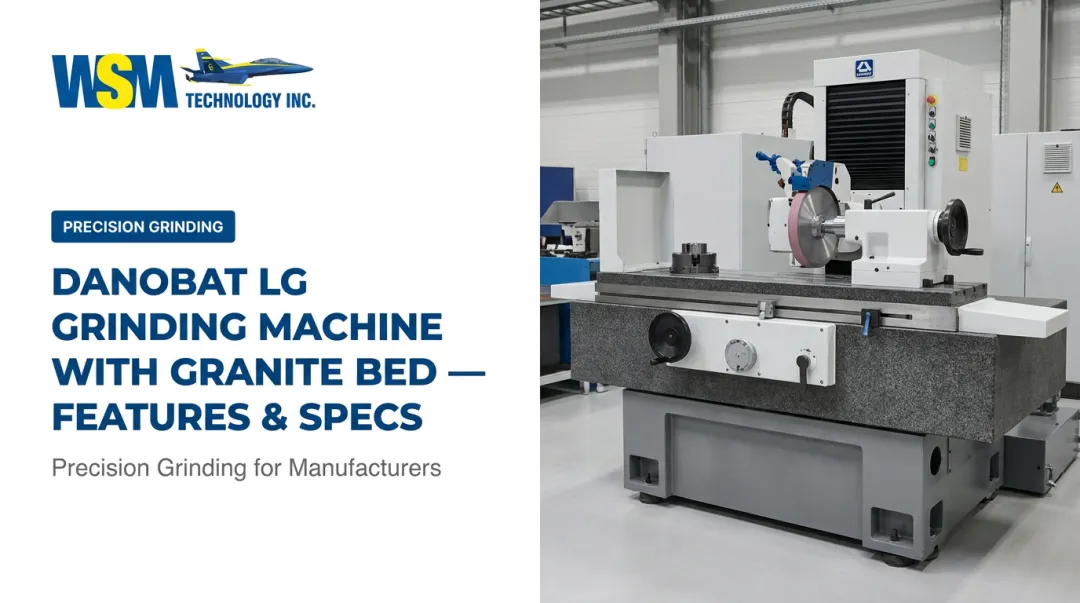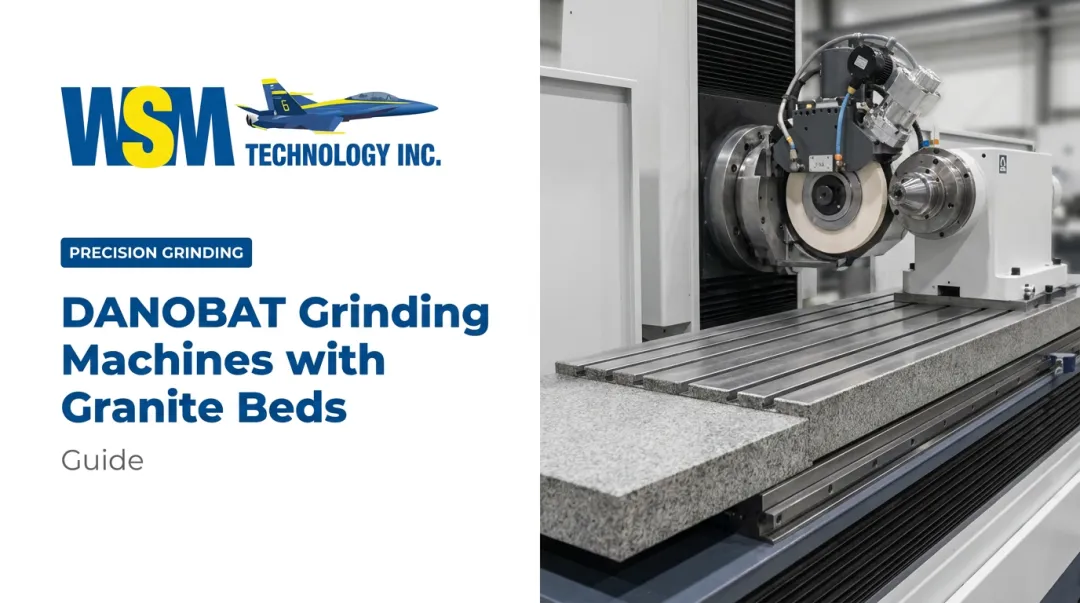

Shops in mold and die, aerospace, and automotive manufacturing increasingly specify granite beds, yet most conversations about them stay at the materials-science level. This article goes further: what granite beds actually do on the shop floor, why the advantages compound across a production run, and what to verify when evaluating precision grinding equipment.
Key Takeaways
- Granite's coefficient of thermal expansion (~5–7 µm/m·°C) is roughly half that of steel, limiting dimensional drift to under half that of steel beds
- Thermal errors account for up to 75% of total machine positional error
- Granite beds arrive factory-flat to DIN 876 Grade 00 standards, with no post-installation bed grinding required
- Grinding chatter is a primary cause of surface finish degradation; granite's damping properties reduce transmitted vibration before it reaches the workpiece
- Aerospace, mold/die, and micro-mechanics shops gain access to a higher precision tier without a proportionally higher capital investment
What Is a Granite Machine Bed?
A granite machine bed is the structural base of a precision machine tool, machined from natural igneous rock — a dense, homogeneous plutonic material — and precision-ground to serve as a stable reference surface for every component mounted on it.
Granite is classified as a coarse- or medium-grained intrusive igneous rock, and its crystalline structure gives it properties that synthetic casting materials try to replicate. Those properties — dimensional stability, vibration damping, and thermal neutrality — make it the preferred base material for machine tools where sub-micron accuracy is non-negotiable.
Where Granite Beds Are Used
Granite beds appear in applications where sub-micron dimensional accuracy is required:
- High-precision surface and cylindrical grinders
- Coordinate measuring machines (CMMs) — ZEISS bridge CMMs and Hexagon systems use granite tables with integrated air-bearing guideways
- EDM machines — granite work surfaces provide the dimensional stability these machines demand
- Ultra-precision turning and milling centers — the Precitech Nanoform 700 Ultra, for example, specifies a sealed natural granite base for long-term stability
Outside these high-accuracy applications, granite beds aren't common — general-purpose lathes and roughing machines don't require the precision investment.
What makes granite beds worth specifying is what they deliver to every component mounted on them: a stable, thermally neutral reference that the rest of the machine system can depend on across long production runs.
Three Core Advantages of Granite Machine Beds in Precision Grinding
These aren't abstract material properties. Each one maps directly to outcomes precision grinding shops track: surface finish Ra, dimensional repeatability, scrap rates, and wheel life.
Superior Vibration Damping
During grinding, the wheel engages workpiece surfaces at high speed, generating continuous micro-shock events. On a cast iron bed, those vibrations propagate through the machine structure and reappear as chatter marks or irregular Ra values. On a granite bed, the crystalline internal structure dissipates vibration energy before it can travel to the workpiece.
Grinding chatter is among the most critical grinding errors, with strong direct impact on geometrical workpiece accuracy. Norton Abrasives notes that wheel imbalance alone can cause chatter and poor surface finish — and any vibration that the machine bed fails to absorb compounds that effect.

Why this matters on the shop floor:
- Chatter marks and Ra inconsistency are often the first symptom of vibration in a precision grinding operation
- Reduced vibration means more uniform wheel-to-workpiece contact force, which reduces micro-chipping of abrasive grains
- Longer dress intervals, lower scrap rates, and fewer re-grinding cycles follow directly
When it matters most: Hardened tool steels, carbide tooling, aerospace turbine components, mold cavity surfaces — any application where Ra tolerances are specified below 0.4 µm or where workpiece geometry can't tolerate waviness.
One practical note: published damping ratios comparing granite to cast iron vary by test conditions and source. Shops evaluating specific machines should request manufacturer test data rather than applying generalized figures.
Thermal Stability and Low Expansion
The CTE data below shows why granite outperforms steel and cast iron in thermally demanding environments:
| Material | Coefficient of Thermal Expansion |
|---|---|
| Natural granite | ~4.8–8.3 µm/m·°C (avg. 6.2, per NIST) |
| AISI 1020 steel | ~11.7 µm/m·°C |
| 6061-T6 aluminum | ~23.6 µm/m·°C |
| Cast iron | ~7.75–19.3 µm/m·°C (grade-dependent) |

In a precision grinding machine, the distance between the grinding wheel spindle and the workpiece table is fixed by the bed geometry. If the bed expands or contracts as shop temperature varies through a workday, that distance changes — producing dimensional error with no change to the CNC program.
Thermal errors can account for up to 75% of total machine positional error, according to Putz et al. (2018), with older literature citing a 40–70% range. Software compensation can partially correct for thermal drift, but granite's low thermal conductivity reduces the error at the source rather than correcting it afterward.
Shop-floor consequences:
- Tighter Cpk values on critical dimensions across a full production run
- Reduced need for mid-shift recalibration
- More consistent part-to-part dimensional repeatability without temperature-controlled environments
When it matters most: Shops without climate control, long grinding cycles, and applications requiring 24-hour dimensional stability — aerospace inspection fixtures, precision mold components, and medical device components where traceability is required.
Long-Term Flatness and Structural Integrity
Precision granite is machined to flatness tolerances governed by DIN 876-1, which covers natural hard rock surface plates. Under Grade 00, the flatness tolerance follows the formula t = 2 × (1 + L/1000) µm — yielding 4 µm over 1,000 mm and 6 µm over 2,000 mm. Planolith supplies precision granite plates with traceable quality test certificates as standard, with DAkkS certificates available on request.
Cast iron beds are subject to residual stresses from the casting process, which continue to relax over years — gradually shifting machine geometry in ways that no control system adjustment can fully correct. Precision granite, as a naturally aged geological material, carries no such residual stress. This makes granite dimensionally stable from day one through the full service life of the machine.
Practical consequence: The flatness of the machine bed directly determines table travel straightness and parallelism between wheel and workpiece. Any deviation creates a systematic geometric error that affects every part produced on that machine.
Why long-term stability matters:
- Part geometry remains consistent across the machine's full service life, not just at installation
- Recalibration frequency decreases, reducing downtime
- The machine retains its value as a capital asset — a granite-bed machine holds its accuracy longer than a cast iron equivalent subject to stress relaxation

When it matters most: High-volume production where tolerance stack-up must stay within spec across thousands of cycles, and in any application requiring traceable dimensional accuracy for quality certifications.
What Happens When Bed Stability Is Overlooked
Shops running precision grinding on cast iron or welded steel beds without adequate thermal and vibration management tend to encounter the same cluster of problems:
- Surface finish inconsistency — Ra values vary shift to shift as the machine warms up and vibration patterns change
- Dimensional drift — parts made at the start of a run measure differently from parts made four hours later
- Unexplained rejections — technicians spend time diagnosing variation that originates in the machine's structural foundation, not in the process parameters
The reactive cycle is expensive. Shops compensate by re-dressing wheels more frequently, running more calibration checks, building higher scrap allowances into job costs, and reducing feed rates to minimize vibration — each of which adds cost per part without fixing the root cause.
General-purpose shops may absorb that tolerance variability. But in mold cavities, aerospace seating surfaces, or micro-mechanical components, the math doesn't work that way. Without a thermally and vibrationally stable base, there's a hard ceiling on what the process can achieve — regardless of how well everything else is dialed in.
Getting the Most from a Granite-Bed Grinding Machine
Granite machine beds deliver their full benefit only when the surrounding system matches the same precision level. A granite bed under a poorly calibrated spindle or worn linear guides won't rescue part quality.
Key factors to verify:
- Linear guides and spindle bearings — specify these to complement the bed's accuracy, not bottleneck it
- CNC controls — thermal compensation features help most when the base material is already holding dimensional stability
- Floor isolation — level on isolation mounts or anti-vibration feet; inadequate mounting lets low-frequency floor vibration bypass the bed's damping entirely
- Environmental conditions — keep direct heat sources away from the machine; even a stable granite bed loses ground when thermal load is high

For shops evaluating whether a granite-bed machine fits their tolerance requirements, WSM Technology's demonstration center in Rootstown, Ohio offers precision test cuts on high-accuracy grinding and milling machines. Seeing actual Ra values and dimensional performance on your part geometry — in a real machine configuration — tells you far more than comparing spec sheets before committing to capital equipment.
Conclusion
For precision grinding in mold/die, aerospace, and automotive manufacturing, granite machine beds address the three variables that erode part quality over time: vibration, thermal drift, and geometric instability. These advantages hold up under production volume and reinforce each other over time.
Selecting a machine with a granite bed is a foundational decision. Shops that get it right reduce the ongoing cost of correction, calibration, and scrap that steadily erodes margin in high-precision work. Shops that don't tend to compensate with additional process steps — ones that add lead time and cost without closing the capability gap.
Frequently Asked Questions
What are the benefits of natural granite machine beds in precision grinding machines?
Natural granite offers three properties that directly improve grinding outcomes: superior vibration damping that reduces chatter and Ra variation, a low coefficient of thermal expansion (~5–7 µm/m·°C) that keeps dimensional geometry stable across a workday, and factory-certified flatness that provides a reliable reference plane for the entire machine system.
How does epoxy granite compare to natural granite for machine beds?
Epoxy granite (mineral casting) can achieve high damping, with Schneeberger reporting up to 10x better than steel or cast iron, and it allows custom geometries through casting molds. Natural granite arrives already certified flat and residual-stress-free, making it simpler to deploy where standard bed geometries apply. Both materials serve overlapping but distinct applications.
Why is cast iron still used for machine tool beds instead of natural granite?
Cast iron is easier to machine into complex geometries, integrates chip channels and mounting features in a single casting, and has a well-established supply chain. For general-purpose machine tools, those practical advantages outweigh its higher thermal expansion and lower damping. Granite becomes the preferred choice when sub-micron precision is the requirement.
What tolerances can a granite machine bed support in precision grinding?
Granite beds certified to DIN 876 Grade 00 hold flatness to approximately 4 µm over 1,000 mm and 6 µm over 2,000 mm. In a well-configured grinding machine, this foundation supports total positional accuracies in the low-micron range and surface finishes below 0.1 µm Ra — dependent on the full machine system, not the bed alone.
How do granite machine beds affect grinding wheel life?
Reduced vibration means the grinding wheel contacts the workpiece with more uniform force, reducing micro-chipping of abrasive grains. Shops with granite-bed grinders typically see longer wheel life and more consistent performance between dress intervals, which directly lowers cost per part over a production run.
Are granite machine beds significantly more expensive than cast iron alternatives?
The cost differential is smaller than most shops expect. According to Reitz Natursteintechnik, the performance gains from granite, including damping, thermal stability, and long-term precision, can be achieved at very little or no extra cost. Cast iron alternatives typically require additional thermal compensation and flatness work to reach the same performance level.