
The stakes are real. As part complexity climbs across aerospace, automotive, and mold-making, the overhead of transferring parts between machines has become a measurable drag on throughput and profitability. Automotive held 36.78% of the broad machining centers market in 2025, per Mordor Intelligence, and aerospace/defense is projected as the fastest-growing segment — both sectors demanding ever-tighter tolerances on increasingly complex geometries.
This article breaks down the decision clearly: what mill-turn machines actually do, where separate machines still make sense, and how to determine which approach fits your production reality.
Key Takeaways
- Mill-turn machines combine turning and milling in a single setup, eliminating inter-machine transfers and re-fixturing errors
- Separate mills and lathes cost less upfront and offer scheduling flexibility for simpler, diverse job mixes
- Mill-turn delivers the strongest ROI on complex cylindrical-plus-features parts at medium-to-high volumes
- Re-fixturing carries real costs: setup time, alignment risk, and scrap potential all add up beyond the sticker price
- Part complexity, production volume, floor space, and operator skill level all determine the right choice
Mill-Turn vs. Separate CNC Mills & Lathes: Quick Comparison
The right choice depends on your part complexity, floor space, and production volume. Use this breakdown to see where each approach wins.
| Factor | Mill-Turn Machine | Separate Mill + Lathe |
|---|---|---|
| Initial Cost | Higher upfront due to combined complexity | Lower per machine; combined cost narrows the gap |
| Setup Time | Single setup for all operations | Re-fixturing required between machines |
| Part Accuracy | Higher — no repositioning error | Acceptable for simple parts; re-fixturing adds tolerance risk |
| Floor Space | Consolidates two machine footprints into one | Requires dedicated space per machine plus transfer area |
| Best-Fit Parts | Cylindrical with milled features (holes, flats, keyways, pockets) | Simple geometry needing only turning or only milling |
| Programming Complexity | Higher — requires combined turning and milling logic | Simpler — each machine programmed independently |
| Scheduling Flexibility | Lower — one machine handles both operations | Higher — machines can run different jobs simultaneously |

What Is a Mill-Turn CNC Machine?
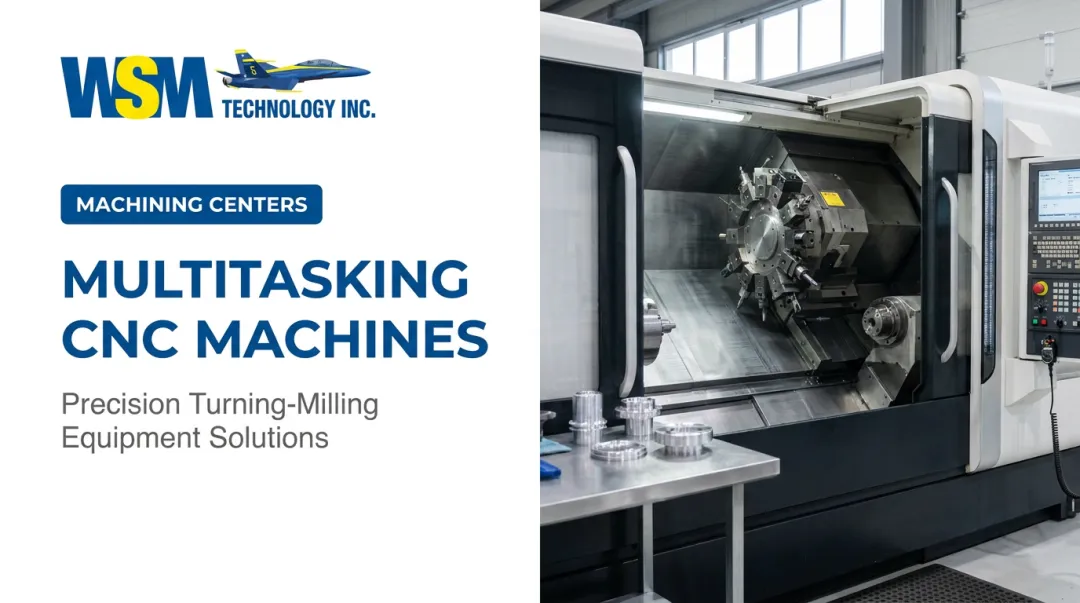
A mill-turn machine — also called a turn-mill center, multi-tasking center, or "done-in-one" machine — performs both turning (rotating workpiece against a stationary tool) and milling (rotating tool against a stationary or indexed workpiece) within the same setup, sometimes simultaneously.
Modern Machine Shop defines a turn/mill machine as a CNC machine capable of both rotating-workpiece turning and rotating-tool milling and cross-drilling. Production Machining describes it as lathe-like equipment that performs milling, drilling, tapping, and related operations using one or more milling spindles — all without moving the part to a second machine.
How the Mechanics Work
Mill-turn centers are built around a powered spindle — like a lathe — combined with live tooling or a dedicated milling spindle. Common features include:
- Y-axis travel that enables off-centerline milling on cylindrical parts
- B-axis milling heads for angled tool approaches
- Subspindles that handle automatic part transfer and backside machining in a single cycle
- Twin spindles and dual turrets for overlapping operations
- Automatic tool changers with large magazine capacity
The DMG MORI NTX 3000, for example, offers simultaneous 5-axis Turn & Mill capability, a second spindle for 6-face machining, 300 mm Y-axis travel, and a maximum workpiece length of 3125 mm. The Nakamura-Tome MX-100 adds a 190-degree B-axis swiveling range and ATC capacity of up to 72 tools.
The Core Productivity Advantage
Because the part never leaves the machine between turning and milling operations, there's no need to re-zero or re-fixture. That eliminates one of the most common sources of alignment error in multi-operation parts. As DMG MORI notes, combining both technologies in one workspace reduces throughput times and minimizes errors by decreasing manual re-clamping.
Getting that productivity in practice depends on the programming. Mastercam's dedicated Mill-Turn software handles synchronized operations for multi-spindle, multi-turret, A/B/Y-axis turning, and high-speed milling. Operators need fluency in both turning and milling logic — shops that underinvest in training often fail to capture the full cycle-time savings the machine is capable of delivering.
Where Mill-Turn Dominates
Mill-turn is ideal for parts that are primarily cylindrical but need secondary milled features — shafts with cross-drilled holes, engine components with flats and keyways, or implants with precisely located pockets.
Industries where this capability is most valuable:
- Aerospace — complex engine and structural components, landing gear
- Automotive — transmission and drivetrain components, racing hardware
- Medical devices — surgical instruments, implants, bone screws, hip cups
- Mold and die — multi-feature tooling components requiring 5-axis work
- Defense — high-precision components with demanding tolerance requirements

What Are Separate CNC Mills and Lathes?
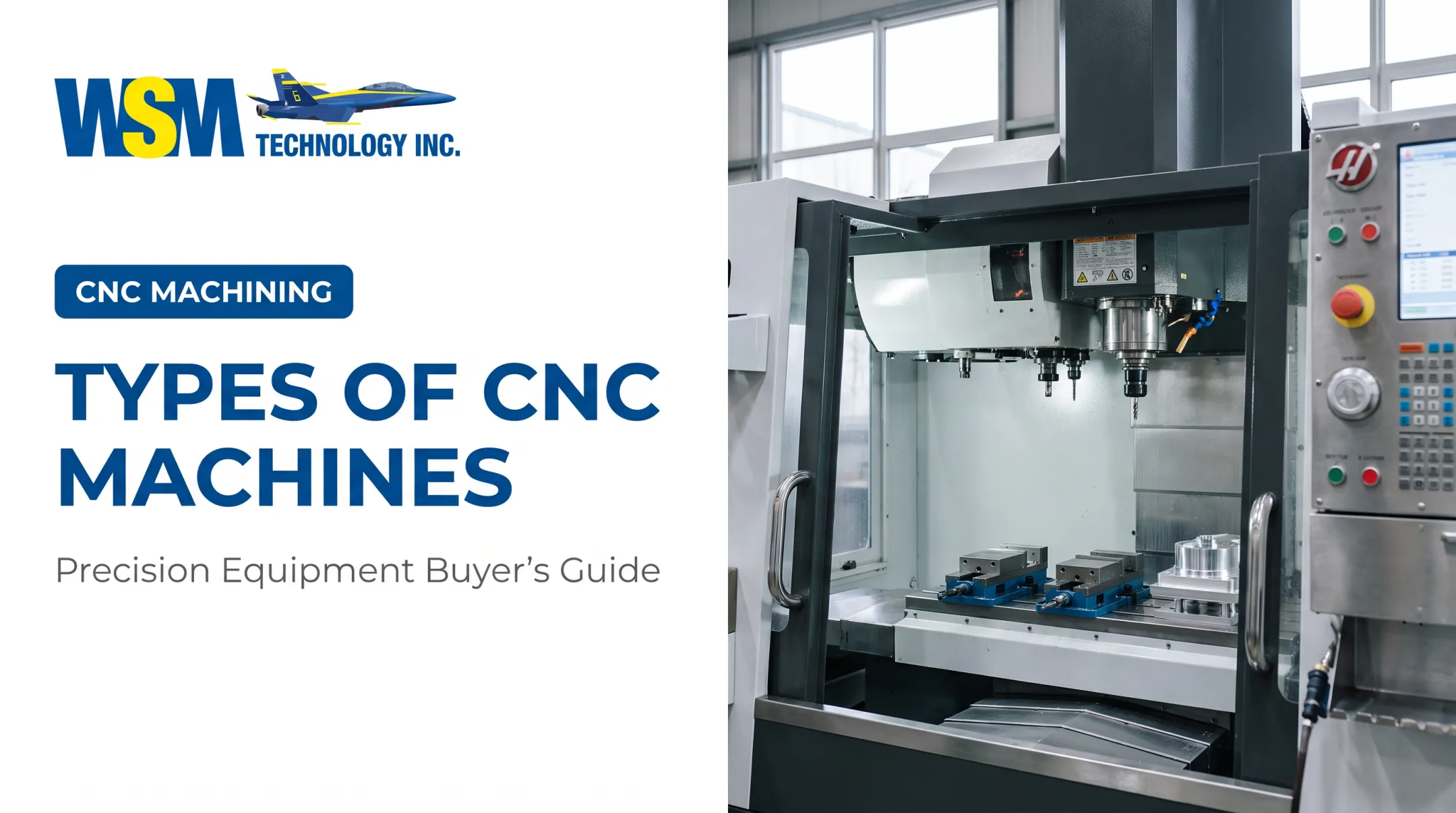
The traditional two-machine approach divides operations by geometry type. A CNC mill holds the workpiece stationary while a rotating tool removes material — best for flat, angular, or complex surface profiles. A CNC lathe does the opposite: the workpiece rotates against a stationary tool to produce cylindrical forms like shafts, pins, and bores. Most shops run some combination of both.
Why Separate Machines Still Make Sense
The separate approach has real advantages that mill-turn can't fully replicate:
- Lower entry cost — buying one machine at a time spreads capital outlay and reduces financial risk
- Concurrent scheduling — the mill and lathe can run different jobs simultaneously, keeping both spindles earning
- Simpler programming — single-function CNC code is less complex and requires less specialized training
- Isolated maintenance — a repair or scheduled downtime on one machine doesn't halt the other
Best-Fit Applications
Separate machines excel when parts are primarily simple in geometry — either purely cylindrical (shafts, pins, rods, bushings) or primarily prismatic (plates, housings, manifolds, brackets) — with minimal overlap between the two operation types.
For high-volume shops running dissimilar job types simultaneously, keeping machines separate preserves scheduling flexibility and lets operators specialize in one discipline. A shop producing large batches of simple turned parts alongside flat plate work has no use for a mill-turn center. But when parts grow more complex — combining turned profiles with milled features, cross-holes, or off-axis geometry — the calculus shifts.
Mill-Turn vs. Separate Machines: Which Is Right for You?
Part complexity is the primary filter. If the majority of your work requires only milling or only turning, separate machines are likely the more cost-effective choice. When a significant portion of your parts require both operations, the cumulative cost of transfer time, re-fixturing, and alignment risk becomes the deciding factor. That's where a closer look at total cost of ownership matters.
Total Cost of Ownership Goes Beyond Purchase Price
The upfront machine price is only part of the calculation. True cost of ownership includes:
- Re-fixturing labor — time spent re-clamping, re-indicating, and re-zeroing parts between machines
- Operator overhead — potentially two operators (or one split between machines) versus one on a mill-turn
- Floor space costs — U.S. industrial space averaged $10.34 per square foot in Q1 2026, per JLL's market data; two machine footprints plus transfer workspace adds up
- Scrap and rework — re-fixturing introduces tolerance stack-up that tight-tolerance parts can't absorb

Precision Is a Quality Decision, Not Just an Efficiency One
For tight-tolerance parts — common in aerospace, medical, and mold-making — the positional error introduced by re-clamping between separate machines can cause costly rejects. Every time a part is re-clamped, datum shift is possible — and on parts with feature-to-feature tolerances measured in tenths, that risk translates directly into rejects.
Mill-turn machines eliminate that exposure by completing both operations in a single setup. The result is fewer opportunities for error stacking across multiple part repositioning events.
Situational Guidance
Choose a mill-turn machine if:
- Your shop produces complex parts requiring both turning and milling operations
- Tight tolerances make re-fixturing error a real quality risk
- Floor space is constrained and consolidation would free capacity
- Production volume justifies the investment in specialized programming and training
Choose separate machines if:
- Work is predominantly simple, single-operation parts
- You run diverse, dissimilar jobs concurrently and need scheduling flexibility
- Upfront capital is a primary constraint
- Operators are specialized in one discipline
Consider a hybrid approach: Some shops operate one mill-turn center for complex flagship jobs while retaining separate mills and lathes for simpler high-volume work. If your order book is genuinely mixed, this setup lets you route each job to the machine best suited for it without forcing one machine to do everything.
Real-World Impact: Why the Switch to Mill-Turn Pays Off
Two documented cases show what the transition actually delivers.
Don Schumacher Racing — Automotive Racing Components
Don Schumacher Racing (DSR) needed to machine complex racing components — supercharger bearing housings, fuel pump extensions, and blower pulleys — that previously required multiple setups and long run times. They added an Okuma Multus U3000 turn-mill with twin spindles, a 12,000 RPM milling spindle, and a 120-position ATC.
Results, documented by Modern Machine Shop:
- Supercharger bearing housing: 8 hours → 40 minutes
- Fuel pump extensions: 3.5 hours → 40 minutes
- Blower pulleys: over 6 hours → 40 minutes

The problem was clear: multiple setups and excessive cycle times for parts that couldn't afford variation. Single-setup mill-turn eliminated both.
Metri-Tech Engineering — Medical, Defense, and Industrial Precision
Metri-Tech Engineering faced high-volume medical orders requiring tolerances most shops can't hold consistently. They built a fleet of 10 multitasking machines, including Nakamura-Tome WT-250Y, NTY3-250, and JX-250 models with twin spindles, turrets, live tooling, Y-axis, and 5-axis milling capability.
Outcomes, reported by Modern Machine Shop:
- Tolerances held to under 0.0001 inch
- Cycle time reductions of 30% to 50%
- Setup time reductions of up to 75%
- Company growth of 250% over eight years
What made the switch successful: volume justified the investment, part complexity demanded single-setup accuracy, and the company committed to training and programming capability. The simultaneous pinch turning and milling also maintained concentricity that separate machine workflows couldn't achieve consistently.
Evaluating the Decision Before You Commit
Both case studies share a common thread: the decision to switch was validated against real parts, real cycle times, and real tolerances — not vendor projections. Shops in Northern Ohio, Western Pennsylvania, and West Virginia can run the same kind of evaluation before committing capital.
WSM Technology's Demonstration Center in Rootstown, OH offers test cuts and time studies that let you compare both approaches against your actual parts. Their application engineering team — with decades of shop-floor background — can build a comparative analysis around your specific production requirements. Contact WSM Technology at (330) 962-8308 or sales@wsmtechnology.com to arrange an evaluation.
Conclusion
Neither mill-turn nor separate machines is the universal answer. The right setup depends entirely on what your parts demand.
Shops with high complexity, tight tolerances, and consistent volume on cylindrical-plus-features parts gain the most from mill-turn: reduced setup time, tighter tolerances, lower scrap rates, and recovered floor space.
Shops with simpler, diverse job mixes — where concurrent scheduling matters more than single-setup precision — often benefit more from the flexibility of separate machines.
The decision is a production strategy question. Get the answer wrong and you're either over-capitalized with machinery you can't fully use, or you're absorbing re-fixturing costs and reject rates that erode margin every production run. Before committing to either path, map your actual part mix, volume consistency, and tolerance requirements — then match the machine configuration to those realities, not the other way around.
Key decision factors to weigh:
- Part complexity and feature overlap (milled features on turned parts)
- Volume consistency vs. job shop variety
- Tolerance requirements and re-fixturing risk
- Available floor space and capital budget
Frequently Asked Questions
What is the difference between mill-turn and turn-mill?
"Mill-turn" and "turn-mill" refer to the same class of multi-tasking CNC machine and are used interchangeably across the industry. The terminology difference is regional or brand-specific. Modern Machine Shop and Production Machining both use both terms for the same equipment category with no functional distinction between them.
Can a CNC mill replace a lathe?
A CNC mill can produce some cylindrical features, but it's not an efficient substitute for a lathe on true rotational or symmetrical parts. Lathes use constant surface speed control that adjusts RPM as the tool moves across different diameters , a capability mills don't replicate. For turning operations, a lathe or mill-turn center is significantly faster and more precise.
What types of parts are best suited for a mill-turn machine?
Mill-turn machines excel on parts that are primarily cylindrical but require secondary milled features: cross-holes, flats, keyways, pockets, or threads. Common examples include aerospace components, medical implants, bone screws, and precision fittings, where single-setup machining delivers measurable accuracy and cycle time gains.
Is a mill-turn machine more expensive than buying separate CNC mills and lathes?
Mill-turn machines carry a higher purchase price than a single mill or lathe, but the comparison changes when you factor in the combined cost of both machines plus labor, floor space, and setup overhead. For shops running high-complexity work, total cost of ownership often favors the mill-turn.
What industries benefit most from mill-turn CNC technology?
Aerospace, automotive, medical device manufacturing, mold and die, and defense are the primary beneficiaries. These industries consistently produce complex, tight-tolerance parts with both cylindrical and prismatic features , which is exactly where single-setup mill-turn delivers its strongest cycle time and accuracy advantages.
How does a mill-turn machine improve part accuracy compared to separate machines?
By eliminating re-fixturing between operations, a mill-turn machine removes the positional error and datum shift that occur every time a part is re-clamped. The result is better feature-to-feature alignment and tighter tolerance consistency, particularly on parts where errors compound across multiple setups.