
Introduction
Picture a mold shop staring down a hardened tool steel cavity with a sharp internal corner. A ballnose cutter can't reach it, and a carbide end mill would snap or burn out before finishing the job.
This is the moment when conventional CNC milling and turning hit a wall.
Electrical discharge machining (EDM) is the answer. It's a non-contact, spark-based process that erodes metal instead of cutting it, making it the go-to solution when hardness or geometry defeats traditional machining.
This article breaks down how EDM works, the main machine types, its advantages and limitations, and where it's used across manufacturing.
Along the way, we'll show how shops across Northern Ohio, Western Pennsylvania, and West Virginia evaluate EDM equipment through WSM Technology's demonstration center in Rootstown, Ohio.
Key Takeaways
- EDM removes material via electrical sparks, not mechanical force, so hardness doesn't limit machining.
- Only electrically conductive materials work with EDM, including steel, titanium, carbide, and copper.
- Four main EDM types exist: sinker, wire, fast-hole, and micro EDM.
- Slower removal rates suit precision and complex features better than high-volume bulk cutting.
What Is Electrical Discharge Machining (EDM)?
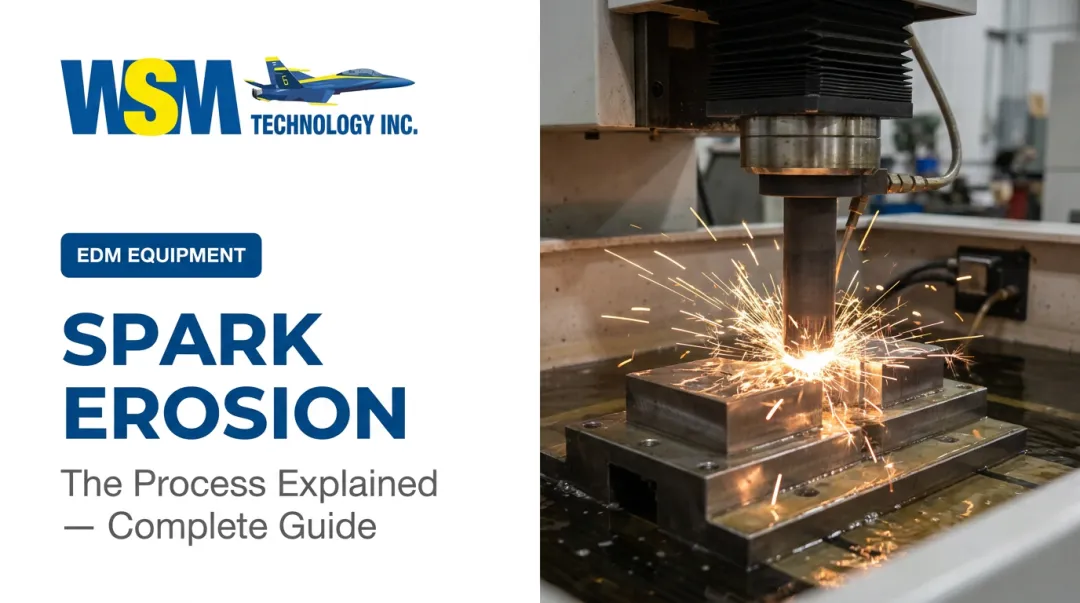
Electrical discharge machining, also called spark erosion or spark machining, removes material through a series of controlled electrical discharges between an electrode and a conductive workpiece. There's no mechanical contact and no cutting force involved. Material simply melts and vaporizes, spark by spark.
The tool and the workpiece both function as electrodes, submerged together in a dielectric fluid and connected to a pulsed DC power supply — not a continuous current, but rapid on-off pulses that generate thousands of individual discharges per second (SME.org's EDM study guide).
Why Conductivity Matters More Than Hardness
Here's the part that surprises a lot of newer machinists: EDM doesn't care how hard your material is. It only cares whether the material conducts electricity.
That means EDM works well on:
- Hardened tool steel
- Titanium
- Carbide
- Copper and copper alloys
- Stainless steel
It cannot machine plastics, glass, or standard ceramics, since these materials won't conduct the current needed to generate a spark.
Because it removes material without physical contact, EDM sits in the category of non-traditional machining, alongside laser and electron-beam processes. This contrasts with conventional machining like milling and turning, which rely on a cutting tool physically shearing material away.
The concept isn't new. It traces back to spark erosion research in the 1940s, when engineers first harnessed controlled electrical discharges to remove metal with precision rather than brute force.
How Does the EDM Process Work?
In simple terms: EDM generates a tiny plasma channel that melts and vaporizes microscopic amounts of material with every spark, and this repeats thousands of times per second until the desired shape emerges.
Electrode Setup and Dielectric Fluid
The electrode (typically copper, graphite, or brass depending on the application) is positioned near the workpiece, separated by a small, precisely controlled spark gap. This gap is usually a fraction of a millimeter. Get it wrong, and you'll either short-circuit the process or stall material removal entirely.
Once that gap is set, it's flooded with dielectric fluid, either hydrocarbon oil or deionized water. This fluid does three jobs:
- Insulates the gap until enough voltage builds up to trigger breakdown
- Cools the freshly machined surface
- Flushes eroded debris out of the cutting zone
Sinker EDM typically runs on oil, while wire EDM machines usually use deionized water for its consistent electrical properties.
Spark Generation, Material Removal, and Servo Control
With the electrode and dielectric fluid in place, voltage builds until it reaches a critical threshold. At that point, the fluid ionizes and breaks down, forming a plasma channel between electrode and workpiece. Discharge temperatures within that channel can reach 8,000 to 12,000°C, according to a peer-reviewed process review (ScienceDirect, 2021). That's hot enough to melt or vaporize virtually any conductive metal in microseconds.
Each discharge lasts only a fraction of a second before the plasma channel collapses. The surrounding dielectric fluid rushes in, sweeping away the melted debris and resetting the gap for the next spark. This cycle repeats continuously, often tens of thousands of times per second on a modern machine.
As material erodes, the gap widens. A servo control system continuously monitors voltage and current, then nudges the electrode forward or backward to maintain that ideal spark gap. Without this feedback loop, you'd get short circuits, unstable arcing, or a stalled process. It's this precision control that makes EDM reliable for tight tolerances.

Types of EDM Machines
EDM machines fall into distinct categories based on electrode type and geometry requirements. Choosing the right one depends on whether you need a cavity, a through-cut profile, a deep hole, or a microscopic feature.
Sinker (Die-Sinking) EDM
A custom-shaped electrode "sinks" into the workpiece, its shape reproduced as a cavity in reverse. This is the classic approach for mold and die tooling: cavities, ribs, blind slots, and other features that a cutting tool simply can't access.
Sinker EDM is the slowest of the EDM family because of the electrode fabrication involved, but it's also the most versatile for producing complex internal geometry. Automotive stamping dies, consumer electronics housings, and aerospace tooling all rely on this process when cavity geometry has to match design intent exactly.
Wire EDM
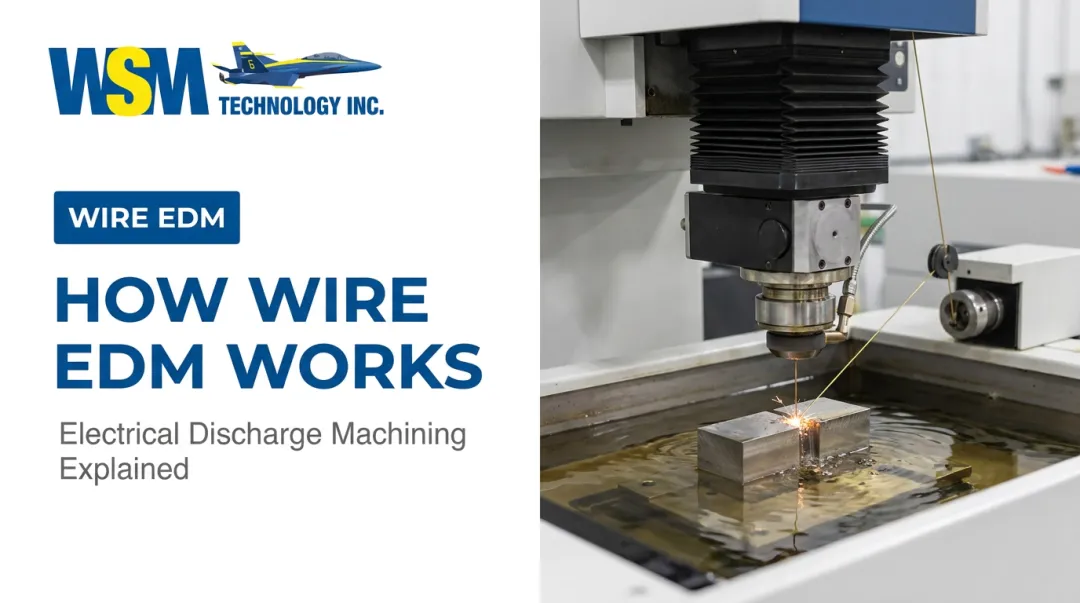
Wire EDM feeds a continuously moving thin wire (usually brass or coated copper) through the workpiece, cutting profiles much like a cheese cutter slices through a block. It's the workhorse for:
- Stamping punches and dies
- Extrusion tooling
- Thick, hardened plate sections requiring precise through-cuts
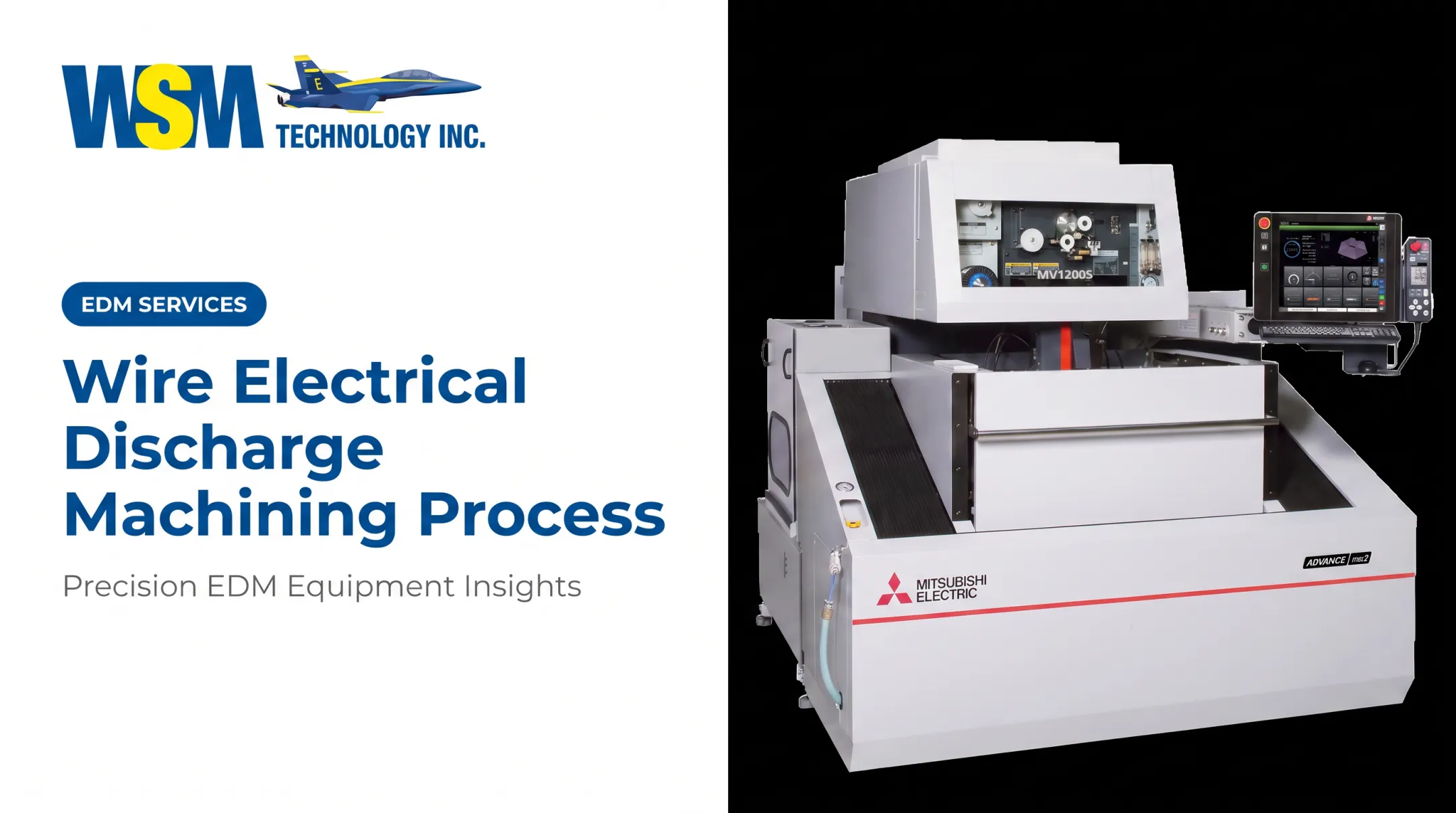
WSM Technology represents Mitsubishi wire EDM equipment, including the MV1200S with its M800 CNC control and linear shaft motor drive, along with the higher-capacity MV2400 for larger workpieces. Shops looking at older, budget-friendly options can also find used units like the Mitsubishi FX10, which still offers ±15-degree taper capability on 4-inch stock.
Hole Drilling (Fast Hole) EDM
Fast-hole EDM uses a rotating tubular electrode combined with high-pressure dielectric flow to drill deep, small-diameter holes fast. Turbine blade cooling channels are a textbook application: dozens of tiny, precisely angled holes drilled through hardened superalloy material. Fuel injector nozzles and diesel spray holes see similar treatment, since conventional drilling can't hold tolerance at that diameter.
WSM Technology is a dealer for Titan hole-drilling EDM machines across Northern Ohio, Western Pennsylvania, and West Virginia, offering both American-made and import machine options backed by local training and OEM parts support.
Micro EDM
Micro EDM scales everything down: fine electrodes, low discharge energy, and micron-level feature control. It's suited for medical components, electronics, and micro-mechanical parts where tolerances are measured in microns, not thousandths of an inch.
WSM Technology supplies Sarix Micro EDM machines, manufactured in Losone, Switzerland since 1993. Unlike WSM's Mitsubishi territory (Northern Ohio, Western PA, and West Virginia), Sarix coverage extends further, reaching Michigan, Indiana, and Kentucky, and giving a wider range of regional shops direct access to micro EDM milling, micro hole drilling, and high-production hole drilling capability.

Advantages and Disadvantages of EDM
Advantages
EDM earns its place on a shop floor for reasons conventional machining can't match:
- Machines any conductive material regardless of hardness: tool steel, titanium, and carbide are no obstacle
- Produces complex geometries: sharp internal corners, deep cavities, and narrow slots unreachable by cutting tools
- Eliminates mechanical stress: the non-contact process avoids distortion, which matters on thin or delicate parts
Disadvantages
EDM isn't the right tool for every job, though. Consider the trade-offs:
- Slower material removal rates. For bulk removal on large volumes, hard milling generally runs shorter cycles and is more efficient (Modern Machine Shop). EDM shines on precision and access, not speed.
- Electrode costs and lead time. Sinker EDM requires a custom electrode for each cavity shape, adding design and fabrication time before cutting even starts.
- Material restrictions. Non-conductive materials are off the table entirely.
- Recast layer. Melted material that doesn't fully clear the gap can resolidify, leaving a thin, heat-affected layer on the surface. Fatigue-critical parts often need secondary finishing, such as grinding or polishing, to remove it.
Industries and Applications of EDM
EDM shows up wherever hardened materials or intricate geometry rule out conventional cutting:
- Mold and die making — cavity molds for injection tooling, punches, and inserts
- Aerospace — turbine blade cooling holes, precision components requiring tight tolerances
- Medical devices — micro-scale components and precision instruments
- Automotive — press dies and stamping tools for production components
- Micro mechanics and electronics — miniature connectors, rotors, and fine-feature parts
Shops in these sectors don't have to guess whether EDM fits their process. WSM Technology's Demonstration Center in Rootstown, Ohio gives mold and die shops, aerospace suppliers, and automotive manufacturers a chance to run test cuts and time studies before committing to equipment.
The center serves shops across Northern Ohio, Western PA, and West Virginia. It's a practical way to validate cycle times and finish quality on your actual part geometry, not just a spec sheet.
EDM vs. Other Machining Processes
How does EDM stack up against the alternatives?
| Process | Removal Method | Best For | Trade-Off |
|---|---|---|---|
| EDM | Pulsed thermal spark erosion | Hardened materials, cavities, fine detail | Slower bulk removal, electrode/wire cost |
| CNC milling/turning | Mechanical cutting force | Fast bulk removal, general shapes | Limited by cutter access and hardness |
| ECM | Electrochemical dissolution | Hard conductive materials, no tool wear | Less capable on sharp, intricate internal geometry |
| Plasma cutting | High-temp arc melting | Fast plate profiling | Lower precision and finish on small parts |
EDM vs. CNC milling: CNC offers faster removal rates and works across a broader range of materials. EDM wins when the part is too hard to cut conventionally, or when the geometry (sharp internal corners, deep narrow slots) is beyond a cutter's reach.
EDM vs. ECM: Electrochemical machining removes material through controlled anodic dissolution rather than sparks, much like electroplating in reverse. ECM generally cuts faster with no tool wear, but it struggles with the sharp, intricate internal geometry that EDM handles routinely.
EDM vs. plasma cutting: Plasma cutting moves fast on thick plate, but it can't match EDM's precision and surface finish on smaller, detailed components where tolerance matters more than throughput.
Frequently Asked Questions
What is EDM (electrical discharge machining)?
EDM is a non-contact manufacturing process that uses controlled electrical sparks to erode conductive materials. It replaces mechanical cutting force with thermal energy, allowing it to machine extremely hard metals and intricate geometries.
What is the difference between EDM and ECM machining?
EDM removes material through thermal spark erosion, generating intense localized heat. ECM uses electrochemical dissolution instead, with no thermal effect and no tool wear. However, it's less capable of producing sharp internal corners and fine detail than EDM.
What materials can be machined with EDM?
EDM works on any electrically conductive material, including tool steel, titanium, carbide, and stainless steel. Non-conductive materials like plastics, glass, and standard ceramics cannot be machined with this process.
How accurate is EDM machining?
Accuracy varies by machine and configuration, but high-end wire EDM systems from major manufacturers can hold tolerances as tight as a few microns on well-maintained equipment. Achievable precision depends on machine rigidity, thermal control, and electrode or wire quality.
Is EDM slower than CNC machining?
Yes, for bulk material removal, hard milling typically runs shorter cycles when there's a large volume to remove. EDM makes up for it with unmatched precision on hardened materials and geometry that conventional cutters can't reach.
What industries use EDM the most?
Mold and die making, aerospace, medical device manufacturing, and automotive are the leading users of EDM technology. These industries consistently need hardened materials machined into precise, complex shapes that conventional methods can't produce.