
Not all precision grinding machines are interchangeable. Surface, cylindrical, centerless, and internal grinders are each built around specific geometries and production demands. Selecting the wrong type doesn't just slow things down — it produces scrap, forces rework, and burns through cycle time chasing tolerances the machine was never designed to hold.
This article breaks down the four primary precision grinding machine types, explains what separates them, and gives manufacturing professionals a clear framework for matching machine capability to part requirements.
Key Takeaways
- Precision grinding achieves surface finishes from 32 microinches Ra down to 4 microinches Ra and finer — well beyond what milling or turning can reliably produce
- The four primary types — surface, cylindrical, centerless, and internal — each address a distinct part geometry
- Machine selection should start with the part feature being ground, not shop familiarity or machine availability
- Mismatched machine types produce scrap and extend cycle times regardless of operator skill
- Material hardness, abrasive compatibility, and production volume all influence which machine type fits your application
What Is Precision Grinding?
Precision grinding uses a rotating abrasive wheel to remove very small amounts of material from a workpiece, achieving dimensional tolerances and surface finishes that milling and turning cannot match. According to Norton Abrasives, conventional machining typically produces surface finishes in the 125 to 32 microinches Ra range, while precision grinding reaches 32 microinches Ra down to 4 microinches Ra and better.
Precision grinding is not the same as rough grinding on a bench or pedestal grinder, where the goal is material removal or deburring. It's a controlled finishing process focused on:
- Final dimensional sizing to tight tolerances
- Achieving specific surface finish targets
- Controlling geometry — flatness, roundness, or bore size — that determines whether a part functions as designed
In mold and die making, aerospace, automotive, and medical manufacturing, precision grinding is often the last operation before inspection. At that stage, there's no corrective operation left — the grind either hits the tolerance or it doesn't.
Types of Precision Grinding Machines
Precision grinding is not one-size-fits-all. The machine type is determined by part geometry, production volume, material, and the specific tolerance and finish targets required.
Beyond the four core types covered here, specialized variants exist — profile/form grinders for complex contoured surfaces and tool and cutter grinders for carbide cutting tool production — but surface, cylindrical, centerless, and internal grinders cover the overwhelming majority of precision grinding work.
Surface Grinding Machine
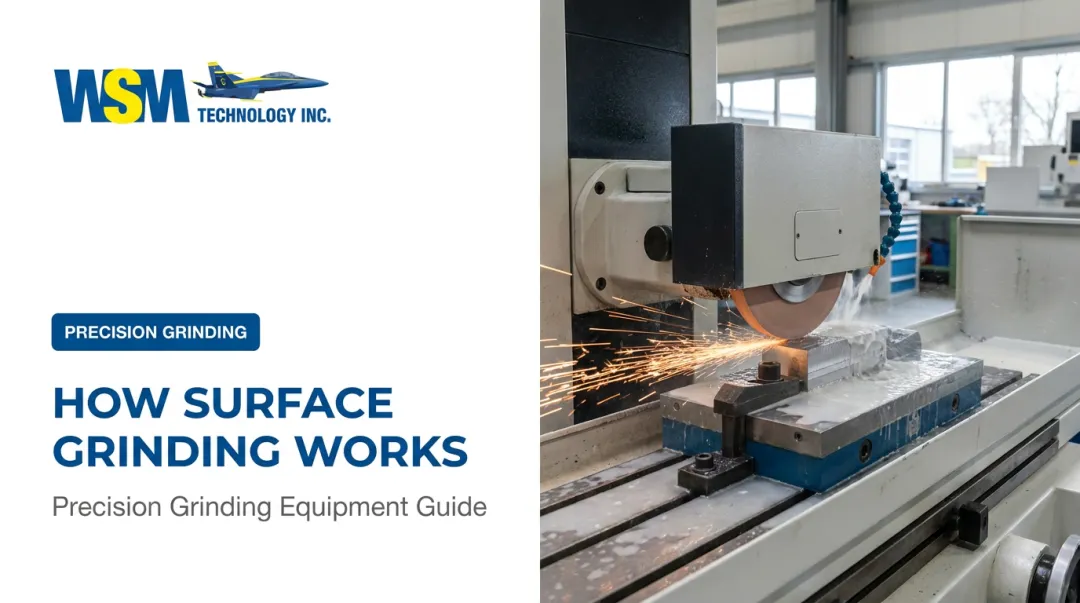
A surface grinder holds the workpiece on a magnetic or vacuum chuck. A rotating abrasive wheel traverses across the surface, and the grinding head indexes down in the vertical axis to control depth of cut. The result: flat, parallel, smooth reference planes held to tight dimensional tolerances.
What surface grinders are optimized for:
- Flatness and parallelism on plate-like workpieces
- Controlled surface finish on flat features
- Creating datum planes that downstream operations depend on
Surface grinders are the go-to machine in tool and die shops, mold making, and job shops producing die shoes, mold plates, machine bases, and stepped reference surfaces.
Capabilities and limitations:
| Factor | Detail |
|---|---|
| Surface finish | Down to 5 RMS microfinishes achievable on high-precision machines |
| Positional accuracy | ±1 micrometer on precision CNC surface grinders |
| Workholding | Magnetic chuck holding forces up to 110 N/cm² |
| Large-format capacity | Double-column machines accommodate tables up to 32" × 80" for mold and die base work |
| Key limitation | Not suited for round or cylindrical parts |

WSM Technology carries the Ziersch Z24 High Precision Surface Grinder, featuring a scraped double V-guideway system in the X-axis, Heidenhain glass scale on the vertical axis, and an electro-permanent magnetic chuck — specifications that reflect genuine high-precision surface grinding capability rather than general-purpose flatwork.
Cylindrical Grinding Machine
A cylindrical grinder rotates the workpiece between centers or in a chuck while the grinding wheel contacts the outer surface, removing material until the target diameter, roundness, and finish are achieved. Universal configurations handle tapers and complex shoulder profiles in a single setup.
What cylindrical grinders are optimized for:
- Outside diameter (OD) sizing on shafts, spindles, pins, and rollers
- Roundness and concentricity control on rotating components
- Mixed part families with varied diameters and lengths
According to United Grinding, cylindrical OD grinding holds diameter tolerances from less than ±1 micrometer to ±10 micrometers, roundness from 0.25 to 2.5 micrometers, and surface finishes from 4 to 30 microinches — capabilities that make it the correct choice for any rotating component where out-of-round conditions would cause vibration, imbalance, or premature bearing failure.
CBN wheels excel on hardened steels in this application. In-process gauging compensates for thermal size drift in real time — critical on long production runs where heat buildup shifts part dimensions between cycles.
Typical applications: automotive crankshafts and camshafts, aerospace turbine components, spindle shafts, landing gear components, and hydraulic valve bodies.
WSM Technology represents Danobat cylindrical grinders and Overbeck external/internal grinders for this category, covering both standalone OD work and combined OD/ID grinding requirements.
Centerless Grinding Machine
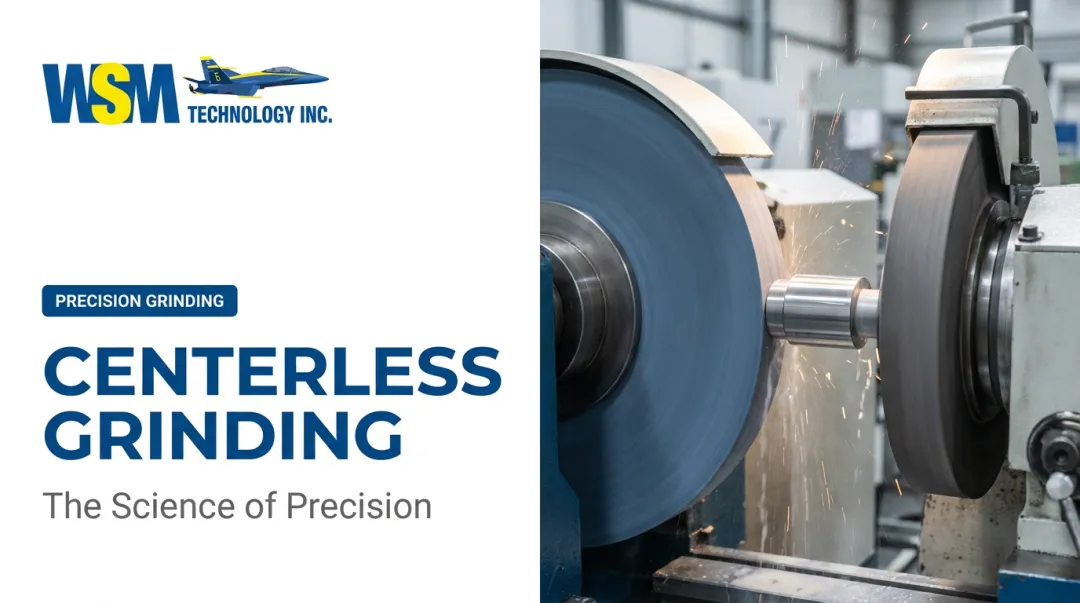
Centerless grinding removes the workpiece from any chuck or center support entirely. The part rests on a work blade between two wheels: a grinding wheel that cuts, and a regulating wheel that controls rotation and feed rate. In throughfeed mode, parts enter one side and exit the other as finished components — continuously.
This configuration eliminates fixturing time per part and removes the need for center holes. For high-volume runs of small, uniform cylindrical parts, no other process comes close for throughput.
What centerless grinders are optimized for:
- High-volume production of pins, needles, bushings, and rollers
- Consistent diameter tolerances across large quantities
- Minimal operator intervention once the machine is dialed in
The numbers reflect the process's precision. In medical device manufacturing, centerless grinding holds guidewire diameters to better than 0.0002" and surgical tool tolerances to better than 0.0001", with mirror finishes of 3Ra to 5Ra achievable on precision components. Some operations grind surgical tools in 9 seconds per part.

Limitations worth noting:
- Setup requires careful regulating wheel angle adjustment (typically +1° to +3°) to avoid lobing — a roundness defect caused by incorrect work height positioning
- Less flexible than chuck-type cylindrical grinders for complex geometries or short-run mixed work
- Not suitable for non-cylindrical parts or features requiring precise location
WSM Technology carries Danobat centerless grinders for high-volume precision production requirements.
Internal Grinding Machine
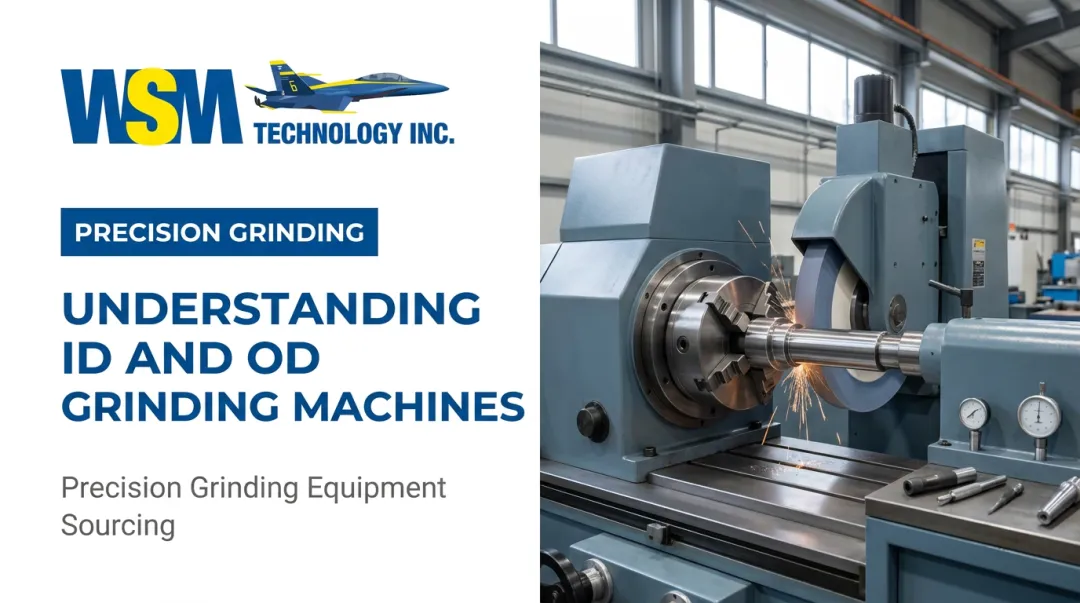
An internal grinder is the bore-focused counterpart to the cylindrical grinder, designed to precision-grind the inner diameter (ID) of a workpiece. The part is held in a chuck while a small-diameter grinding spindle runs at high RPM inside the bore, removing material until the required ID size, roundness, and finish are achieved.
What internal grinders are optimized for:
- Bearing housings, hydraulic cylinders, mold core bores, and spindle bores
- Through-bores and blind bores where surface finish affects sealing or bearing fit
- Any application where bore roundness and size are critical to mating part function
Internal grinding achieves ID tolerances from ±0.00004" to ±0.00039" according to United Grinding data. Studer cites internal grinding bores up to 400 mm (15.7") deep when grinding H6 fits — the tolerance class required for precision bearing and hydraulic component applications.
Critical setup requirement: Grinding wheel spindle alignment must be maintained to within 0.0002" deviation during slide travel. A component misalignment of just 0.001" can produce hourglass or tapered bores rather than true cylindrical forms.
Limitations:
- The grinding wheel must be smaller than the bore, limiting rigidity and requiring higher spindle speeds
- Deep, small-diameter bores require deflection compensation to avoid chatter
- Cycle times are longer than OD grinding for equivalent material removal
WSM Technology offers both Overbeck external/internal grinders and Danobat OD/ID grinders for internal diameter work. The Danobat combines OD and ID grinding in a single setup, reducing part handling and improving concentricity between internal and external features.
How to Choose the Right Precision Grinding Machine
The right machine is determined by the geometry and function of the part — not by what's most familiar in the shop. The core question is always: what surface needs to be ground, and what tolerance does it need to hold?
Match the Machine to the Feature
- Flat surfaces, reference planes, mold plates: Surface grinder
- External diameters, shafts, spindles: Cylindrical grinder
- High-volume cylindrical parts without complex geometry: Centerless grinder
- Internal bores, bearing housings, hydraulic cylinders: Internal grinder

Trying to adapt the wrong machine type to a feature is a losing proposition. It wastes setup time and rarely produces the required result regardless of how skilled the operator is.
Production Volume and Part Variety
- Centerless grinding excels at long runs of identical cylindrical parts — it has no equal for throughput on simple round components
- CNC cylindrical grinders handle mixed part families efficiently through programmable plunge, traverse, and multi-diameter sequences
- Surface grinders serve both low-volume toolmaking and higher-volume flat component production
Tolerance, Finish, and Material
Tighter tolerances demand more from the machine itself. Before specifying equipment, confirm it can meet your part requirement with margin — not just barely. Key factors to verify:
- Spindle geometry and thermal compensation — critical for holding sub-micron tolerances over long runs
- In-process gauging capability — required for closed-loop size control on tight-tolerance parts
- Abrasive compatibility — hardened tool steels and superalloys require CBN or diamond superabrasive wheels, and not every machine configuration supports every wheel type
Confirm abrasive compatibility before specifying a machine for a new material. It's a detail that surfaces late in the process and creates real problems when overlooked.
Getting Application Engineering Support
For manufacturers in Northern Ohio, Western Pennsylvania, and West Virginia evaluating precision grinding equipment, WSM Technology's team in Rootstown, Ohio offers application engineering support, test cuts, and time studies across their Danobat, Hembrug, and Overbeck grinding lines. Bring specific part requirements — tolerances, materials, production volumes — to that conversation before committing to a machine.
Common Mistakes When Selecting a Precision Grinding Machine
Three selection errors show up repeatedly — and each one is avoidable with the right evaluation process.
- Overspecifying for the work at hand: A larger, more technically advanced grinder than your parts require drives up capital cost, floor space, and operating complexity without improving quality. Match capability to actual part requirements, not theoretical future needs.
- Focusing only on purchase price: Initial cost is one line item. Wheel consumption rates, cycle time efficiency, maintenance requirements, parts availability, and local service coverage determine real cost per part across the machine's service life. A cheaper machine with poor regional support can cost more in downtime within the first year alone.
- Underestimating operator training: CNC cylindrical and internal grinders require significant setup knowledge and programming expertise. The learning curve is real — underestimating it produces high scrap rates during ramp-up and leaves machine capability chronically underutilized.

Conclusion
Surface, cylindrical, centerless, and internal grinding machines serve fundamentally different purposes. Each is engineered for a specific class of part geometry, and choosing the right one determines whether tolerances hold, finishes stay consistent, and production runs without costly rework.
Knowing which machine fits which application turns equipment selection from a guessing exercise into a deliberate, defensible decision — one that pays off across every production run.
WSM Technology works with manufacturers across Northern Ohio, Western Pennsylvania, and West Virginia on precision grinding equipment selection and broader machining workflow questions. Reach the team directly:
- Northern Ohio: (440) 796-5238
- Western PA & West Virginia: (412) 770-5849
- General inquiries: sales@wsmtechnology.com
- Demonstration Center: 3393 Industry Rd, Rootstown, OH 44272
Frequently Asked Questions
What are the four types of grinding machines?
The four primary precision grinding machine types are surface, cylindrical, centerless, and internal grinders. Surface grinders address flat geometry; cylindrical grinders handle external diameters; centerless grinders excel at high-volume cylindrical production; and internal grinders finish bores and internal features to tight tolerances.
Which machine is suitable for precision grinding?
All four machine types described above qualify as precision grinders. The right choice depends on part geometry: flat features point to surface grinding, external diameters to cylindrical grinding, bores to internal grinding, and high-volume round parts to centerless. Any of the four can hold tolerances well beyond what conventional machining achieves.
What is the difference between cylindrical and centerless grinding?
Cylindrical grinding holds the workpiece between centers or in a chuck, giving the operator precise individual part control for complex geometries and tight diameter tolerances. Centerless grinding supports the part on a blade between two wheels, enabling continuous throughfeed production without fixturing — a tradeoff of higher throughput against reduced flexibility for complex profiles.
What tolerances can precision grinding machines achieve?
Cylindrical OD and ID grinding can hold diameter tolerances from less than ±1 micrometer to ±10 micrometers with roundness from 0.25 to 2.5 micrometers. Centerless grinding achieves guidewire diameter tolerances better than 0.0002" in precision applications. Actual results depend on machine quality, wheel selection, thermal management, and setup.
When should I use surface grinding vs. cylindrical grinding?
Use surface grinding for flat, parallel, or stepped features on plate-like workpieces such as mold plates, die shoes, and machine bases. Use cylindrical grinding for round parts where diameter, roundness, and concentricity are the critical dimensions. The part geometry makes the decision; there's no meaningful overlap between the two applications.
What industries commonly use precision grinding machines?
Mold and die making, aerospace, automotive, medical device manufacturing, and tool manufacturing are the primary users. Components like bearing surfaces, hydraulic parts, surgical instruments, and turbine blades all require the tight tolerances and surface finishes that precision grinding delivers.