
It's often the last operation before a part ships — and the tolerances involved aren't casual. Shops can hold squareness and parallelism to 0.0001 inch on mold components, according to a documented mold-shop case study.
Yet plenty of operators run a surface grinder daily without fully understanding what's happening between the wheel and the workpiece. That gap in knowledge shows up as poor finishes, premature wheel wear, or scrapped stock. This guide breaks down exactly how surface grinding works, step by step.
Key Takeaways
- Surface grinding uses a rotating abrasive wheel to shave a flat, precise surface onto a workpiece.
- The process moves through setup, wheel engagement, controlled feed, and dressing before a finishing pass.
- Shops use it to finish tool steel, mold bases, dies, and hardened components after milling or EDM.
- Precision applications can hold tolerances near 0.0001 inch with the right wheel, speed, and coolant setup.
- Wheel selection and dressing frequency directly affect finish quality and cycle time.
What Is Surface Grinding?
Surface grinding is a machining process that uses a rotating, bonded abrasive wheel to remove small amounts of material and create a flat, precise surface finish. Instead of cutting with a single defined edge like a mill or lathe tool, the wheel's thousands of abrasive grains each shear off microscopic chips.
Why it exists as a separate step: Milling and turning leave surface irregularities, tool marks, or residual stress that keep a part from meeting tight flatness or finish specs. Grinding cleans that up.
What Surface Grinding Is Not
It's easy to lump grinding processes together, but they solve different problems:
- Cylindrical/OD-ID grinding shapes round, rotating parts, such as shafts, bushings, and bores, not flat surfaces.
- Lapping and polishing are lower-material-removal steps, often using loose abrasive rather than a fixed wheel, and typically come after grinding for ultra-fine finishes.
- Surface grinding stays focused on plane geometry: flat, square, parallel.
Why It Still Matters Despite Faster Milling
High-speed milling has closed some gaps, and hard milling can even replace hand grinding on select contoured die details. But for flat, hardened, tight-tolerance work, grinding still wins.
According to Norton's surface-finish benchmarks, precision grinding achieves 32 to 4 microinches Ra or better, compared to roughly 125 to 32 microinches Ra for conventional milling or turning. That gap matters when a mold plate needs to seal or a die component needs to slide without galling.

Two Main Configurations
- Horizontal spindle (peripheral) grinding: the wheel's edge contacts the part as it reciprocates beneath it. Narrower contact, better suited to controlled fine finishing.
- Vertical spindle grinding: the wheel's face contacts the part, often over a rotary table. Larger contact area, faster stock removal, but demands more from coolant and power delivery.
How Does Surface Grinding Work?
Surface grinding follows a defined sequence: setup, wheel engagement, controlled material removal, and finishing passes. Each stage affects the final result, and skipping steps or rushing them is where most quality problems start.
Initiation: Setup and Mounting
The workpiece gets secured to the machine table first, typically with a magnetic chuck for ferromagnetic parts, or a vise/fixture for geometries and materials that won't hold magnetically.
Workholding options include:
- Magnetic chucks dominate flat ferrous work because they expose most of the top surface to the wheel.
- Vises and fixtures handle nonmagnetic materials or irregular shapes, and can themselves be clamped to a chuck.
Machine control also varies by shop:
- Manual grinders leave positioning and compensation to the operator's eye and feel.
- CNC-controlled machines store setup cycles and automate wheel compensation for repeatable results.
Common bottlenecks here: improper workholding that lets the part shift mid-cut, or a wheel specified for the wrong material hardness before the first pass even starts.
Core Operation: The Grinding Action
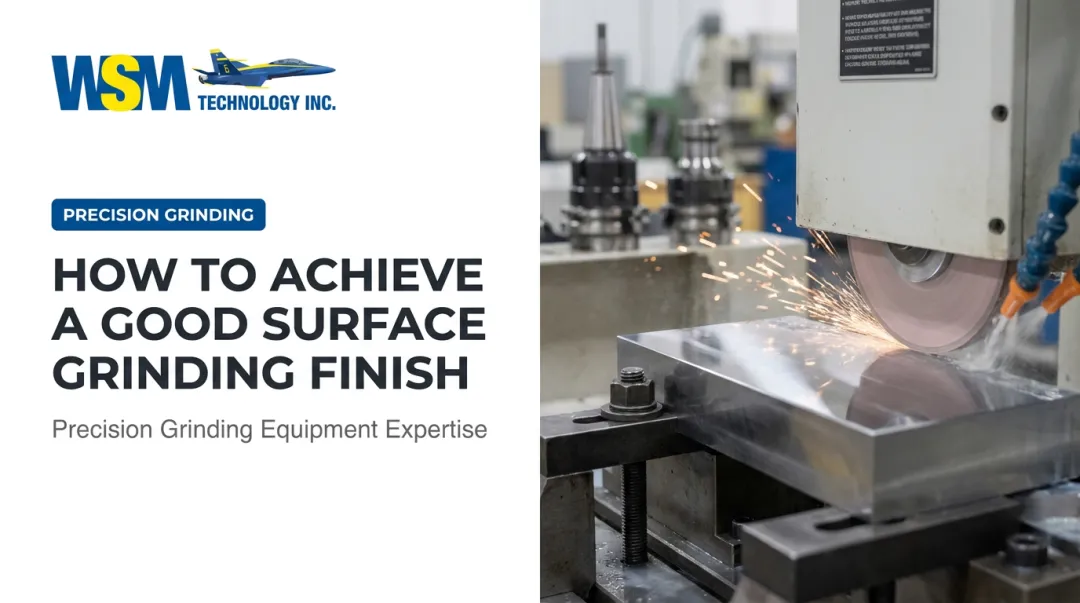
Once mounted, the abrasive wheel spins at high speed while the table moves the workpiece beneath it. Each grain on the wheel's surface acts like a tiny cutting edge, shearing off material in shallow passes rather than one deep cut.
The wheel's cross-feed moves it laterally across the part while the table travels back and forth, gradually working across the full surface. Three variables control what comes out the other end:
| Variable | Effect on outcome |
|---|---|
| Wheel speed | Higher speed can improve finish, but must stay under the wheel's rated maximum |
| Table feed rate | Slower feed improves finish; faster feed raises productivity but roughens texture |
| Depth of cut | Shallower cuts improve finish and reduce heat; deeper cuts remove stock faster |
These settings interact, and you can't tune one in isolation. A slower feed might improve finish but generate more localized heat if coolant delivery doesn't keep pace.
Regulation: Coolant and Dressing
Grinding is a thermally aggressive process. Left uncontrolled, heat at the contact zone can cause burn, softening, rehardening, cracking, or warping: problems that don't show up until the part fails inspection or service. Coolant delivery must actually reach the wheel-work interface rather than get deflected by the air barrier the spinning wheel creates.
Wheel dressing is the other half of consistency. As the wheel wears, it dulls and loads up with swarf. Dressing:
- Fractures the bond to expose fresh, sharp grains
- Clears loaded material from the wheel's pores
- Restores wheel geometry for accurate contact
There's no universal dressing schedule; it's condition-based. Shops dress when finish drifts, chatter appears, or a validated CNC interval calls for it. Skip this step and parts start warping or losing hardness before anyone notices why.
Output: The Finishing Pass
The final pass determines what the customer actually receives: a flat, dimensionally accurate surface with a specified finish, usually measured in microinches Ra. Rough grinding removes bulk stock with coarser wheels; the finishing pass switches to finer grit, lighter depth, and often a spark-out pass (no further infeed, just cleanup).
A properly ground mold base or die component assembles correctly the first time. That consistency is what keeps rework off the shop floor and parts moving into production on schedule.

Where Surface Grinding Is Used
Surface grinding typically shows up as the last stop after milling, turning, or EDM, especially for parts where flatness and finish are non-negotiable.
It performs best on:
- Hardened or hard-to-machine tool steels
- Parts with tight flatness or parallelism callouts
- Components needing a fine finish for sealing or wear resistance
Documented applications include multicavity mold components, injection-mold plates, punches and dies, machine-tool bases, jig-grinder components, and aerospace and automotive flat interfaces.
Mold and die shops are the segment WSM Technology works with most closely on EDM, milling, and CNC turning. These shops often pair surface grinding with those upstream operations to bring a cavity block, plate, or fixture to final spec.
WSM's own equipment portfolio includes grinding lines from Danobat and Overbeck, reflecting how often grinding and machining purchases go hand in hand for shops finishing hardened tooling.

Conclusion
Surface grinding works through a controlled sequence: secure mounting, abrasive contact, coolant and dressing management, and a finishing pass. Get each stage right and you get tight tolerances and a repeatable surface finish. Skip a step, and you get burn marks, wheel wear, or a part that doesn't hold spec.
Understanding that sequence helps shops make better calls on wheel selection, process order, and equipment partners. For shops evaluating complementary precision milling, EDM, or CNC turning equipment to pair with their grinding operations, WSM Technology's Demonstration Center in Rootstown, Ohio offers hands-on evaluation. Their application engineering support helps you sequence the whole job correctly.
Frequently Asked Questions
What is precision surface grinding?
Precision surface grinding is a finishing process that uses a rotating abrasive wheel to achieve tight flatness tolerances and fine surface finishes on flat workpieces. It's typically the final step after milling, turning, or EDM.
How accurate is precision surface grinding?
Documented mold-shop applications have held squareness and parallelism to 0.0001 inch, with finishes in the 32-to-4-microinch Ra range or better. Actual results depend on wheel grit, machine rigidity, and part geometry.
What is the difference between rough grinding and precision surface grinding?
Rough grinding removes larger amounts of material quickly using coarser wheels and deeper passes. Precision grinding uses finer wheels, lighter depth of cut, and spark-out passes to hit tight tolerances and smooth finishes.
What's the difference between surface grinding and cylindrical or centerless grinding?
Surface grinding produces flat surfaces on chuck- or fixture-held parts. Cylindrical and centerless grinding shape round, rotating workpieces, with centerless work rotating between a grinding wheel and a regulating wheel.
What materials can be surface ground?
Surface grinding handles ferrous and non-ferrous metals, hardened tool steels, carbide, and cast iron, with wheel selection matched to the material's hardness. Common examples include HSS, aluminum, and A36 steel.
How long does the surface grinding process take?
Cycle time depends on stock removal needed, wheel type, and finish targets. Finer grit often means slower feed rates, so a tight-tolerance finish pass can take longer than a rough stock-removal pass on the same part.