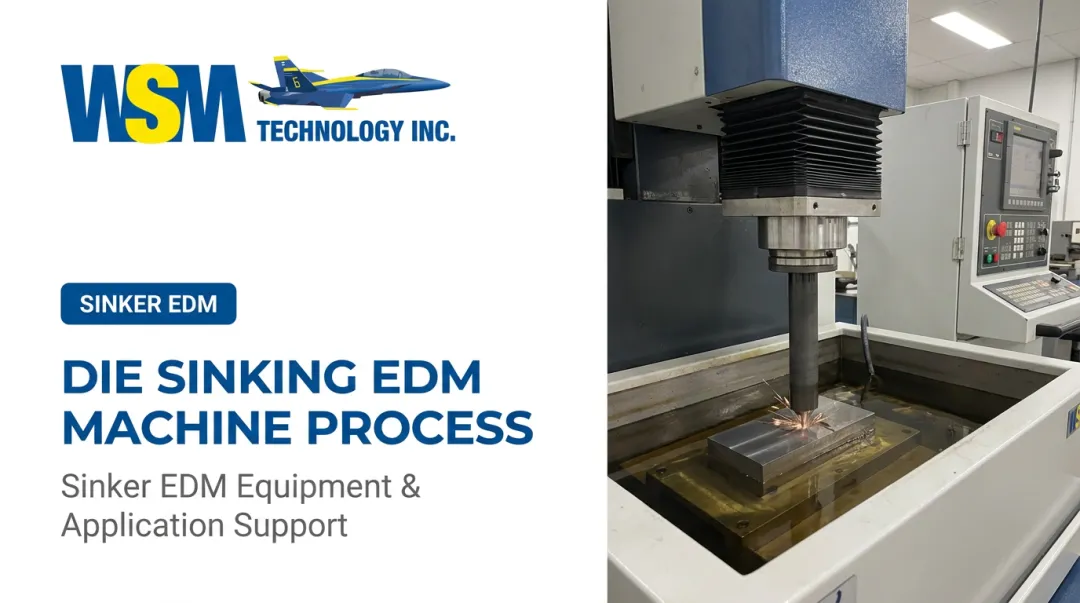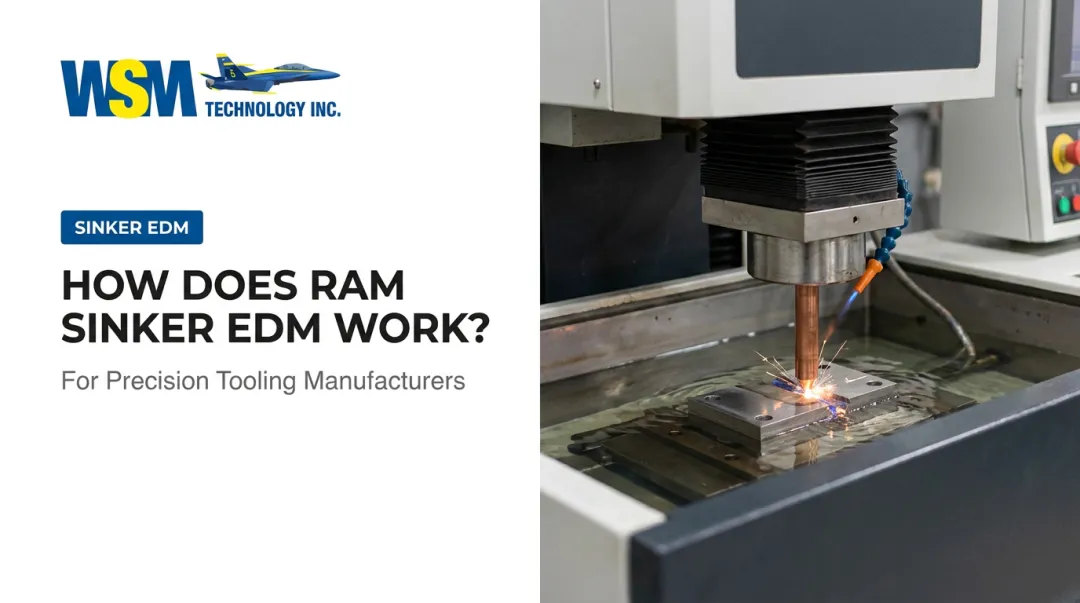

Many shop owners understand that Ram EDM works, but not how it works stage by stage. That gap leads to poor process selection and underused machine investments. This guide breaks down exactly what happens inside a Ram Type EDM machine, from setup to finished cavity.
TL;DR
- Ram EDM uses a shaped electrode and electrical sparks in dielectric fluid to erode material and form cavities
- The process runs through initiation, spark generation, gap regulation, and material removal
- Excels on hardened metals, deep cavities, and intricate mold/die features milling can't reach
- Favored in mold and die, aerospace, and automotive work for complex cavity geometry
What Is a Ram Type EDM Machine?
Ram EDM, also called Sinker EDM or Plunge EDM, is a non-contact process. A custom-shaped electrode erodes conductive material through controlled electrical discharge. Modern Machine Shop describes these as "die sinkers" for good reason. The electrode is a mirror image of the cavity you want, and the machine sinks it into the workpiece one spark at a time.
This process exists because hardened, brittle, or geometrically complex conductive materials often can't be cut with traditional tools without inducing mechanical stress or tool wear.
What Ram EDM is not:
- Not Wire EDM — uses a shaped electrode instead of a continuously fed wire, and produces blind 3D cavities wire EDM can't cut.
- Not conventional milling — there's no physical tool contact, so there's no cutting force on the workpiece.
Despite advances in CNC milling, Ram EDM remains the only practical way to produce deep, sharp-cornered, blind 3D cavities in hardened tool steel.
Standard vs. Micro/Fine-Hole EDM
Standard Ram EDM handles large cavity work in mold and die applications. Micro/Fine-Hole EDM targets small precision holes, sometimes measured in microns, using finer electrodes and tighter gap control.
WSM Technology represents Mitsubishi Electric/MC Machinery Systems for standard Ram EDM—die sinking, mold and die work, and aerospace and automotive components. For micro and fine-hole work, WSM represents Sarix, a Swiss manufacturer founded in 1993 that serves micro molding, textile, micro mechanics, and automotive shops.
How Does a Ram Type EDM Machine Work?
Ram EDM runs through a defined sequence: setup, spark discharge, gap regulation, and material removal. Each stage directly affects final part accuracy.
Initiation
The workpiece and electrode sit submerged in dielectric fluid, either oil or deionized water, positioned with a precise gap between them. The electrode is built as a mirror image of the desired cavity. Once it is mounted and programmed, initiation is largely automated and CNC-controlled.
Common bottleneck: Poorly designed electrodes or inadequate dielectric flushing cause inconsistent results right from this first stage. Get the electrode geometry wrong, and everything downstream suffers.
Core Operation
A pulsed electrical voltage between electrode and workpiece creates controlled sparks. These sparks vaporize and erode tiny amounts of material with each pulse.
According to Modern Machine Shop's breakdown of the sinker EDM process, sinker EDM produces 500 to 30,000 sparks per second, though they occur one at a time rather than simultaneously. As material erodes, the electrode gradually advances—the actual "ram" or "plunge" motion—forming the cavity shape.

Three variables control the outcome:
- Spark frequency — affects cutting speed
- Current — affects material removal rate and finish
- Polarity — positive reduces electrode wear; negative burns faster and suits titanium and other exotic metals
Regulation and Control
The machine has to maintain a consistent spark gap even as erosion constantly changes the distance between electrode and workpiece. It adjusts electrode position in real time, making small servo corrections after each spark.
Dielectric flushing and filtration play an equally critical role. Flushing removes debris from the gap, preventing short-circuits or uncontrolled arcing. Contamination or swarf buildup causes repeated sparking in one spot, damaging finish quality or the workpiece itself.
Poor gap regulation shows up fast: inconsistent surface finish, excess electrode wear, or scrapped parts. Shops that invest in process training and time studies—support WSM Technology builds into its turnkey EDM work—catch these issues before they turn into scrap.

Output and Result
The end result is a precisely eroded cavity or feature that matches the electrode's negative shape, held to tight tolerances. That output feeds directly into downstream work: mold assembly, injection molding setup, or final part finishing. Consistent cavities cut rework later and extend tool and mold life across production runs.
Where Ram Type EDM Machines Are Used
Ram EDM fits into several distinct workflow stages:
- Mold and die cavity creation — sinking the initial cavity shape
- Complex internal forms and gear features — shaping geometries cutting tools can't reach cleanly
- Finishing hardened components — cleaning up after rough machining on hardened stock
It's the go-to process when you're dealing with:
- Hardened, conductive materials like tool steel, tungsten carbide, titanium, or Inconel
- Blind cavities with no through-access
- Sharp internal corners that cutting tools can't replicate
- Thin walls that would flex or break under mechanical cutting force
Mold and die shops lean on Ram EDM primarily for cavity sinking. Aerospace, automotive, and medical manufacturers use it for precision components where hardness or geometry rules out conventional machining.

Conclusion
Ram EDM works through controlled sparks, real-time gap regulation, and gradual material erosion. That process is what makes it capable of complex, hardened-material machining other methods can't match.
Understanding each stage leads to better process selection and less wasted machine time. Shops across Ohio, Western PA, and West Virginia can lean on WSM Technology's EDM application expertise, Rootstown demonstration center, and hands-on training to get more from their machine investment.
Frequently Asked Questions
What does EDM mean in manufacturing?
EDM stands for Electrical Discharge Machining, a non-contact process using electrical sparks to erode conductive material. It converts electrical energy into thermal energy to melt or vaporize the workpiece, regardless of hardness.
What are the two types of EDM?
The two main types are Ram/Sinker EDM and Wire EDM. Ram EDM uses a shaped electrode to create 3D cavities, while Wire EDM feeds a continuous wire for 2D profile cutting.
What is EDM hole drilling?
EDM hole drilling, sometimes called fast-hole or fine-hole EDM, produces small, precise, deep holes using a specialized electrode and dielectric flushing. WSM Technology offers EDM hole-drilling equipment under the Titan brand.
What's the difference between EDM and ECM?
EDM uses electrical sparks to erode material through melting and vaporization. ECM, or Electrochemical Machining, instead relies on electrolytic dissolution, with no sparks involved at all.
How long does the Ram EDM process take to machine a cavity?
Cycle time varies widely based on cavity depth, material hardness, and required surface finish, ranging from minutes to many hours. A job-specific time study is the most reliable way to estimate this for your application.
Can Ram EDM machine any conductive material?
Yes. Ram EDM works on any conductive material regardless of hardness, including hardened tool steel, titanium, tungsten carbide, and Inconel. Hardness that would wreck a cutting tool has no effect on spark erosion.