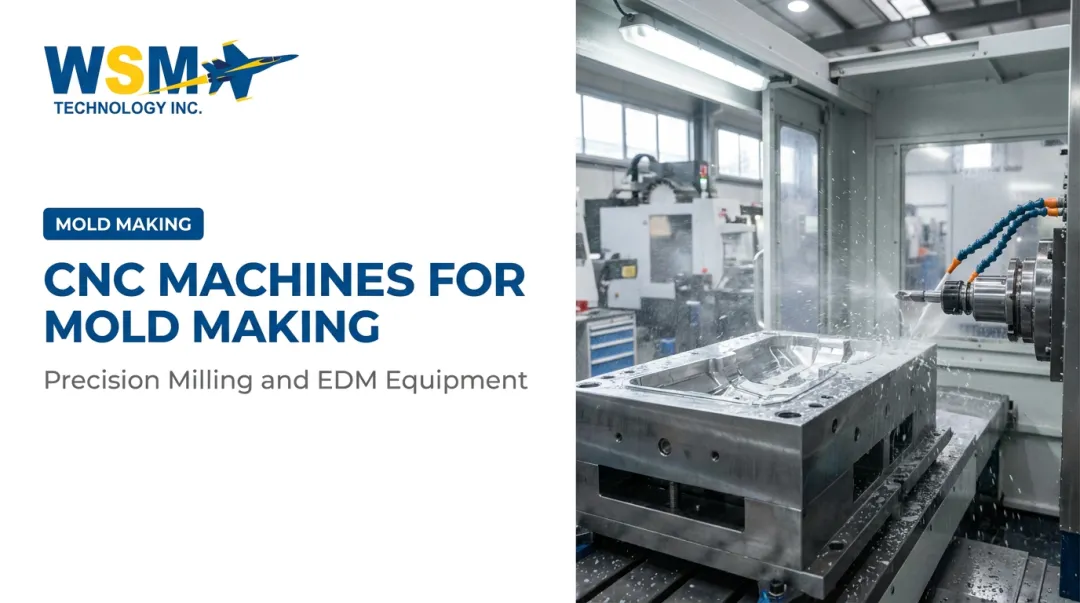

This breakdown is for mold makers, tool shops, and manufacturers working in or around injection molding. Precision here isn't a nice-to-have. It directly determines part quality, cycle life, and how consistent your production run stays over hundreds of thousands of cycles.
The term "mold machining" gets used loosely and is sometimes confused with molding itself. They're not the same thing. This article breaks down how mold machining actually works, what affects its outcome, and where it fits into the mold-building lifecycle.
Key Takeaways
- Mold machining shapes the tool; the molding machine shapes the plastic part
- The typical workflow runs through roughing, EDM, finishing, then polishing/texturing
- Tolerances, steel hardness, and cavity complexity drive machining time and method
- CNC milling, EDM, or a hybrid approach affects tool life, cosmetics, and cost
What Is Mold Machining for Injection Molding?
Mold machining is the use of CNC milling, EDM (wire and sinker), turning, and grinding to convert a solid block of tool steel or aluminum into the cavity and core halves of an injection mold. Nothing about it involves plastic. It's metal removal, cut by cut, until a raw block becomes a functional tool.
The end result is straightforward to describe even though it's hard to achieve: a finished mold with precise cavities, cooling channels, and ejector pin holes. Add tight parting lines, and that mold will repeatedly form thousands to millions of identical plastic parts.
Mold machining vs. injection molding, in one line: mold machining builds the tool; injection molding uses that tool to produce parts. One happens once (or occasionally gets refreshed); the other happens continuously.
Mold machining also differs from general CNC part machining in a few important ways:
- Material shrinkage dictates cavity size — every cavity is cut oversized to compensate for how much the plastic contracts as it cools
- Draft angles go into every vertical wall so parts release cleanly from the mold
- Multi-cavity alignment has to be dead-on, since even a few microns of mismatch between cavities can create parts with inconsistent wall thickness across the same shot
A general CNC shop cutting a bracket doesn't need to think about any of that. A mold shop does, on every job.

Why Mold Machining Is Critical for Injection Molding
Injection molding demands a mold capable of holding exact dimensions across thousands or millions of cycles, all while enduring repeated heat and clamping pressure. Only precision machining delivers that kind of repeatability. There's no shortcut around it.
What the Molding Process Demands From the Mold
Every production mold needs to deliver:
- Tight tolerances that hold up cycle after cycle without drifting
- Smooth, consistent surface finish matching cosmetic and functional specs
- Accurate parting lines that close cleanly with zero gap
- Reliable ejection so parts release without sticking or deforming
Mold machining addresses each of these directly. The cavity geometry, surface texture, and ejector placement are all cut into the steel during this stage, not adjusted later.
What Goes Wrong Without It
Skimp on machining accuracy and the downstream problems show up fast: poor cavity fill, flash at the parting line, warped parts, short shots, or premature mold wear.
Parting-line flash in particular is a known mold killer. Trapped debris and resin concentrate load on the parting surface, damaging the steel and making the flash problem worse over time, not better.
Upfront investment in machining accuracy costs far less than fixing geometry problems after the mold is already cut.
Is This a Hard Requirement or Just Best Practice?
It's closer to non-negotiable. The Plastics Industry Association's mold construction classes run up through Class 101, built for 1 million-plus cycles.
That means the steel, the fit, and the initial machining accuracy all have to be right from day one. There's no fixing it later on a tool expected to run that long, according to Plastics Technology's breakdown of mold life expectations.
Tolerance expectations vary by supplier and application rather than following one universal number. Protolabs, for example, publishes a tool-machining tolerance around +/-0.003 in (0.076 mm) for its supplier network, while specialty mold shops serving high-precision work have claimed figures as tight as +/-0.0001 in.
The number depends entirely on the shop, the steel, and the application. Don't treat any single figure as an industry-wide standard.
Shops serving aerospace, medical, and automotive work typically operate at the tighter end of that range, since those industries have less tolerance for dimensional drift across a production run.
How Mold Machining Works (Conceptual Flow)
A mold design starts as a CAD/CAM file. CAM software translates that file into toolpaths, and a sequence of cutting, EDM, and finishing operations progressively shapes the steel or aluminum block into the final cavity and core.
The inputs feeding this process include:
- Mold steel or aluminum blanks (pre-hardened or fully hardened, depending on the job)
- CAD/CAM programming that defines geometry and toolpaths
- Cutting tools for milling and shaped electrodes for EDM
- Coolant and lubrication systems to manage heat and chip evacuation
Material comes off layer by layer, either through rotating cutting tools during milling or through spark erosion during EDM, until the block holds the negative geometry of the final plastic part. CNC programming controls every pass, including spindle speed, feed rate, and tool selection; for EDM, voltage settings and electrode wear management play that same role.
What starts as a raw block ends up as a mold half with precise cavities, cooling lines, ejector holes, and a surface finish ready for texturing, polishing, or trial shots.
Step 1: Roughing and Cavity Blocking
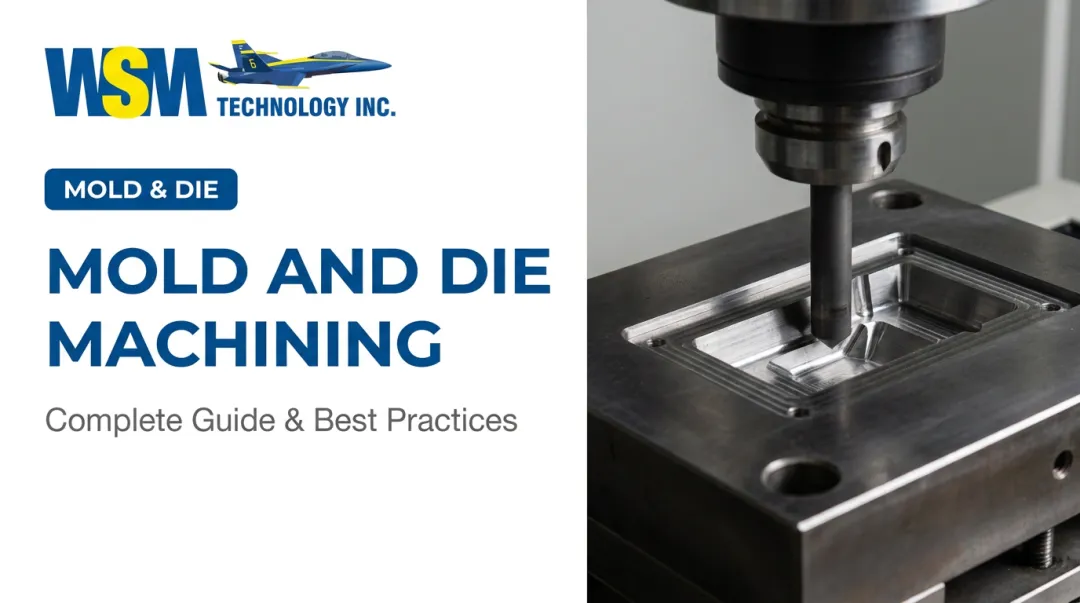
CNC milling quickly removes large volumes of material to rough out the general cavity and core shape. This step leaves stock behind intentionally: enough material for finishing passes to clean up later without risking an oversized or undersized cavity.
Step 2: EDM for Complex Geometry
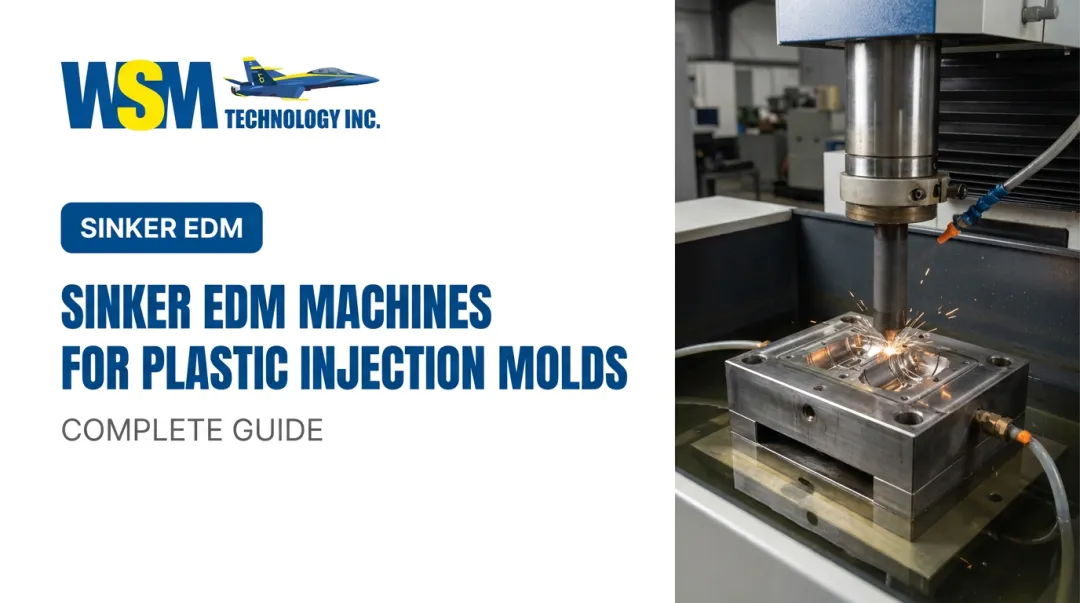
Wire and sinker EDM handle what milling can't reach: sharp internal corners, deep ribs, and features cut into hardened steel. Sinker EDM burns a shaped electrode into blind cavities and intricate hardened features, while wire EDM handles precise through-cuts and profiles where a mechanical cutter simply won't fit or would break trying.
Step 3: Finishing, Polishing, and Texturing
Finish milling, hand polishing, or texturing (Mold-Tech style finishes, for instance) brings the cavity to its final surface tolerance and cosmetic spec. If the part needs a textured finish, draft angles have to account for it because texture depth adds resistance during ejection. Designers increase the draft accordingly before sampling and validating the mold.

Where Mold Machining Is Applied & Key Factors That Affect It
Mold machining shows up across the full mold lifecycle, not just at the start:
- New mold builds — the original cavity and core cut from raw stock
- Mold repair and refurbishment — restoring worn cavities or damaged parting surfaces
- Cavity modifications — cutting in design changes without building an entirely new tool
- Preventive maintenance — touch-up work during long production runs to extend mold life
You'll find this work happening in tool and die shops, in-house mold departments at OEMs, and dedicated mold-making facilities serving automotive, aerospace, medical, and micro molding.
Access to the right equipment shapes how efficiently a shop can take on complex mold work. Milling centers, sinker and wire EDM, and precision turning each play a different role — the wrong machine for a job either burns time or compromises the result.
That's part of why regional mold shops lean on established equipment partners. A dealer like WSM Technology, based in Rootstown, Ohio, works directly with shops on machine selection, setup, and ongoing support, drawing on decades of hands-on EDM and milling application experience.
What actually affects the machining process:
- Steel grade and hardness — pre-hardened steel like P20-type material machines differently than fully hardened tool steel, affecting cutting speed and tool wear
- Cavity complexity and count — single-cavity molds move faster than multi-cavity or family molds with multiple distinct geometries
- Machine rigidity and electrode quality — directly caps the tolerances a shop can realistically hit
- Production volume expectations — a prototype tool doesn't need the same finishing investment as a million-cycle production mold
- Cooling channel and ejector pin placement — needs precision machining upfront, since poor placement causes downstream cycle time or part-quality issues that are expensive to fix later
Common Misconceptions & When Mold Machining May Not Be Appropriate
The biggest misconception is treating mold machining and injection molding as the same process. One builds the tool. The other uses that tool to produce parts. Confusing the two leads to unrealistic expectations about lead time and cost.
A second misconception: "any CNC shop can machine a mold." In practice, mold work requires specialized knowledge of shrinkage allowances, draft angles, and steel hardening sequences that a general-purpose shop simply doesn't encounter in everyday work.
A third misconception: machining accuracy and part accuracy aren't the same thing. A perfectly machined mold can still produce out-of-tolerance parts if material shrinkage or molding process settings aren't dialed in correctly. The tool being right doesn't guarantee the part comes out right.
Full mold machining isn't always the right call:
- Extremely low-volume needs (a handful of parts) often make more sense with 3D-printed or soft tooling. Metal tooling runs hundreds of thousands of cycles versus a few hundred shots for printed tooling
- Heavy design iteration signals it's time to hold off. Cutting a full production mold before geometry stabilizes means paying to re-cut it later

Conclusion
Mold machining is the precision subtractive process that combines CNC milling, EDM, and finishing to transform raw steel or aluminum into the tooling injection molding depends on. This groundwork happens well before any plastic is injected, laying the technical foundation that makes production possible at scale.
Understanding how this process actually works helps shops and manufacturers set realistic expectations for cost, lead time, and tolerance capability before committing to a mold build. Success comes down to matching the right machining approach and equipment to the mold's complexity and production goals, rather than defaulting to one method for every job that comes through the door.
Frequently Asked Questions
What is the process of mold parts machining?
It starts with CAD/CAM programming, followed by CNC roughing, EDM for complex or hardened features, and finishing/polishing to shape a steel or aluminum block into the mold's cavity and core.
What are examples of injection-molded parts?
Common examples include bottle caps, automotive interior components like dashboards, medical device housings, and consumer electronics casings.
What is the difference between tooling and a mold?
"Tooling" is the broader term covering all mold-related hardware, including the mold base, inserts, and cooling systems. "The mold" specifically refers to the cavity and core that shape the plastic part.
What materials are used to machine injection molds?
Most molds are machined from pre-hardened or hardened tool steel, such as P20 or H13 grades. Aluminum is sometimes used for lower-volume or prototype tooling.
How long does it take to machine an injection mold?
Timelines vary widely based on part complexity, cavity count, and finishing requirements — anywhere from a few weeks for a simple single-cavity mold to several months for complex, high-cavitation tooling.
What is the difference between CNC milling and EDM in mold making?
CNC milling removes material mechanically and works faster on open, accessible geometry. EDM uses electrical spark erosion to reach tight corners and hardened features that milling cutters physically can't access.