
Introduction
A single dimensional error of a few thousandths of an inch can ground an aircraft or scrub a launch. In aerospace manufacturing, there's no room for "close enough."
Manufacturers face a brutal combination: tolerances tighter than almost any other industry, materials that fight back against every cutting tool, and certification requirements that can take years to earn. Titanium galls. Nickel superalloys work-harden mid-cut. One bad batch can cost a supplier its entire aerospace contract.
This guide breaks down what aerospace CNC machining actually involves and why it's become the industry's default manufacturing method. It also covers which materials and parts define the work, plus what shops need on the floor to compete for this business.
Key Takeaways
- Aerospace CNC machining blends milling, turning, drilling, and EDM to hit 0.0005-inch tolerances
- The global aerospace machine-tools market is set to grow from $3.43B in 2025 to $5.13B by 2031
- Titanium and nickel superalloys demand specialized coolant strategies to manage heat and tool wear
- 5-axis machining and EDM work together to produce geometries standard 3-axis mills can't reach
- AS9100 and Nadcap certifications are non-negotiable for OEM aerospace supply chains
What Is Aerospace CNC Machining?
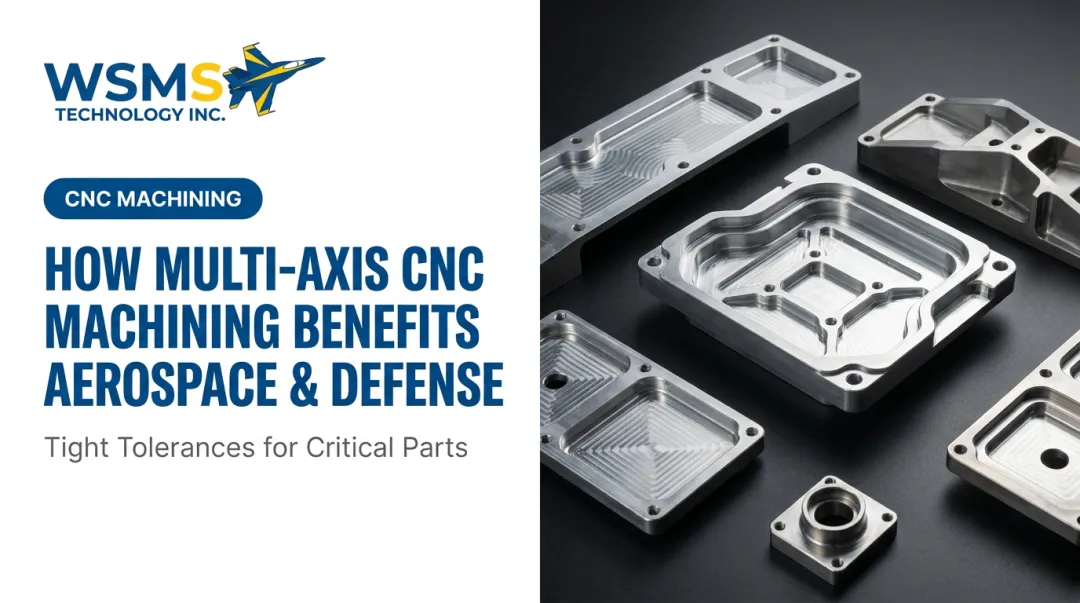
Aerospace CNC machining refers to computer-controlled milling, turning, drilling, and EDM processes used to produce precision parts for aircraft, spacecraft, and defense systems. Unlike manual machining, CNC programs remove the guesswork. A part machined today will match a part machined six months from now, down to the same cutting path and feed rate.
That repeatability matters because aerospace tolerances leave almost no margin for error. In one documented case, a five-axis machining center held hole centerlines to within 0.0005 inches of a datum centerline, starting three to four inches away from that reference point.
This isn't a universal number every part must hit; tolerances still vary by drawing, feature, and material.
"CNC machining" in aerospace is really shorthand for several processes working together:
- Milling for contours, pockets, and structural features
- Turning for cylindrical and rotational parts
- Drilling and tapping for fastener holes and threaded features
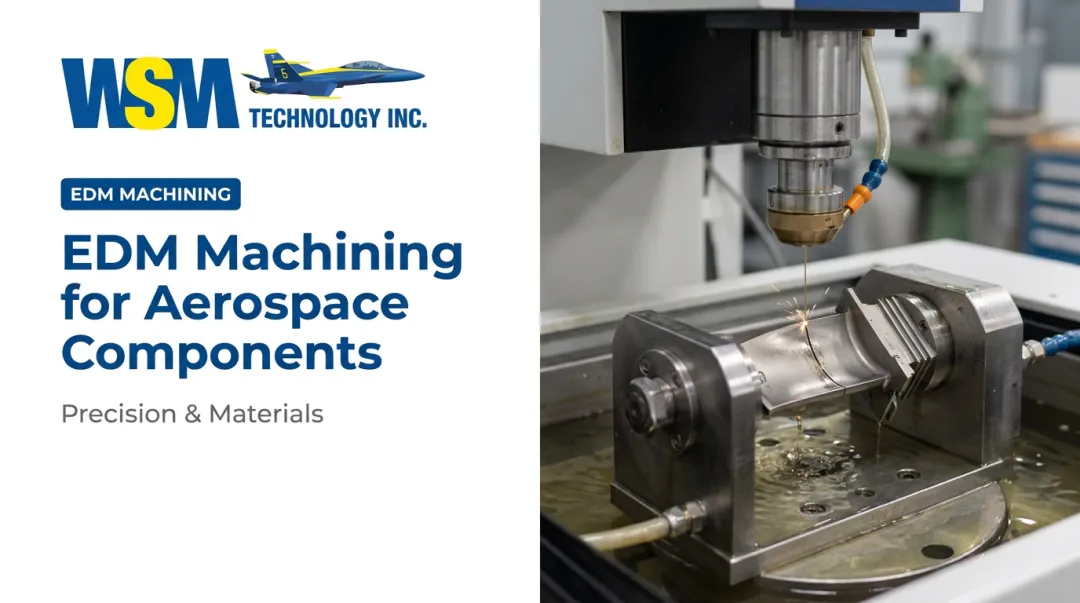
- Wire and sinker EDM for hardened alloys and geometries conventional tooling can't reach
Is CNC Machining Actually Used in Aerospace?
Yes, CNC has become the standard method for both prototype and production aerospace parts. The global aerospace machine-tools market was valued at $3.43 billion in 2025 and is forecast to reach $5.13 billion by 2031, growing at a 6.94% CAGR, with five-axis systems identified as the fastest-growing category.
The evidence spans the entire industry:
- Commercial aviation: Turbine blades machined and finished in a single five-axis setup
- Defense: Lockheed Martin's F-35 uses CNC-milled composite skin sections with precision trimming, drilling, and countersinking
- Defense: Boeing's F-15 speed brake was machined from one solid piece using high-speed CNC methods
- Space: NASA's Johnson Space Center lists precision CNC milling and turning among its methods for flight and ground-support hardware

Why Aerospace Manufacturers Rely on CNC Machining
Aerospace programs change constantly. A design revision that would require retooling on conventional equipment just means loading a new program on a CNC machine. That flexibility is why CNC dominates a sector defined by frequent iteration and short production runs mixed with long-term contracts.
Three capabilities make CNC indispensable for aerospace work:
- Rapid reprogramming: New revisions load as updated programs instead of triggering costly retooling, keeping pace with frequent design changes.
- Multi-process setups: A single CNC setup mills, drills, and taps a complex airframe bracket without moving the part between machines, cutting handoffs and cycle time for jobs that once needed three or four operations.
- Repeatable precision: Every cut follows the same programmed path, meeting the zero-defect standards aerospace primes demand.
EDM picks up where cutting tools struggle. It removes conductive material through spark erosion regardless of hardness, handling:
- Hardened nickel alloys that resist standard cutting tools
- Intricate cavity features that demand high-precision erosion
- Tight-tolerance geometries in hard-to-machine aerospace alloys
This is why shops serious about aerospace work invest in dedicated EDM equipment. WSM Technology, for example, carries Mitsubishi wire EDM systems like the MV1200S and MV2400, plus Mitsubishi sinker EDM machines built for exactly this kind of hard-alloy, tight-cavity work.
Together, these capabilities explain why shops handling aerospace contracts invest in dedicated CNC and EDM equipment rather than stretching general-purpose machines to do work they weren't built for.
Materials Used in Aerospace CNC Machining & Their Challenges
Titanium and Nickel-Based Superalloys
Titanium and nickel-based superalloys earn their place in aerospace because of an unbeatable strength-to-weight ratio and resistance to extreme heat. Turbine sections and structural fittings rely on these properties. But they're brutal to machine:
- Poor thermal conductivity traps heat at the cutting edge instead of dissipating through the chip
- Work hardening means the material gets tougher exactly where the tool is cutting
- Rapid tool wear results from both of the above, driving up cost per part
The fix is usually coolant strategy. High-pressure coolant creates a hydraulic wedge between the chip and the insert. According to Sandvik's testing on aerospace alloys, this approach can extend tool life by up to 50% while allowing a 20% increase in cutting speed.
Cryogenic cooling, using liquid nitrogen through the tool, is another option when conventional coolant can't keep up. Getting coolant pressure and toolpath dialed in for a specific alloy is exactly the kind of test-cut and time-study work application engineers handle before a machine ever reaches the shop floor.
Aluminum Alloys
Aluminum remains the workhorse for structural aerospace components, and for good reason. It machines fast, costs less than titanium or steel, and still delivers the strength-to-weight performance aerospace engineers need for non-critical structural parts.
Material-removal rates on aluminum can run many times higher than on titanium, translating directly into shorter cycle times and lower per-part cost.
Composites and High-Performance Plastics
CFRP and PEEK-type plastics show up wherever weight savings matter most: interior brackets, fuselage panels, clamps, and bearings. CFRP's abrasive, layered structure creates real delamination risk during drilling, so shops lean on:
- Sharp PCD tooling to reduce fiber pullout
- Conventional (not climb) milling strategies
- Peck-drilling cycles for metal-composite stacks
PEEK, meanwhile, gets specified for its chemical resistance, stiffness, and ability to hold up at elevated temperatures without the weight penalty of metal.

Common Aerospace Parts Produced via CNC Machining
CNC machining touches nearly every part category in an aircraft or spacecraft. The most common include:
- Structural airframe components — ribs, spars, and brackets
- Engine and turbine housings — casings that must survive extreme heat cycling
- Landing gear assemblies — heavily loaded, safety-critical parts
- Avionics and sensor housings — precision enclosures for electronics
- Fluid system manifolds and valve bodies — often requiring deep, straight drilled passages
Two of these categories push machining capability the furthest: turbine hardware and the micro-features hidden inside it.
Where 5-Axis Milling Meets EDM
Turbine blades and engine cases demand 5-axis machining because their geometry can't be cut from a single fixed angle. A five-axis setup lets the tool approach multiple faces without unclamping and re-referencing the part, cutting both setup count and the error that comes with each new setup.
Some features go beyond what any mill can produce. Turbine blade cooling holes, often a fraction of a millimeter in diameter, require small-hole EDM with breakthrough detection to avoid punching through an internal back wall.
This is exactly the kind of work Sarix Micro EDM platforms are built for. It's a big reason shops competing for engine-component work carry both milling and EDM capability under one roof.
Precision, Tolerances & Quality Standards in Aerospace Machining
Winning aerospace work starts with certification. AS9100 governs the quality management system a supplier runs, layering requirements for risk management, configuration control, and counterfeit-parts prevention on top of standard ISO 9001 practices.
Nadcap works differently: it accredits specific special processes like heat treating or non-destructive testing, and it's managed through an industry-run audit program rather than a single blanket certificate.
Neither certification, on its own, proves a machine can hold a tolerance. That's verified through inspection:
- CMM measurement for dimensional accuracy on complex geometries like turbine blade roots
- Laser tracker metrology for large-volume, assembly-level verification
- Optical scanning for fast, non-contact digitization of freeform surfaces
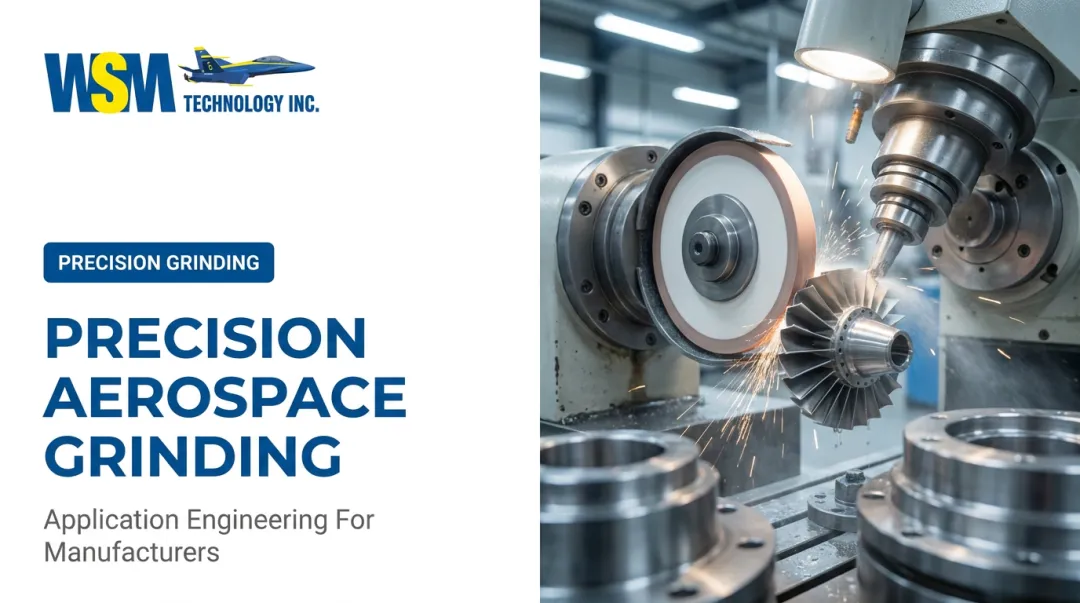
Dimensional accuracy alone doesn't guarantee an airworthy part. Surface finish carries weight beyond looks: a rougher-than-specified surface on a turbine blade can measurably change aerodynamic efficiency and shorten fatigue life. Aerospace drawings routinely call out finish requirements that go well beyond what a dimensional tolerance alone would demand — and those callouts are non-negotiable on the shop floor.
Choosing the Right CNC & EDM Equipment for Aerospace Machining
Winning aerospace contracts isn't just about operator skill anymore. It comes down to what's sitting on the shop floor: machine rigidity, multi-axis capability, and EDM precision that can actually hold the tolerances a customer's drawing demands.
That's the equipment gap WSM Technology's product line is built to close. The lineup includes:
- Mitsubishi EDM (wire and sinker) for hardened alloys and complex cavities
- Sarix Micro EDM for small-hole drilling work like turbine cooling features
- JINGDIAO high-speed milling for tight-tolerance 3- and 5-axis contouring
- Schaublin lathes for high-precision, Swiss-engineered turning
Selecting from that lineup isn't guesswork. Founder Blaise Buholzer built WSM around decades of EDM application-engineering experience dating back to his time at Charmilles USA. That background shapes how the company approaches equipment selection: match the machine to the material and geometry, not the other way around.
Before committing capital, shops can run test cuts and time studies at WSM's Demonstration Center in Rootstown, Ohio. It's a practical way to validate whether a given machine setup actually performs on aerospace-grade parts before it's sitting on your floor.

Frequently Asked Questions
What is aerospace machining?
Aerospace machining refers to the precision manufacturing processes, primarily CNC milling, turning, drilling, and EDM, used to produce aircraft, spacecraft, and defense components. It operates under strict tolerance, material, and safety standards.
Is CNC used in aerospace?
Yes. CNC machining is a core aerospace manufacturing method, used for both prototyping and full production of critical parts like turbine blades, structural airframe components, and composite skins.
What is the most commonly used material in aerospace CNC machining?
Titanium and aluminum alloys see the most use. Titanium offers strength-to-weight and heat resistance, while aluminum provides a cost-effective, highly machinable option for structural parts.
What tolerances are typical for aerospace CNC machined parts?
Tolerances vary by part and feature, but sub-thousandth-inch accuracy is common, with many aerospace components held to +/-0.0005 inches or tighter. Even small deviations at this scale can compromise fit or function.
Is 5-axis CNC machining necessary for aerospace parts?
Not always. Complex geometries like turbine blades and engine cases typically require 5-axis machining, but simpler structural parts can be produced accurately on 3- or 4-axis equipment.
What certifications should an aerospace CNC machining shop have?
AS9100 certification covers a shop's overall quality management system. Nadcap accreditation applies to specific special processes, and the exact requirements depend on the customer contract.