
For mold and die makers, tool shops, aerospace suppliers, and precision manufacturers, this matters most when a part needs blind cavities, deep ribs, or sharp internal corners in hardened metals that conventional cutters simply can't reach.
The term gets thrown around on shop floors constantly, but the details — electrode design, dielectric behavior, parameter tuning — often get glossed over. This article breaks down how the process actually works step-by-step, what factors drive results, where it fits best, and when another method makes more sense.
Key Takeaways
- Erodes cavities using a custom electrode and electrical sparks in dielectric fluid
- The standard choice for mold cavities, deep ribs, blind holes, and complex 3D shapes
- Discharge current, pulse frequency, and flushing determine removal rate, finish, and wear
- Won't cut non-conductive materials and is inefficient for simple through-cuts
What Is Die Sinking EDM?
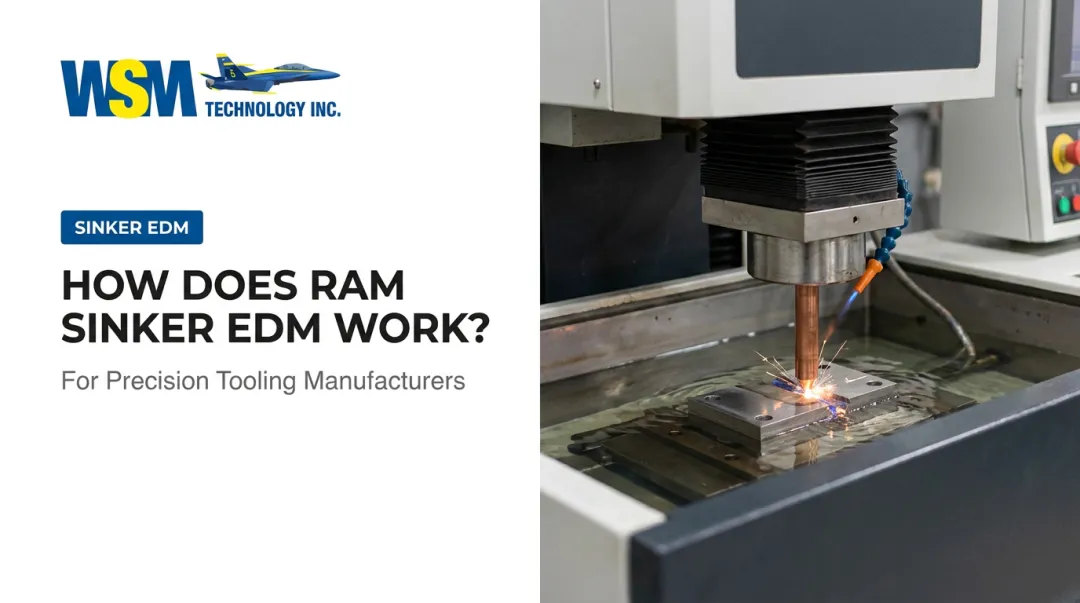
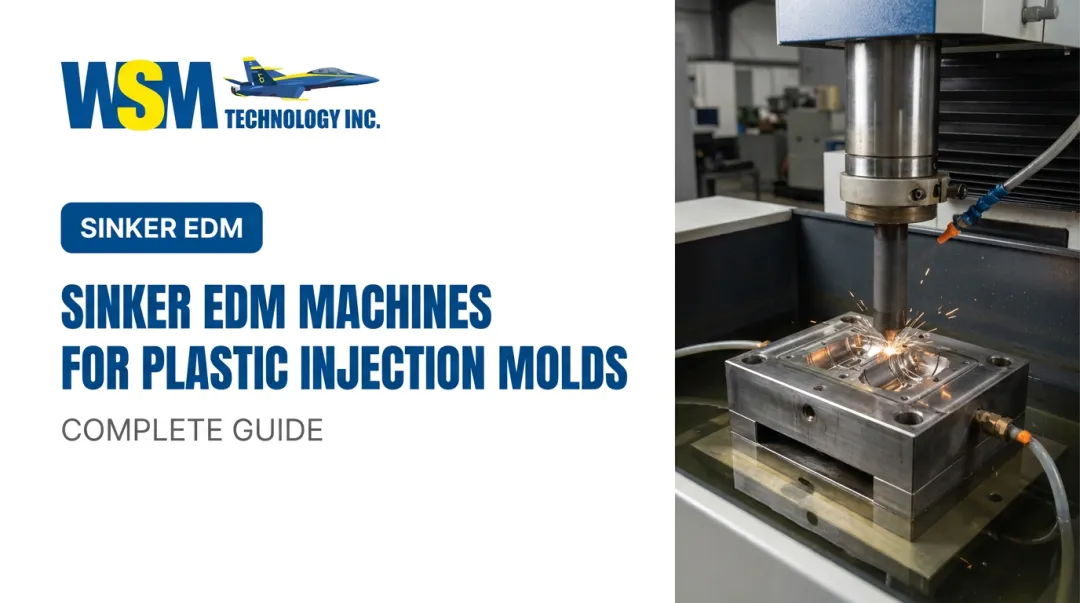
Die sinking EDM is a thermal, non-contact process where a custom-shaped electrode is "sunk" into a workpiece submerged in dielectric fluid. Rapid electrical discharges erode a cavity that matches the electrode's shape, burning a negative impression of the tool into the metal.
The outcome: a precise cavity in materials too hard, too deep, or too geometrically complex for a rotating cutter to touch. Think hardened tool steel mold cavities with sharp internal corners a milling cutter's radius could never produce.
Die Sinking vs. Wire EDM
The two get confused constantly, but the distinction is straightforward:
| Aspect | Die Sinking EDM | Wire EDM |
|---|---|---|
| Electrode | Solid, custom-shaped tool | Continuously moving wire |
| Primary motion | Z-axis (vertical plunge) | X-Y plane |
| Cavity type | Blind cavities (closed bottom) | Through-cuts only |
According to MC Machinery's breakdown of sinker and wire EDM, sinker EDM can start machining anywhere in the material and produce blind 3D features. Wire EDM, by contrast, requires a through path to cut a profile.
If the job needs a closed-bottom pocket, wire EDM is off the table entirely. That's a geometry limitation, not a matter of preference.
Why Die Sinking EDM Is Used in Mold, Die & Precision Manufacturing
Mold and die shops need to reproduce complex 3D cavity geometries in hardened tool steels without cracking or warping the tooling. Conventional milling or grinding often can't get there — either the cutter deflects in deep, narrow features, or the mechanical force induces stress the hardened steel can't absorb.
Die sinking EDM addresses three specific problems:
- Consistent cavity geometry across production runs, since spark erosion doesn't wear or deflect the way a cutting tool does
- Tight tolerances in geometries with sharp internal corners that a round cutter physically cannot reproduce
- Machining post-hardened materials without a second heat-treatment cycle, since the electrode doesn't need to be harder than the workpiece
What Goes Wrong Without It
Shops that try to force conventional cutting into these applications typically run into:
- Cracked or warped tooling from mechanical cutting forces on hardened steel
- Inability to reach sharp internal corners or deep, narrow ribs
- Inconsistent cavity replication between mold halves or across tooling batches
One important caveat: "no mechanical stress" doesn't mean "no thermal effect." EDM can leave a recast layer, a heat-affected zone, and occasional microcracking, so surface-integrity requirements still need to be part of the process plan, not an afterthought.
These surface-integrity trade-offs are manageable, but they underscore why equipment choice matters as much as process planning. Die sinking EDM is an industry-standard best practice rather than a regulatory requirement, so shops running reputable equipment brands tend to see more consistent results simply because machine repeatability and application support reduce trial-and-error.
WSM Technology represents Mitsubishi/MC Machinery sinker EDM equipment across Northern Ohio, Western Pennsylvania, and West Virginia. MC Machinery Systems recognized the company as a 2018 Machining Technologies Sales Leader, tied to the consistent machine performance and application support shops need when cavity accuracy can't be an afterthought.

How the Die Sinking EDM Process Works
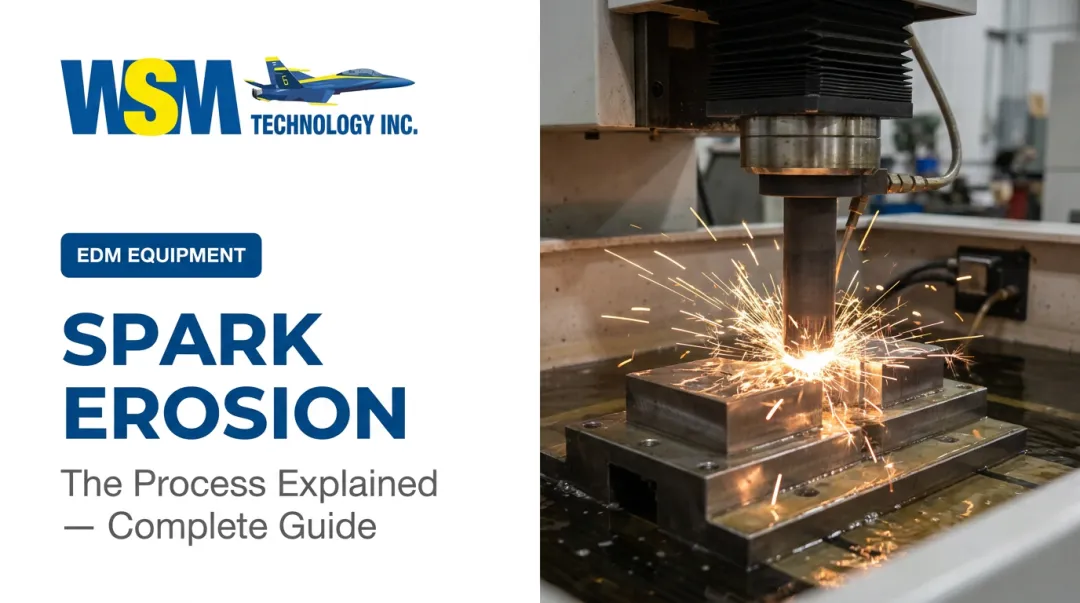
At a high level: the electrode and workpiece sit submerged in dielectric fluid, positioned close but never touching. A controlled voltage generates thousands of discharges per second, eroding material until the cavity takes shape.
What goes into the process:
- A CNC-machined electrode, commonly graphite or copper
- A conductive workpiece
- Dielectric fluid (hydrocarbon oil or synthetic)
- A servo-controlled power supply
During the core action, dielectric breakdown creates a plasma channel between electrode and workpiece. Localized heat (reported in the 8,000°C to 12,000°C range at the spark, with some studies citing up to 20,000°C at the crater) melts and vaporizes material, which the circulating dielectric then flushes away.
According to Modern Machine Shop's look inside the sinker EDM process, a single sinker EDM operation can generate 500 to 30,000 individual sparks per second. Each spark forms its own tiny plasma channel, leaving a microscopic crater behind.
Servomechanisms maintain a precise spark gap throughout, while operators adjust discharge current, pulse on/off time, and polarity to balance removal rate, surface finish, and electrode wear. The result: the workpiece gains a cavity that's the reverse impression of the electrode, and the electrode itself sees minor, predictable wear.
Step 1: Electrode and Workpiece Setup
A custom electrode, a positive image of the desired cavity, gets machined first. Both electrode and workpiece are then submerged and aligned in the dielectric tank, with the servo system holding a precise initial gap before any sparking begins.
Step 2: Spark Erosion and Material Removal
Voltage triggers controlled sparks that melt and vaporize workpiece material in tiny craters. The dielectric fluid cools the area continuously and flushes debris away, preventing short-circuits that would otherwise stall the process.
Step 3: Cavity Formation and Finishing Passes
The electrode advances gradually as material erodes. Finishing passes at lower current and higher frequency refine the surface finish and hold tight tolerances before the part gets measured against spec.

Where Die Sinking EDM Is Applied & Key Factors That Affect It
Die sinking EDM shows up primarily in tooling and mold production, not in-line part manufacturing. Typical applications include:
- Injection mold cavities and stamping dies
- Deep ribs and blind keyway machining
- Internal splines
- Tungsten carbide tooling
The process is project-based rather than continuous, driven by new mold builds or tooling rework rather than high-volume repeat production. The trigger is almost always a design requiring blind cavities, sharp internal corners, or geometry a rotating cutter can't reach.
Key Factors That Affect Outcomes
Electrode material drives wear resistance, machinability, and achievable finish. Graphite made up roughly 95% of North American EDM electrodes, according to a technical comparison published by Mercer through POCO's electrode research, thanks to its low wear and easier machining.
Copper offers finer detail and finish but machines slower and weighs more. Copper-tungsten handles carbide and exotic alloys where wear control matters more than electrode cost.
Discharge current and pulse frequency directly trade off material removal rate against surface finish: higher current removes stock faster but coarsens the surface and often increases wear.
Dielectric condition and flushing efficiency determine whether debris clears the gap properly. Poor flushing on deep cavity cuts causes arcing and shorts instead of clean, distributed sparks.
Workpiece material and hardness (steel alloys, tungsten carbide, titanium, nickel alloys) change achievable speed and required polarity. A steel/graphite recipe doesn't transfer cleanly to carbide/copper-tungsten work; the pairing changes the whole equation.
For shops trying to nail these variables down before committing to a machine, WSM Technology's demonstration center in Rootstown, Ohio offers test cuts and time studies. These validate electrode and parameter choices against the shop's actual material and geometry, rather than relying on a generic settings table.
Common Issues, Misconceptions & When Die Sinking EDM May Not Be the Right Choice
A few misconceptions come up often enough to address directly.
"It can machine any material." Not true. Die sinking EDM only works on electrically conductive materials. Plastics and most ceramics are out unless you're working with a specialized conductive composite.
"One electrode handles roughing and finishing." Shops that skip a dedicated finishing electrode often end up with poor surface finish or excess overcut. Roughing electrodes remove bulk stock; finishers establish size, corners, and surface quality. Trying to make one electrode do both usually shows up as a quality problem later.
"Electrode wear means something went wrong." Some wear is expected and gets accounted for in electrode design from the start. It's not a process failure. Reported wear rates vary widely by pairing: copper-tungsten on tungsten carbide runs around 18-20%, while graphite on tungsten carbide can hit 45-50% under comparable conditions.

Die sinking EDM also isn't always the right call. It's often unnecessary or inefficient for:
- Simple through-cuts (wire EDM wins here)
- Thin flat profiles
- High-volume simple geometries better suited to conventional milling
A signal worth watching for: if a shop defaults to sinker EDM out of habit for shapes a standard end mill could produce at lower cost and faster cycle time, that's worth revisiting. It's a process choice, not a fixed rule.
Frequently Asked Questions
What is die sinking EDM?
Die sinking EDM is a non-contact process that uses a shaped electrode and electrical sparks to erode a mirrored cavity into a conductive workpiece. It's commonly used for molds, dies, and tooling that require blind, complex geometries.
What is the difference between EDM die sinking and EDM wire cut processes?
Die sinking uses a custom 3D-shaped electrode that moves mainly along the Z-axis to create blind cavities. Wire EDM uses a continuously spooled wire moving in the X-Y plane to make through-cuts.
What materials can be used as electrodes in die sinking EDM?
Graphite, copper, copper alloys, and tellurium copper are the main options. Graphite is the most popular choice due to its low wear, ease of machining, and cost-effectiveness.
What tolerances can die sinking EDM achieve?
Depending on machine precision and parameter control, die sinking EDM can hold tolerances as tight as 0.0001 inches. That figure reflects machine capability, not a guaranteed outcome on every job — electrode accuracy and wear still factor in.
Can die sinking EDM machine non-metallic materials?
No. The process requires electrically conductive materials to generate the spark discharge. Plastics and most ceramics can't be machined without specialized adaptations.
Is die sinking EDM slower than other machining methods?
For simple geometries, yes: conventional cutting or wire EDM is usually faster. But for complex blind cavities in hardened materials, die sinking EDM is often the more efficient and reliable choice overall.