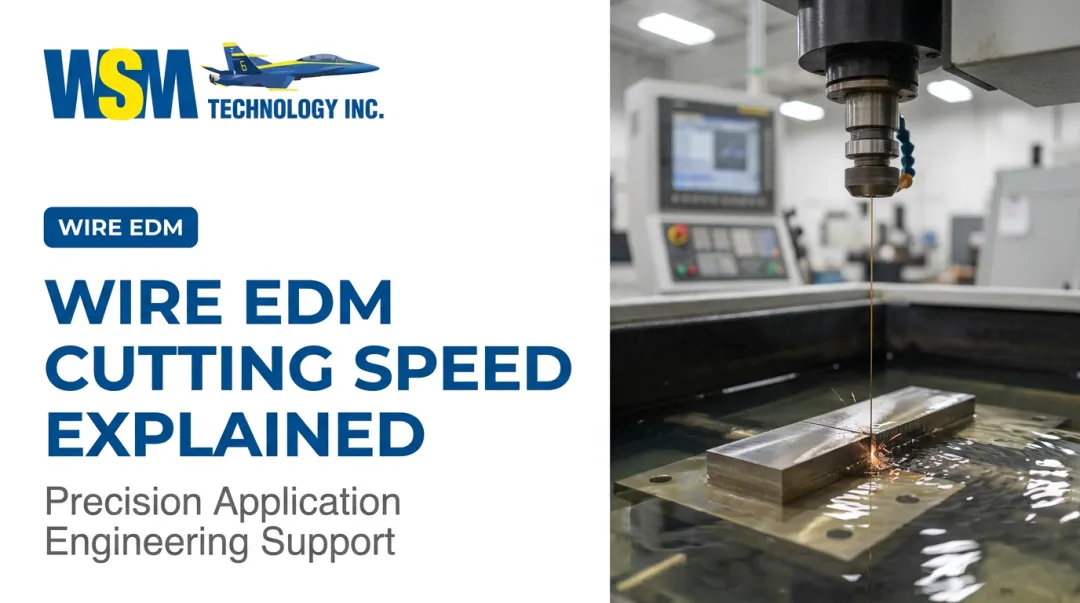

The frustrating part is that wire EDM cut time isn't mysterious — it follows predictable physics. Material, thickness, geometry, wire type, power settings, and flushing conditions all interact in ways that can be quantified, once you know the right framework.
This guide covers the six variables that drive cut time, both calculation methods (linear and area-based), speed reference data by material, and how to connect your estimates to competitive job pricing.
Key Takeaways
- Core formula: Time (min) = Cut Length ÷ (Feed Rate × Efficiency Factor)
- Cut time is shaped by six variables — material, thickness, geometry, wire type, power settings, and flushing conditions — and each one compounds the others
- Feed rates vary significantly by material — reference data provides baselines, not guarantees
- Coated wire can cut 10–50% faster than standard brass, depending on wire type and application
- Shops that track actual vs. estimated cut times consistently produce tighter quotes and reduce underpricing risk
What Drives Wire EDM Cut Time: The 6 Key Variables
Material Type and Electrical Properties
A material's electrical and thermal conductivity determine how efficiently each spark removes material — not just its hardness.
Harder materials like D2 tool steel, titanium, and carbide require more discharge energy per spark and cut slower than softer, more conductive materials like aluminum. Low thermal conductivity can actually concentrate heat near the discharge zone, altering how material behaves under sparking conditions. A 2020 Heliyon review on titanium EDM found that titanium alloys can achieve higher early-stage material removal than iron alloys precisely because titanium's low thermal conductivity keeps heat localized at the cut.
For D2 tool steel, manufacturer data shows a meaningful thickness effect:
- 30 mm thickness: ~180 mm²/min cutting speed
- 100 mm thickness: ~80 mm²/min cutting speed
Carbide requires machine-specific test cuts; no reliable universal speed table exists for it.
Workpiece Thickness
Cutting time scales roughly in proportion to workpiece height. A 100 mm workpiece takes significantly longer than a 50 mm workpiece at the same linear feed rate, because the wire must discharge through more material per unit of contour progress.
Tall parts compound this with flushing problems. For parts over 75 mm thick, watch for these compounding effects:
- Dielectric fluid has more distance to travel through the kerf
- Debris accumulates and slows effective cutting speed
- Wire break frequency increases, requiring conservative efficiency factors in your estimates
Part Geometry and Complexity
Thickness affects how long each pass takes; geometry determines how many passes and how much non-cutting repositioning time your job actually carries. Straight cuts are the fastest — every deviation adds time:
- Tight radii require slowed feed rates to maintain accuracy
- Sharp internal corners need additional repositioning passes
- Complex contours increase cornering deceleration across the entire path
- Multiple start holes (punch plate arrays, cavity patterns) add wire threading and repositioning time that has nothing to do with the cut path itself
According to wire EDM FAQ data from Absolute Machine Tools, complex shapes like gears can take 28% longer than circles of identical cut length due to wire drag and path curvature effects.

Wire Type, Diameter, and Power Settings
Wire selection has a bigger impact on cut time than most shops account for in their quotes.
According to Sodick's EDM wire guide, coated wires deliver 10–30% better cutting efficiency than standard brass. Thermocompact's product data goes further, with specific coated wire products claiming 20–50% speed gains over brass baseline.
In a thick D2 punch case documented by Modern Machine Shop, a 0.016" coated wire achieved 2–3x the roughing speed of conventional 0.010" brass wire, largely because it could carry 60 A versus roughly 30 A for standard brass.
Wire size matters too:
- Larger diameter wire carries more current, enabling faster roughing cuts
- Smaller diameter wire (down to 0.05 mm on some machines) opens up tighter radii and finer detail work, though at reduced cutting speed
Power settings — peak current, pulse width, and duty cycle — directly control material removal rate. Higher energy settings speed up roughing but degrade surface finish and increase wire wear, often requiring additional skim passes that add back the time you gained.
The Wire EDM Cut Time Calculation Formula
The Linear Cut Time Formula
The standard quoting formula:
Time (min) = Cut Length ÷ (Feed Rate × Efficiency Factor)
Variable definitions:
- Cut Length — total programmed wire travel path in mm or inches
- Feed Rate — machine cutting speed in mm/min for the given material, thickness, and pass type
- Efficiency Factor — a multiplier between 0.80 and 1.0 that accounts for cornering slowdowns, wire threading pauses, retract moves, and flushing interruptions
Choosing the right Efficiency Factor:
| Job Type | Efficiency Factor |
|---|---|
| Simple contours, few corners, good flushing | 0.95–1.0 |
| Moderate complexity, some internal features | 0.88–0.94 |
| Complex contours, tight radii, poor flushing | 0.80–0.87 |
The Area-Based Cutting Speed Formula
Average Cutting Speed (mm²/min) = (Cut Length × Workpiece Thickness) ÷ Total Cut Time
This formula normalizes performance for material height, making it the standard unit for comparing machine capabilities. OEM brochures use it almost exclusively — Mitsubishi's FA catalog shows machining samples at 300 mm²/min, and FANUC ROBOCUT literature lists up to 330 mm²/min under specified conditions.
Which formula to use:
- Linear formula (mm/min): quoting, CNC programming, job scheduling
- Area formula (mm²/min): benchmarking machine performance, comparing wire types, evaluating process settings
Working Through a Step-by-Step Example
Scenario: 500 mm contour in 50 mm-thick D2 tool steel, machine feed rate 2.0 mm/min, Efficiency Factor 0.85.
Rough cut calculation:
Time = 500 ÷ (2.0 × 0.85)
Time = 500 ÷ 1.70
Time = 294 minutes (~4.9 hours)
Adding skim passes:
Most precision work requires at least one or two skim passes after the rough cut. Skim passes run slower — typically 40–60% of rough cut speed — and each one adds directly to total job time.
| Pass | Feed Rate | Efficiency | Time |
|---|---|---|---|
| Rough cut | 2.0 mm/min | 0.85 | 294 min |
| Skim pass 1 | 1.0 mm/min | 0.90 | 556 min |
| Skim pass 2 | 0.7 mm/min | 0.90 | 794 min |
| Total | ~27.4 hours |

The rough cut alone represents less than 20% of total machining time in this three-pass scenario. Skim passes aren't a footnote — they're often the majority of the job.
Accounting for Non-Cutting Time
A complete job estimate must include time that doesn't appear in the cut path:
- Setup: workpiece fixturing, program loading, parameter verification
- Wire threading: each start hole requires threading time (typically 30 seconds to several minutes depending on machine and conditions)
- Repositioning: moves between features, especially on multi-cavity work
- Inspection pauses: mid-job measurement on critical features
For a punch plate with 50 start holes, threading time alone can add hours to the total.
Built-In Machine Estimators
These non-cutting time factors are exactly where built-in machine estimators earn their keep. Modern wire EDM machines, including the Mitsubishi FA series that WSM Technology carries, include job estimators that calculate machining time and wire consumption once the operator inputs material type, geometry, and workpiece thickness. They simplify quoting significantly for shops running current-generation equipment. That said, validate the outputs against actual run times on your specific materials and settings — factory defaults don't always reflect real shop conditions. WSM Technology's application team can help calibrate those parameters to your equipment and workpiece mix.
Wire EDM Cutting Speed and Feed Rate Reference Data
Understanding the Two Speed Units
- mm/min = linear feed rate of the wire along the programmed contour. Used in CAM programming and quoting.
- mm²/min = area-based cutting speed that incorporates material thickness. Used by machine manufacturers for performance ratings.
These numbers are not interchangeable. A machine rated at 300 mm²/min doesn't cut at 300 mm/min along a contour — the area rating already accounts for thickness.
Cutting Speed Reference by Material
The table below provides conservative benchmarks. Actual rates vary by machine model, wire type, dielectric setup, and surface finish target. Always validate with your OEM technology table or actual test cuts for critical jobs.
| Material | Thickness | Approx. Speed | Notes |
|---|---|---|---|
| D2 / Tool Steel | 30 mm | ~180 mm²/min | Brass wire, 4-cut sequence |
| D2 / Tool Steel | 100 mm | ~80 mm²/min | Brass wire, flushing-limited |
| Stainless 304 | 3 mm | ~80–120 mm/min (linear) | Research benchmark, not production default |
| Aluminum alloy | Variable | ~40–60 mm/min (linear) | Faster than steel; finish-sensitive |
| Ti-6Al-4V | Thin stock | ~2.74 mm³/min MRR | Volumetric MRR — not directly comparable to mm²/min ratings above; requires current/pulse optimization |
| Tungsten carbide | All | Machine-specific | No reliable public table exists |

Feed Rate and Surface Finish Tradeoffs
Target surface finish (Ra) has a direct, nonlinear impact on total cut time. Sodick notes that submerged wire EDM can achieve Ra 7.5 μm with a single rough cut but may require up to seven skim passes to reach finishes as fine as Ra 0.36 μm.
Approximate pass counts by finish target:
| Target Ra | Typical Pass Count |
|---|---|
| Ra 3.2 μm | 1–2 passes |
| Ra 1.6 μm | 2–3 passes |
| Ra 0.8 μm | 3–4 passes |
| Ra 0.4 μm | 4–6 passes |
| Ra 0.2 μm or finer | 6–7+ passes |
Each additional pass reduces feed rate and adds to total time. When quoting jobs with tight finish requirements, pass count is often the largest single variable in your time estimate — worth confirming before committing to a delivery date.
Translating Cut Time into Job Cost Estimates
The Basic Cost Formula
Total Machining Cost = (Total Cut Time in Hours × Machine Hourly Rate) + Wire and Consumable Costs + Setup Labor
In practice, no universal machine hourly rate applies to all shops. Your burdened hourly rate (full cost per machine hour) depends on equipment depreciation, labor model (attended vs. unattended), consumable costs, power, floor space, and utilization rate. Build that number from your actual cost drivers — not a figure borrowed from a forum. WSM Technology's team can help you structure this calculation for your specific equipment.
Wire Consumption Cost Calculation
Wire cost is calculated as:
Wire Cost = Wire Feed Rate (m/min) × Total Cut Time (min) × Cost per Meter
Thermocompact's catalog provides a concrete reference point: a 0.25 mm JP5 spool lasts approximately 20 hours at 10 m/min feed rate. From there, divide spool cost by total wire length to get cost per meter.
Coated wire vs. brass — the real comparison:
Coated wire costs more per spool, but the math often favors it. In a documented D2 thick-punch case from Modern Machine Shop, switching to coated wire dropped wire cost from $19.92 to $18.56 per job — and the faster cut speed reduced machine hours enough to offset the premium. Total job cost (machine time plus wire) is always the right metric, not wire cost in isolation.
Connecting Estimates to Competitive Quoting
Accurate cut time estimation isn't just about recovering costs — it's about quoting competitively. The margin between winning jobs and leaving money on the table usually comes down to data quality:
- Under-estimating erodes margin on every job you win
- Over-estimating hands work to competitors who've done the math
- Accurate estimates come from tracked actuals, not padded guesses
Shops that build a cut time database from real jobs — and update it regularly — quote with confidence instead of insurance buffers.

Tips to Sharpen Your Wire EDM Cut Time Estimates
Track Actual vs. Estimated Times
The single most effective improvement is systematic logging. After every job, record:
- Material type and thickness
- Cut length and pass count
- Estimated time vs. actual time
- Any unusual interruptions (wire breaks, flushing issues, threading failures)
After 20–30 jobs in a given material and geometry category, your efficiency factors will reflect your actual machine — not generic published values.
Lock Down Consistent Settings Before Chasing Speed
Consistent machine settings, wire tension, and flushing pressure reduce variability in actual cut times, which makes all future estimates more reliable. A machine that cuts D2 at 2.0 mm/min reliably is easier to quote around than one that swings between 1.7 and 2.3 mm/min depending on operator settings.
If you want to accelerate this process, WSM Technology offers formal time study services at their Rootstown, Ohio demonstration center or on-site at your facility. These sessions produce real-world performance data tied to your specific equipment, materials, and process conditions — directly applicable to job quoting.
Validate Complex Parts With CAD/CAM
For high-value or complex jobs, CAD/CAM software with EDM post-processors can calculate cut path length and simulate feed rates far more accurately than manual estimation. The upfront time investment in a CAM-based estimate often pays back many times over when it prevents a badly mispriced quote on a 40-hour job.
Frequently Asked Questions
How do you calculate wire EDM machining time?
Use the formula: Time (min) = Cut Length ÷ (Feed Rate × Efficiency Factor). A complete estimate also adds threading time at each start hole, setup time, and separate time calculations for each skim pass — each at its own (slower) feed rate.
What is the cutting speed of wire EDM?
Cutting speed depends heavily on material, thickness, and finish target. Machine manufacturers rate performance in area speed terms: OEM benchmarks typically show high-speed capability in the 300–330 mm²/min range, while real-world production rates on tool steel drop to 80–180 mm²/min depending on thickness and pass strategy.
What factors affect wire EDM cutting speed the most?
Material hardness and thermal conductivity, workpiece thickness, and dielectric flushing efficiency have the largest impact. Power settings interact with all three — increasing peak current can raise speed but degrades surface finish and may require more skim passes.
What is the difference between mm/min and mm²/min?
mm/min is the linear feed rate of the wire along its programmed path, used in CAM programming and quoting. mm²/min is the area-based rate that multiplies linear speed by workpiece thickness, used to compare machine and process performance across different part heights.
How accurate are wire EDM cut time estimates?
Accuracy depends on how well your inputs reflect your actual machine and conditions. Estimates built from machine-specific feed rate data and calibrated efficiency factors typically land within 10–15% of actual run time — and that margin tightens once you build a historical log of real job times.
Can I use my wire EDM machine's built-in estimator for quoting?
Yes, most modern machines include job estimators that work well as starting points. Validate their outputs against your actual run times, since default settings may not reflect your shop's wire type, dielectric setup, or typical part geometry.