
So what separates a machine that holds micron-level tolerances for 20 or 30 years from one that gradually loses accuracy and requires constant re-scraping and carriage replacement?
The answer, in demanding applications, is hydrostatic guideways. By replacing metal-to-metal contact with a pressurized oil film, this design principle eliminates the root cause of guideway wear — and with it, a cascade of precision problems that affect aerospace, mold and die, automotive, and heavy industrial machining shops.
This article explains how hydrostatic guideways work, what they offer compared to rolling element and sliding contact alternatives, and where they belong in a precision manufacturing operation.
Key Takeaways
- Eliminates metal-to-metal contact by suspending moving elements on a pressurized oil film, preventing mechanical wear
- Delivers damping values exceeding 470,000 kg/s (Schaeffler HLE45-A-XL), directly improving surface finish and tool life
- Increases stiffness by raising oil pressure without adding friction or accelerating wear
- Best suited for grinding, heavy boring, milling, aerospace components, and high-precision contouring
- Requires different maintenance than rolling element systems — no guideway re-scraping or carriage replacement needed
What Are the Different Types of Guideways?
Three guideway technologies appear in CNC machine tools, each with a different friction mechanism and performance ceiling.
Sliding Contact Guideways
The most basic configuration — a carriage slides directly on the rail surface, separated only by a lubricant film. High frictional resistance makes these poorly suited for high-speed or high-accuracy applications. They remain in use on basic, low-cost machinery where simplicity outweighs performance.
JTEKT's development research on machine tool guideways reports friction coefficients of approximately 0.02 to 0.1 for sliding guideways under test conditions — high enough to cause stick-slip at low feed rates and significant heat generation at higher speeds.
Rolling Element Guideways
Ball or roller linear guides replace surface-to-surface contact with rolling contact, cutting friction sharply. HIWIN reports coefficients of approximately 0.004 for ball-type and 0.003 for roller-type linear guideways — roughly 10–30× lower than sliding contact.
These are the standard choice across most CNC machining centers today. Preloading improves stiffness, but as THK's friction documentation confirms, frictional resistance rises with preload — meaning a stiffer setup comes at the cost of higher friction and accelerated fatigue wear.
Hydrostatic Guideways
The most advanced practical option. Carriages float on a continuously replenished high-pressure oil film, with no physical contact between moving and stationary surfaces. Schaeffler describes friction between guideway and carriage as approximately zero, with resistance coming primarily from seal displacement — roughly 20 N per carriage.
That near-zero friction is what makes hydrostatic guideways the preferred choice for precision grinding, ultra-fine boring, and other applications where even minor stick-slip would compromise part accuracy.
Quick comparison of guideway friction characteristics:
| Guideway Type | Typical Friction Coefficient | Key Limitation |
|---|---|---|
| Sliding contact | 0.02 – 0.1 | Stick-slip at low feed rates |
| Rolling element | 0.003 – 0.004 | Fatigue wear under high preload |
| Hydrostatic | ~0 (seal drag only) | Requires pressurized oil supply system |

How Do Hydrostatic Guideways Work?
The Pressurized Oil Film
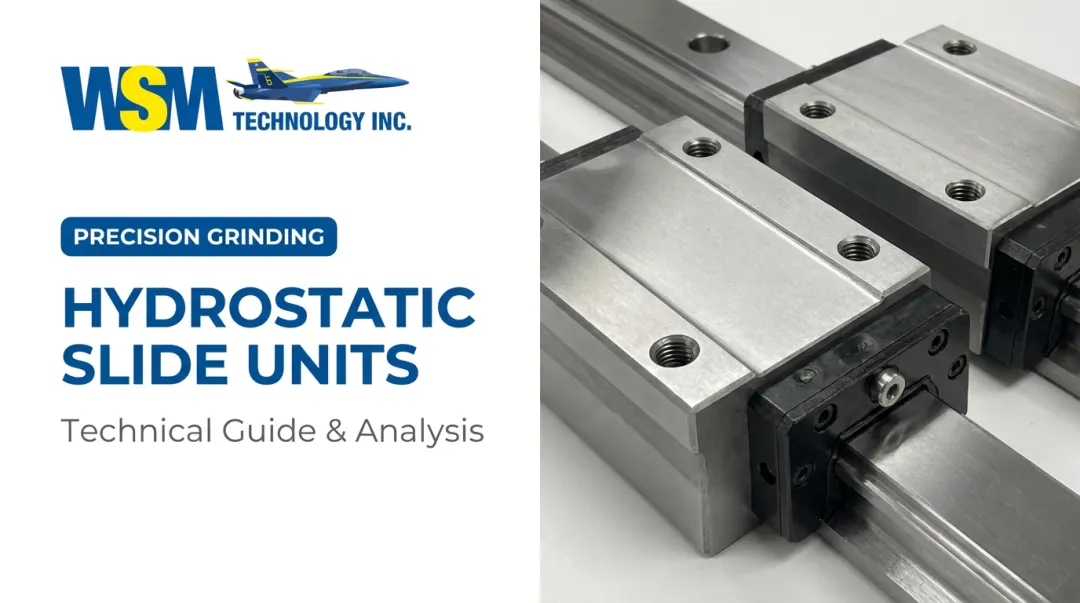
Hydrostatic guideways work by continuously pumping pressurized hydraulic oil through restrictors into recesses — called pressure pockets — machined into the carriage. The oil film completely separates the carriage from the guideway rail, creating pure fluid friction with no mechanical contact.
Kingsbury describes this film as potentially as thin as 0.015 mm, while JTEKT research has measured floating values of 7.5–10 µm in test guideway configurations. The exact gap depends on operating pressure and load.
Pressure Pockets and Flow Regulation
Integrated chokes within the carriage regulate oil flow to each pocket independently, ensuring the carriage lifts evenly and remains centered on the rail. Oil is supplied continuously to the pressurized side and spent oil drains and recirculates through a closed-loop circuit.
Schaeffler's TPI 149 technical documentation for the HLE45-A-XL specifies:
| Parameter | Specification |
|---|---|
| Oil type | ISO VG 46 / HLP 46 |
| Flow rate | 1.3 L/min per carriage |
| Operating pressure (rigidity data) | 10 MPa (100 bar) |
Stiffness and Load Behavior
Raising oil pressure increases rigidity without increasing friction or wear — a behavior that sets hydrostatic systems apart from rolling element designs. With rolling element guideways, adding preload for more stiffness simultaneously raises friction and accelerates fatigue. Here, those tradeoffs don't exist.
Schaeffler's verified stiffness data for the HLE45-A-XL illustrates this directly:
| Direction | Rigidity | Load Capacity at 10 MPa |
|---|---|---|
| Compressive | 1,200 N/µm | 22,000 N |
| Tensile | 900 N/µm | 17,400 N |
| Lateral | 500 N/µm | 7,500 N |
Failsafe and Contamination Protection
Modern hydrostatic carriages incorporate multiple layers of protection against both pressure loss and contamination:
- Sliding-material linings inside the pressure pockets act as a failsafe if oil pressure drops unexpectedly
- Elastic lip seals at the carriage perimeter block metal chips and cutting fluid ingress
- Sealing strips along the rail provide a secondary barrier against debris
This layered approach makes hydrostatic guideways significantly more resistant to contamination than open rolling element configurations.
Key Benefits of Hydrostatic Guideways
Zero Wear and Extended Machine Life
No metal-to-metal contact means no contact-related wear in normal operation. The guideway precision established at manufacture is preserved for as long as the oil supply functions correctly.
This isn't theoretical. Modern Machine Shop's feature "The Case For Hydrostatic Ways" profiles Form Grind Corporation's turbine-blade grinding operations and documents how hydrostatic systems support long-term precision retention — including a 30% faster grinding result in that application. Where rolling element guides require periodic carriage replacement and guideway re-scraping as wear accumulates, hydrostatic systems simply don't generate the wear mechanism in the first place.
Superior Vibration Damping
The oil film functions as a natural vibration absorber, dissipating vibration energy from cutting forces, grinding wheel contact, and external disturbances. Rolling element guides transmit vibration directly through their steel contacts into the machine structure, which sets a hard ceiling on surface finish quality that no amount of tuning overcomes.
Schaeffler's HLE45-A-XL achieves damping values of >470,000 kg/s, and MMS Science Journal research on machine tool vibration reduction confirms that hydrostatic guideways exhibit better damping properties than rolling element linear guideways as a class.
The practical impact:
- Improved surface finish quality at equivalent feed rates
- Reduced tool wear from dampened shock loading
- Ability to increase material removal rates without sacrificing surface quality

Elimination of Stick-Slip
Stick-slip occurs when the gap between static and kinetic friction causes jerky, inconsistent motion at low speeds. It's a persistent problem for rolling element and sliding contact guides.
Hydrostatic guideways have approximately zero static friction (Schaeffler: ~20 N seal resistance per carriage), so motion stays smooth across any speed — from the slowest contouring pass to full rapid traverse.
As Kingsbury confirms, the oil film physically prevents the conditions that generate stick-slip. This matters most in:
- Complex surface contouring at slow feed rates
- Precision grinding with fine depth-of-cut increments
- Any application where consistent motion at low velocity is required
High Load-Bearing Capacity
The closed pressurized pocket structure handles large cutting forces and overturning moments effectively. The rigidity values above — 1,200 N/µm compressive, 900 N/µm tensile — make hydrostatic systems suitable for heavy workpieces, aggressive stock removal, gantry-format machines, and wide grinding wheel applications.
PAMA's horizontal boring and milling machines offer hydrostatic guideways specifically for maximum metal removal, and Waldrich Coburg's Taurus vertical bridge mill incorporates frictionless hydrostatic guideways as a standard feature — both reflecting the technology's suitability for large-format, heavy-duty work.
Lower Cost Per Part Over Time
That structural performance compounds into real cost savings across a machine's service life:
- Reduced tooling costs — less vibration means less shock loading on cutting tools
- Fewer rejected parts — consistent motion produces more consistent dimensions
- No guideway reconditioning — eliminates periodic re-scraping and carriage replacement costs
- Different maintenance, not more — fluid management and filtration replace mechanical wear item replacement
Kingsbury's published analysis confirms that hydrostatic guideways reduce cost per machined part through lower maintenance requirements, improved surface finishes, and lower tool wear — compounding advantages over a machine's service life.
Hydrostatic Guideways vs. Other Guideway Types
Side-by-Side Comparison
| Criterion | Hydrostatic | Rolling Element | Sliding Contact |
|---|---|---|---|
| Precision/Repeatability | Excellent | Good to Very Good | Fair |
| Vibration Damping | Excellent (>470,000 kg/s) | Limited | Good (high mass) |
| Wear/Longevity | No contact wear | Fatigue wear over time | Surface wear |
| Stick-Slip | None | Possible at low speed | Significant |
| Load Capacity | High | Moderate to High | Moderate |
| Installation Complexity | High (requires hydraulic unit) | Low (standardized) | Low |
| Initial Cost | High | Low to Moderate | Low |

Where Rolling Element Guides Outperform
Rolling element guides are dominant in general CNC machining for legitimate reasons:
- Lower initial cost and simpler installation with standardized, interchangeable components
- No hydraulic oil supply system required
- Well-suited for high-speed applications in standard-precision environments
- Straightforward maintenance without fluid management requirements
For most general machining applications, rolling element guides are the right choice. That changes when precision targets, vibration control, or service life demand more than rolling elements can reliably deliver — which is where hydrostatic systems become difficult to substitute.
Why Hydrostatic Cannot Simply Replace Linear Guides
Four practical incompatibilities prevent free substitution:
- Hydrostatic systems require a dedicated hydraulic oil supply unit — rolling element guides do not
- The oil film self-averages minor rail irregularities; rolling elements follow surface errors directly, without that correction
- Rolling guides cannot match hydrostatic damping and stiffness under heavy cutting loads or high-vibration conditions
- Hydrostatic systems are sensitive to oil contamination, while rolling guides shed wear particles that may disqualify them from cleanroom or vacuum environments
Modern Compact Designs Bridging the Gap
Newer hydrostatic guide designs — such as Schaeffler's HLE series, documented in TPI 149 as "Matching the design envelope of a monorail guidance system" — match DIN/ISO dimensional footprints used by standard profiled-rail linear guides. Machine builders can now offer both technologies on the same platform, selecting hydrostatic for precision-critical configurations without a larger machine envelope. This eliminates the size and integration hurdle that historically kept hydrostatic out of standard machine envelopes.
Industries and Applications for Hydrostatic Guideways
Precision Grinding
Grinding applications concentrate the highest density of hydrostatic guideway installations. Surface grinding, cylindrical grinding, and profile grinding all benefit from the combination of vibration damping and zero stick-slip — particularly where wide grinding wheels, high horsepower, and fine surface finish requirements coincide.
Concrete examples from documented applications:
- Optical lens grinding — Scientific.Net research documents the 2MK-1760 grinding machine using block thin-film hydrostatic guide rails specifically to meet large-scale optical lens manufacturing requirements. Glass is unforgiving: chip the surface once and the part is scrap.
- Turbine blade and disc grinding — Aerospace Manufacturing reports Magerle implemented wrap-around hydrostatic guideways for turbine blade and disc manufacturing, where profile accuracy and surface integrity are non-negotiable
- Green energy component grinding — Renishaw describes a KMT Lidkoping VTG4000 vertical turning-grinding machine using hydrostatic guideways, air seals, and linear motors for micron-precision grinding of wind turbine components

Aerospace, Energy, and Heavy Industry
Floor-type boring and milling machines serve a wide range of demanding verticals where hydrostatic systems earn their keep:
- Aerospace structural components — large frames, spars, and housings requiring long-term dimensional accuracy
- Turbine housings and energy equipment — where thermal growth and load-induced deflection must be controlled across multi-hour cycles
- Oil and gas manifolds and defense assemblies — heavy, complex parts that push machine rigidity to its limits
LAZZATI's hydrostatic boring mills are purpose-built for aerospace work — the closed-loop oil circuit maintains thermal stability across machining cycles that routinely run 8–12 hours on a single part. That thermal consistency is what keeps tolerances from drifting as the machine heats up.
High-Precision Milling and CNC Machining
For mold and die manufacturers, precision tooling shops, and automotive component producers, the guideway system in a precision CNC machine is a core performance variable — not a background specification. Micron-level accuracy in complex contouring is what separates acceptable parts from rejected ones.
WSM Technology represents Danobat, Hembrug, and Overbeck across Northern Ohio, Western Pennsylvania, and West Virginia — brands whose cylindrical grinding, hard turning, and external/internal grinding machines are among those most commonly configured with hydrostatic guideways in demanding production environments.
For specific guideway configurations and application fit, their team at the Rootstown, Ohio demonstration center can work through the technical requirements directly with you.
Frequently Asked Questions
What does "hydrostatic" mean?
"Hydrostatic" refers to fluid behavior under pressure when at rest. In guideways, it describes a pressurized oil film that bears the full load — the moving component never contacts the stationary surface, and all force transfers through the incompressible fluid.
What are examples of hydrostatic systems?
Common examples include hydrostatic guideways in precision machine tools, hydrostatic bearings in large turbines, journal bearings in precision spindles, and hydrostatic lead screws. In every case, a pressurized fluid film prevents direct contact between surfaces.
What are the different types of guideways?
Three main types: sliding contact (direct surface friction), rolling element (ball or roller linear guides), and hydrostatic (pressurized oil film, no contact). Magnetic levitation guideways also exist but remain rare due to cost and practical complexity.
Are hydrostatic guideways better than rolling element linear guides?
It depends on the application. Hydrostatic guideways outperform rolling element guides in vibration damping, long-term precision retention, and heavy-load work. Rolling element guides are preferable where lower cost, simpler installation, and no hydraulic system are the deciding factors.
What maintenance do hydrostatic guideways require?
Maintenance focuses on the hydraulic system: changing oil, maintaining filtration, and verifying pressure and flow rates. Because there is no mechanical wear, guideway re-scraping and carriage replacement are eliminated entirely.
What industries benefit most from hydrostatic guideways?
Industries where damping, precision, and longevity under load are critical: precision grinding (optical, turbine, green energy), aerospace component machining, power generation, oil and gas boring, mold and die manufacturing, and precision optics. Any application demanding consistent accuracy under heavy cutting forces is a strong candidate.