
Hydrostatic slide units solve this at the physics level. By maintaining a pressurized oil film between mating surfaces at all times, they eliminate metal-to-metal contact entirely — and with it, the wear mechanism itself.
This guide gives engineers and manufacturing decision-makers a practical technical reference for understanding how hydrostatic slide units work, how to evaluate their performance, and how they compare to alternative guideway technologies.
Key Takeaways
- Hydrostatic slide units use a pressurized oil film to fully separate mating surfaces, achieving near-zero friction and eliminating mechanical wear
- Unlike hydrodynamic systems, the supporting film is externally generated, keeping these systems effective at any speed — including standstill
- Critical performance metrics include static stiffness, dynamic compliance, thermal stability, and stick-slip behavior
- Stiffness is tunable via supply pressure, but structural limits apply — base deflection can erode gains at high pressures
- Outperform rolling element and hydrodynamic alternatives in damping, low-speed precision, and long-term accuracy retention
What Are Hydrostatic Slide Units and How Do They Work?
A hydrostatic slide unit is a linear or rotary guideway system in which pressurized fluid — typically oil — is externally supplied to maintain full-film separation between the carriage and the guide rail. Metal-to-metal contact is prevented at all speeds, including standstill.
The critical distinction from hydrodynamic systems: the oil film is externally generated via a pump and supply circuit, not created by carriage motion itself. This matters in practice. Hydrodynamic systems depend on surface speed to build film pressure — at startup, during slow infeed, or in micro-feed movements, that film collapses. Hydrostatic systems maintain film pressure regardless of carriage speed.
Hydrostatic Pocket and Compensator System
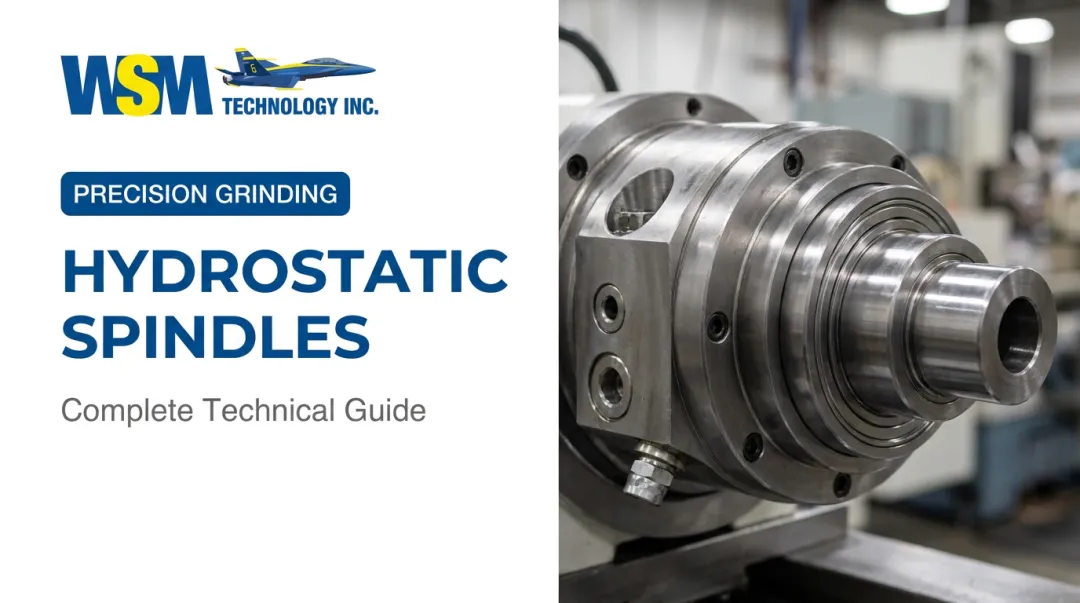
The operating mechanism centers on hydrostatic pockets — recessed regions in the bearing surface where pressurized oil enters. Each pocket is balanced by a compensator (a fixed restrictor or self-compensating orifice) that adjusts flow in response to load changes. When load increases on one side, the compensator restricts flow to the opposite pocket and increases it to the loaded side, maintaining a stable gap. This load-balancing mechanism is the source of the system's stiffness.

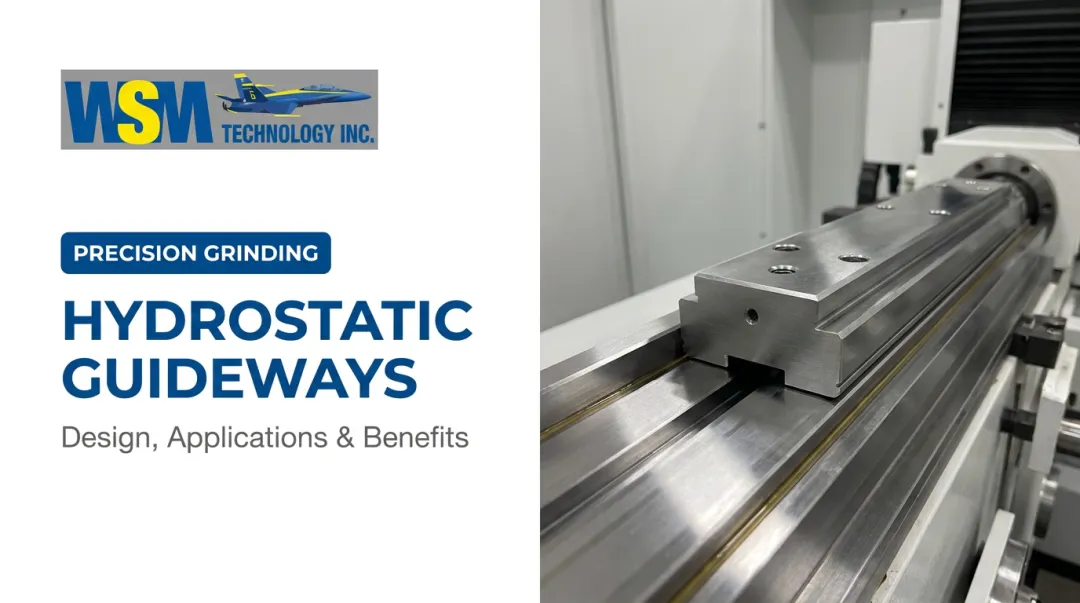
In advanced designs, the guideway profile wraps around the bearing elements — often an inverted T-slot configuration — with multiple pockets and compensators per block, all internally ported to a single supply line. This reduces external plumbing complexity and improves stiffness uniformity across the carriage.
The Role of Oil Viscosity and Temperature
Oil viscosity directly controls gap thickness and stiffness. New Way's hydrostatic slide unit investigation found that ISO VG 25 oil produced measurably greater stiffness than ISO VG 10 oil under comparable test conditions — a meaningful difference for engineers specifying a system.
Temperature compounds this directly. As oil temperature rises, viscosity drops, thinning the film and introducing dimensional drift. Engineers specifying hydrostatic systems should account for:
- Viscosity grade selection — higher grades (ISO VG 25 vs. VG 10) provide greater stiffness but are more sensitive to temperature swings
- Thermal drift risk — even modest temperature increases can shift gap dimensions enough to affect part accuracy
- Integrated temperature control — chillers or heat exchangers are a functional requirement in precision applications, not an optional upgrade
Analyzing Hydrostatic Slide Unit Performance: Key Metrics
Spec sheets tell part of the story. The gap between rated performance and real-world behavior under load and temperature is where problems hide. Four metrics matter most.
Static Stiffness
Static stiffness measures resistance to deflection under applied load — expressed in force per unit displacement (lbs/µin or N/µm). In hydrostatic systems, stiffness is tunable by varying supply pressure, which gives engineers a meaningful design lever.
The non-linearity, however, complicates the picture. Research from New Way Air Bearings tested hydrostatic slide units with oil film gaps of 0.0005"–0.0007" at both 300 psi and 500 psi. At 500 psi, retaining-way deflection exceeded 50% of the original hydrostatic gap — and stiffness dropped rather than increased. The machine base was deflecting more than the oil film could compensate for.
The practical implication: selecting a hydrostatic system requires evaluating machine base stiffness alongside supply pressure. Higher pressure doesn't guarantee better performance if the structure can't support it.
MM Science Journal's 2021 machine-tool study reinforces this: reducing film thickness from 20 µm to 5 µm at 10 MPa increased stiffness from 37 N/µm to 137 N/µm — nearly a 4× improvement. Gap geometry, then, is the primary stiffness lever — but tighter gaps demand correspondingly tighter surface quality and thermal control.

Dynamic Compliance and Natural Frequency
Dynamic compliance is the inverse of dynamic stiffness — high compliance means the system deflects more under oscillating forces, which translates directly to chatter in grinding and milling operations.
Hydrostatic systems perform exceptionally well here. New Way's investigation reports dynamic stiffness above 1,000,000 µin/lbs even at resonance. For machine tool builders, that number matters: chatter typically forces compromises in grinding wheel selection or cutting parameters.
A guideway system that maintains high dynamic stiffness through resonance expands the process window without mechanical changes.
Because hydrostatic stiffness is pressure-tunable, the system's natural frequency shifts with supply pressure — meaning the machine can be tuned at setup, or via active feedback, to move resonance away from problematic frequencies. No structural modifications required.
Stick-Slip and Smoothness at Low Speed
Stick-slip — sometimes called "crawling" — occurs when static friction exceeds kinetic friction at low speeds. In metal-on-metal or hardened slideways, this creates intermittent jerky movement that leaves micro-scratches on the workpiece and introduces positioning errors.
Hydrostatic slides eliminate stick-slip entirely. The oil film maintains consistent separation regardless of velocity, making static and kinetic friction values nearly identical. TAC Rockford documents that hydrostatic slides permit 0.1 µm movements without reversal backlash or stick-slip — a capability that conventional slideways cannot match.
Thermal Stability
Conventional slideways generate friction heat that causes thermal expansion and datum shift over long production runs. Hydrostatic slides reduce friction-generated heat significantly, but they introduce a different thermal challenge: oil temperature management.
As oil temperature rises during operation, viscosity decreases, film thickness changes, and positional accuracy drifts. The relationship is direct: warmer oil means thinner film means dimensional error.
Temperature-controlled oil supply — maintained at a consistent set point, typically around 20°C in research configurations — is not optional for high-precision applications. It's what keeps film thickness stable and dimensional accuracy consistent across extended production runs.
Key thermal management requirements:
- Maintain oil temperature within ±0.5°C of the set point during operation
- Size the chiller/heat exchanger for worst-case duty cycles, not average load
- Monitor viscosity grade against seasonal ambient temperature shifts
Hydrostatic vs. Hydrodynamic vs. Rolling Element Slides
Choosing guideway technology is an investment decision that affects machine uptime, surface quality, and accuracy over the machine's service life. Here's how the three primary technologies compare across the criteria that matter most.
Hydrostatic vs. Hydrodynamic Slideways
Hydrodynamic slideways generate their oil film through wedge action — the relative motion of sliding surfaces creates pressure. At high speeds, this works well. At startup, low feed rates, or during intermittent feed movements, the film breaks down and metal-to-metal contact occurs.
| Attribute | Hydrostatic | Hydrodynamic |
|---|---|---|
| Film generation | External pump | Surface motion (wedge action) |
| Low-speed capability | Full film at any speed | Film collapses at low/zero speed |
| Startup wear | None (film present at rest) | Metal contact during startup |
| Cost tier | Higher (pump, controls) | Lower |
| Typical applications | Precision grinding, EDM-adjacent milling, copying | Vertical boring, planing, high-speed sliding |
For micro-feed operations, precise grinding infeed, or any application requiring controlled motion near zero velocity, hydrostatic is the clear choice.
Hydrostatic vs. Rolling Element Slides
Rolling element guides — recirculating ball or roller systems — offer high stiffness and compact design at lower cost. They're the dominant choice for general CNC linear axes for good reason. But they carry two performance liabilities that compound over time:
- Preload degradation: Contact stiffness in rolling guides depends on preload, and preload degrades with use. Research modeling of linear rolling guides links preload loss directly to reduced contact stiffness — a slow accuracy drift that's difficult to reverse without disassembly.
- Limited damping: MM Science Journal's 2018 study found hydrostatic guideways reduced forced oscillation amplitude at the first eigenfrequency by 15 times compared to linear rolling-element guides. Schaeffler's hydrostatic compact guidance system specifies damping exceeding 470,000 kg/s — substantially higher than rolling contact alternatives.

Rolling element guides remain the practical choice where cost, simplicity, and compactness dominate. For sub-micron positioning, fine surface finish requirements, or applications demanding accuracy retention over years of continuous use, hydrostatic slides are demonstrably superior.
Danobat/Hembrug's Mikroturn platform, for example, specifies 1 µm positioning and 0.2 µm repeatability using fully hydrostatic slide and spindle systems. The company attributes that durability to the hydrostatic design itself, with documented accuracy retention beyond 25 years of service.
Where Hydrostatic Slide Units Are Used and How to Select the Right One
Primary Applications
Hydrostatic slide units appear consistently in applications where sub-micron positioning, vibration-free motion, and long-term dimensional repeatability are non-negotiable:
- Precision grinding machines — cylindrical, centerless, and surface grinders where surface finish and roundness tolerances are measured in fractions of a micron
- High-accuracy milling centers — particularly where thermal stability and chatter resistance define part quality
- EDM machines — ultra-smooth axis motion directly impacts surface integrity and electrode positioning
- Jig boring machines — bore location accuracy depends on guideway repeatability across the full stroke
- Coordinate measuring machines (CMMs) — where any friction or stick-slip contaminates measurement data
In each case, the guideway system isn't a background component — it's what separates acceptable parts from scrap. That reality shapes every decision in the selection process.
Selection Criteria
When evaluating a hydrostatic system, engineers should assess:
- Static stiffness matched to the actual load envelope, not just the peak rating
- Supply pressure range and the stiffness curve it produces — including the point where structural limits start eroding gains
- Oil viscosity grade and temperature control requirements — ISO VG selection directly affects gap thickness and load stiffness
- Pocket geometry and compensator type — fixed restrictors and self-compensating orifices behave differently under dynamic loads
- Machine base stiffness — New Way's testing at 500 psi is a clear warning here: if the base deflects more than the hydrostatic gap, higher pressure makes performance worse, not better

Maintenance Flags
Hydrostatic systems require less maintenance than conventional slideways. TAC Rockford documents one linear-motor guide application where upkeep consists solely of filter and oil changes — the constant oil flow actively pushes contamination away from guideway surfaces.
Warning signs worth monitoring include:
- Dimensional drift increasing over time — often indicates oil temperature creep or viscosity shift
- Pressure fluctuations in the supply circuit — may signal pump wear or filter restriction
- Stick-slip reappearing at low speed in a previously smooth system — suspect oil contamination or film thickness loss
- Oil temperature trending upward — a precursor to accuracy degradation before visible symptoms appear
How WSM Technology Supports Precision Manufacturing with Advanced Machine Solutions
For manufacturers in Northern Ohio, Western Pennsylvania, and West Virginia evaluating high-precision machine tools, WSM Technology serves as a technically grounded regional resource with direct access to machines engineered for demanding accuracy requirements.
WSM's portfolio includes brands like Hembrug and Danobat — purpose-built for precision grinding and hard turning with hydrostatic and roller guideway designs — alongside the JINGDIAO High Speed 3 and 5-Axis Milling systems and Mitsubishi EDM platforms. These machines are built for the kind of long-term dimensional stability that precision guideway design enables.

WSM's Demonstration Center in Rootstown, Ohio gives manufacturers a practical option: evaluate machine performance hands-on before purchase. The team offers:
- Test cuts using your material and part geometry
- Time studies for cycle time and throughput analysis
- Application engineering support to match machine configuration to your accuracy and production requirements
Founder Blaise Buholzer brings over four decades of precision manufacturing experience: a four-year Swiss apprenticeship in precision mechanics, formal mechanical engineering training, and a career that began as an Application Engineer on wire and die-sinker EDM machines at Charmilles. That background shapes how WSM approaches machine selection — starting with your application requirements, not the product catalog.
For shops where slideway performance, accuracy retention, or vibration damping matters to your application, contact WSM Technology at sales@wsmtechnology.com or call (330) 962-8308 to discuss your application.
Frequently Asked Questions
What does hydrostatic mean?
In lubrication engineering, "hydrostatic" refers to a pressurized fluid in a static or near-static pressure state. In machine tools, it describes a system where fluid under constant external pressure creates a load-bearing film that supports moving components without surface contact The pressure is maintained by an external pump, not by motion.
How does a hydrostatic bearing work?
An external pump supplies pressurized oil into recessed pockets between bearing surfaces. The pressurized film lifts and separates the surfaces, while compensators automatically adjust flow to maintain a stable gap as loads change , preventing metal contact under both static and dynamic conditions.
What's the difference between hydraulic and hydrostatic?
"Hydraulic" refers broadly to any system using pressurized fluid to transmit force or motion, such as hydraulic cylinders and clamping systems. "Hydrostatic," in the machine tool context, specifically refers to a pressurized fluid film that supports and separates bearing surfaces — a subset of hydraulic technology focused on frictionless guidance rather than force transmission.
What is the difference between hydrostatic and hydrodynamic slideways?
Hydrodynamic slideways generate their oil film through sliding motion speed; the film collapses at low or zero speed, causing metal contact. Hydrostatic slideways generate the film externally via a pump, maintaining full separation at all speeds including standstill. This makes hydrostatic the correct choice for slow, precise, or intermittent feed movements.
What are the main advantages of hydrostatic slide units in precision machining?
Key advantages include:
- Eliminates stick-slip for smooth low-speed motion
- Near-zero wear for sustained long-term accuracy
- High damping — up to 15× better than rolling guides
- Tunable stiffness via supply pressure adjustment
- Sub-micron positioning: 1 µm accuracy, 0.2 µm repeatability in production use
What types of machines commonly use hydrostatic slide units?
Precision grinding machines (cylindrical, centerless, surface), jig boring machines, high-accuracy machining centers, coordinate measuring machines, and EDM platforms where ultra-smooth, wear-free motion is critical to long-term dimensional accuracy and surface integrity.