
It's the component that makes precision bore work possible at all. Understanding how it works, and why it's built the way it is, helps shops make smarter decisions about equipment, outsourcing, and process planning.
This article covers what an internal grinding spindle is, its key components, how it differs from external (OD) spindles, common applications, and how to tell if your shop actually needs this capability in-house.
Key Takeaways
- Internal grinding spindles spin small wheels at extreme speeds to finish a workpiece's bore.
- Bore size limits wheel diameter, so these spindles run far faster than external grinding spindles.
- Rigidity, bearing precision, and balance determine bore roundness, straightness, and finish.
- Shops use internal grinding when boring or turning can't hold tolerance, or hardened parts need correction.
What Is an Internal Grinding Spindle?
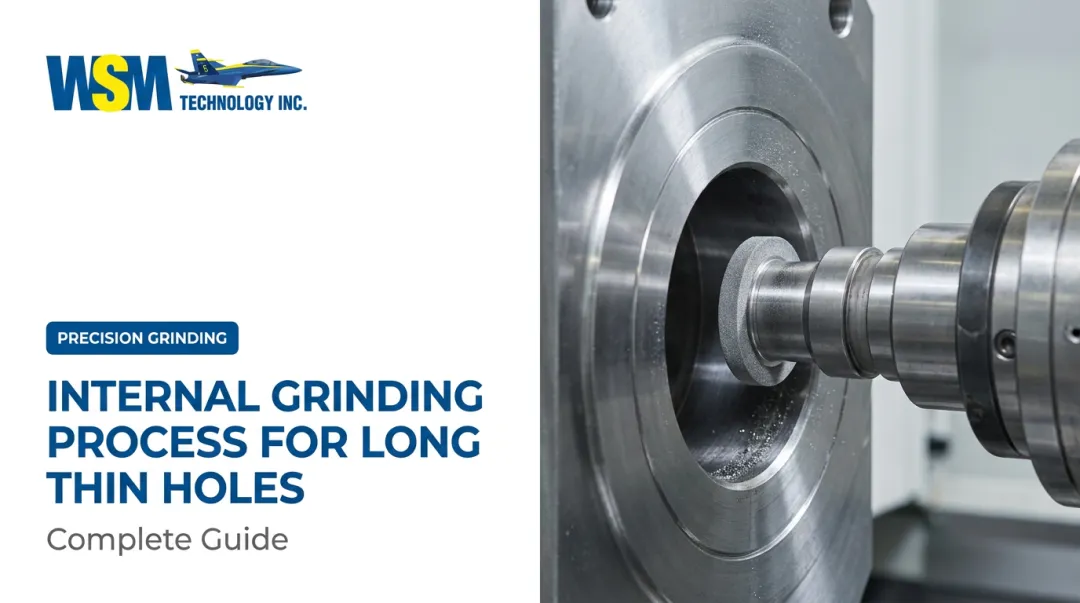
An internal grinding spindle is the rotating unit inside an internal (ID) grinder. It holds a small-diameter grinding wheel and spins it at high speed to remove material from the inside of a bore. Think of it as the engine of the operation: everything else on the machine exists to position and support this one spinning assembly with extreme accuracy.
The setup flips the typical grinding arrangement. In external grinding, the workpiece spins against a large stationary or rotating wheel. In internal grinding, the part usually sits still (or rotates slowly in a chuck) while the spindle-driven wheel works inside the bore itself.
Two terms get used interchangeably, but they're not the same thing:
- Grinding spindle — the physical hardware: motor, bearings, shaft, and wheel interface
- Internal grinding — the broader machining process this hardware performs
Why High Speed Matters
Bore diameter caps wheel diameter. A wheel grinding a half-inch bore might only be a few tenths of an inch across. To maintain effective cutting speed at the wheel's surface, the spindle has to spin dramatically faster than it would with a larger wheel.
A standard grinding-speed formula captures the relationship simply: new RPM equals original RPM times original diameter, divided by current diameter. Shrink the wheel, and RPM has to climb to keep surface speed constant.
That's why internal grinding spindles routinely reach speeds unheard of elsewhere in machining. GMN's high-speed grinding spindle catalog lists internal-grinding models spanning 20,000 to 250,000 RPM, with the smallest-bore spindles running fastest. STUDER's S121 and S151 internal cylindrical grinders top out at 120,000 RPM. These aren't universal limits, but they show how far manufacturers push spindle speed to keep small wheels effective.

Why Rigidity and Precision Matter
Here's the part that trips up shops new to ID grinding: you can't see what's happening. The wheel is buried inside the bore. There's no visual feedback on contact, wear, or deflection.
That means spindle rigidity and vibration control are non-negotiable, not nice-to-haves. Small issues show up immediately:
- Deflection in the shaft
- Looseness in the bearings
- Imbalance in rotation
Any one of these produces an out-of-round bore, a tapered hole, or chatter marks on the finish, with no operator glance to catch the problem mid-cut.
Key Components of an Internal Grinding Spindle
Every internal grinding spindle shares a handful of core components, and each one has an outsized effect on bore quality.
Spindle shaft. This transfers rotational power from the motor to the wheel. At speeds reaching six figures, even microscopic runout translates into visible bore error. Straightness and concentricity here are core specifications, the baseline that every other component in the spindle depends on.
Bearings. High-precision angular contact bearings, often hybrid ceramic designs, keep the shaft rigid while managing heat. SKF's super-precision bearing catalog notes that hybrid bearings use silicon nitride rolling elements roughly 60% lighter than steel, cutting centrifugal loading at high speed while also running cooler. That combination of lighter mass and improved rigidity is exactly what extreme RPM demands.
Motor and drive type. Three general approaches show up across the industry:
- Belt-driven — motor power transmits through a belt and pulley, allowing torque/speed flexibility
- Direct-drive — motor couples straight to the spindle shaft, no belt or gear stage
- Built-in motor — the motor lives inside the spindle housing itself, minimizing vibration sources
Each trades off differently between torque, precision, and footprint, and the right choice depends on the bore size and material being ground. That decision also shapes how the wheel itself mounts to the shaft.
Tool/wheel interface. The wheel mounts via a quill, arbor, or similar interface. Secure, repeatable mounting matters more than it sounds, because any looseness here reintroduces the same runout problems the bearings were built to eliminate.
Cooling and lubrication. Spinning at tens of thousands of RPM generates real heat. Water-cooled or air-cooled jackets and dedicated lubrication channels protect bearing life and keep the spindle dimensionally stable during long production runs.
Balance. At these speeds, even a tiny imbalance creates vibration that shows up as chatter or an out-of-round bore. Manufacturers dynamically balance every spindle before it ships, treating it as a core build requirement rather than an afterthought.

Internal Grinding Spindles vs. External (OD) Grinding Spindles
Shops that only run external grinding often underestimate how different internal grinding really is. The two processes share a category, but the equipment and technique diverge sharply.
| Factor | Internal (ID) Grinding | External (OD) Grinding |
|---|---|---|
| Wheel size | Small, constrained by bore diameter | Larger, less restricted |
| Typical speed | Tens of thousands to 100,000+ RPM | Comparatively lower RPM |
| Visibility | Blind, no direct view of contact | Operator sees wheel-to-part contact |
| Common methods | Longitudinal and plunge grinding | Longitudinal, plunge, deep, and face/shoulder grinding |
The visibility gap is a bigger deal than it might seem. Modern Machine Shop reported on a control system that used acoustic-emission sensing to detect the exact moment the wheel first touched the bore, eliminating guesswork around the air gap. That's the kind of technology internal grinding setups lean on, since the operator simply can't watch it happen.
Beyond the visibility challenge, external grinders also have more process flexibility. They can run deep grinding and hybrid face/shoulder operations that internal grinders generally can't match, since ID work is largely limited to longitudinal and transverse plunge grinding.
That said, plenty of shops now run universal grinding machines that combine both external and internal spindle capability on one platform. This cuts down on part handling and re-fixturing, which matters a lot when you're chasing tolerances measured in microns. WSM Technology supplies both dedicated OD/ID grinders and universal platforms, helping shops match the right spindle setup to the job at hand.
Types and Applications of Internal Grinding
Internal grinding spindles show up across a range of operations, each solving a slightly different bore-finishing problem.
ID (bore) grinding finishes the inside diameter of parts like bearing housings, hydraulic cylinders, bushings, and dies. Shorter parts are typically held in a chuck or on a magnetic chuck during the operation.
Thread grinding handles precision threads on hardened parts. A shaped grinding wheel synchronizes with the part's rotation and pitch to cut the thread form.
Tap-and-die methods can't cut fully hardened material. Thread grinding solves this by letting a shop finish the thread after heat treatment instead of before, avoiding the distortion that comes from hardening an already-cut thread.
Tapered internal grinding produces conical internal surfaces designed to mate precisely with another part, often requiring a fine surface finish to seal or seat correctly.
Industries leaning on these processes include:
- Mold and die components
- Hydraulic and pneumatic assemblies
- Bearing races and rings
- Aerospace bushings
- Micro-mechanical and medical components
WSM Technology's precision grinding lineup, including OD/ID and cylindrical machines, serves many of these same industries, from mold and die shops to aerospace bushings work.
Precision benchmarks vary by application, but they illustrate what the technology enables. STUDER's internal grinding applications report notes spindle-component production holding coaxiality below 1 micron, roughly 40 microinches.
That's an example from one application, not a universal guarantee, but it shows the level of accuracy internal grinding spindles are built to deliver on demanding work.

When Does Your Shop Need Internal Grinding Capability?
Not every shop needs an internal grinder sitting on the floor. But a few signals usually mean it's time to have the conversation:
- Turning or boring can't hold the required bore tolerance, especially on precision fits or sealing surfaces
- The material is hardened and resists conventional cutting tools entirely
- Heat-treated parts distort, and the bore needs correction to bring it back to print after hardening
Skip this capability and the costs show up quietly:
- Scrap and rework pile up on tolerance-critical bores
- Lead times stretch when parts ship out to a grinding vendor and back
- Shops lose bids outright when the job requires a finished bore they can't produce
Closing that gap starts with matching the right grinder to the job. WSM Technology works with mold and die, micro molding, and precision mechanics shops across Northern Ohio, Western Pennsylvania, and West Virginia that run internal grinding alongside EDM, milling, and turning.
Machines in WSM's lineup, including Danobat OD/ID grinders and Overbeck external/internal grinders, are built specifically for this kind of bore-finishing work.
If you're weighing whether to add this capability or keep outsourcing it, WSM's Demonstration Center, test cuts, and time studies can help you evaluate how a bore-finishing step actually fits your process. Talk to an applications engineer about your specific bore tolerance, material, and volume before committing to new equipment.
Frequently Asked Questions
What is the difference between an internal grinding spindle and an external (OD) grinding spindle?
Internal spindles use small, high-RPM wheels to finish bores from the inside. External spindles use larger wheels running at comparatively lower RPM to finish outside diameters.
What RPM does an internal grinding spindle typically run at?
RPM scales inversely with bore and wheel diameter, so smaller bores demand faster spindles. Industry examples range from roughly 20,000 RPM up to 250,000 RPM depending on the wheel size involved.
What industries rely most on internal grinding spindles?
Mold and die, aerospace, hydraulics, bearing manufacturing, and micro-mechanical or medical component production all depend heavily on internal grinding for precision bore work.
How is an internal grinding spindle different from a dressing spindle?
A dressing spindle uses diamond rollers to sharpen and true the grinding wheel's profile. The grinding spindle performs the actual material removal on the workpiece itself.
Can internal grinding spindles handle very small bore diameters?
Yes, but the tightest bores require specialized, extremely high-RPM spindles and careful setup, since the bore itself constrains how large the wheel can be.
How do you maintain or troubleshoot an internal grinding spindle?
Monitor balance and vibration regularly, check coolant flow and temperature, and inspect the wheel interface for looseness. For anything beyond routine checks, contact OEM service.