
Yet the term gets thrown around constantly without much explanation. Many shop owners and engineers hear "CNC" in nearly every sales pitch but never get a straight answer about how it actually works, what machine types exist, or how to pick the right one.
This guide breaks down what CNC stands for, how the technology works, the major machine categories (including EDM), the real benefits, where it's used, and how to choose a CNC equipment partner who won't leave you guessing after the sale.
Key Takeaways
- CNC (Computer Numerical Control) automates machine tools, replacing manual handwheels with programmed precision.
- Beyond milling and turning, CNC also powers EDM (wire, sinker, micro), plasma, and waterjet cutting.
- Machine type, brand, and dealer support directly shape productivity, quality, and long-term ROI.
- Mold and die, aerospace, automotive, and medical manufacturers rely on CNC for tight tolerances.
What Is CNC Machining & How Does It Work?
CNC stands for Computer Numerical Control — the automated operation of machine tools through computer software instead of a human turning dials and cranking handwheels.
CNC replaced older numerical control (NC) systems that ran on punched cards and magnetic tape. That shift wasn't instant.
NC machines debuted at the 1960 Machine Tool Show reading instructions straight off punched tape, and by 1976 the National Bureau of Standards found that only 30% to 50% of NC machine tools used computer-assisted programming. CNC as we know it today grew out of that decade-plus transition, not a single overnight upgrade.
Manual Machining vs. CNC Machining
The core difference from manual machining comes down to who's driving. In manual machining, an operator physically guides the cutting tool, watching gauges and adjusting by feel. In CNC machining, a programmed part file dictates:
- Every tool movement and path
- Cutting speed and feed rate
- Depth of cut at each pass
The machine executes the program exactly the same way, part after part, without operator fatigue or judgment calls creeping into the geometry.
The CAD-to-CAM-to-G-Code Workflow
Getting from a design to a finished part follows a consistent sequence:
- Design the part in CAD (computer-aided design) software, creating the 3D model and dimensional specs.
- Translate the model into machine-executable instructions using CAM (computer-aided manufacturing) software, generating G-code (motion commands) and M-code (machine functions).
- Load the program into the machine's control unit.
- Run a trial cut so an operator can verify the program before full production starts.
That trial run matters more than it sounds. A single programming error caught in a test cut is an inconvenience. The same error caught mid-production run can mean a scrapped tool, a damaged spindle, or a ruined workpiece.

Axes, Motion Control & Precision
CNC machines move along X, Y, and Z linear axes, with multi-axis machines adding rotary A, B, or C axes for angled or simultaneous cutting. More axes mean more complex geometries in fewer setups: a part that once required three separate fixturings might now finish in one.
Precision also depends on control architecture. Closed-loop systems use feedback (linear scales or encoders) to continuously check and correct actual tool position against the programmed path. Open-loop systems assume the command was executed correctly, with no verification.
That feedback loop is why closed-loop control is the industry standard for tight-tolerance work. A documented five-axis machining center, for example, achieved ±0.5-micron positional accuracy and held bore tolerances to +1.5/-0 microns in a fiber-optic connector application.
That's a specialized machine built for a specific job, not a baseline every CNC hits, but it shows what closed-loop precision makes possible at the high end.
Types of CNC Machines & Processes
CNC technology covers a family of processes, each suited to different geometries, materials, and production volumes.
CNC Milling Machines
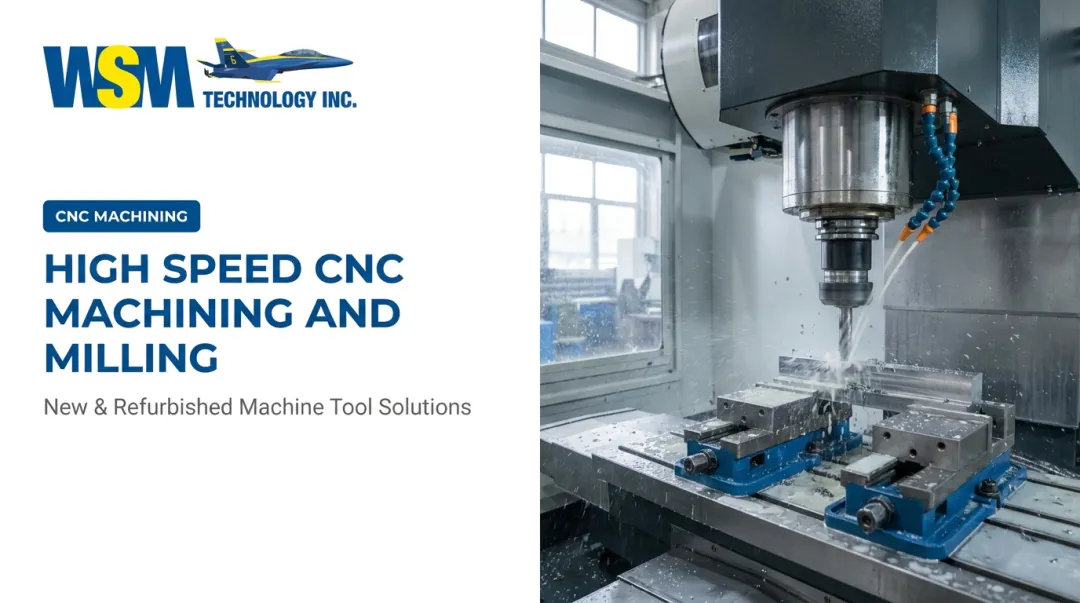
Milling centers use rotating cutting tools to remove material from a stationary (or indexed) workpiece. Two configurations dominate:
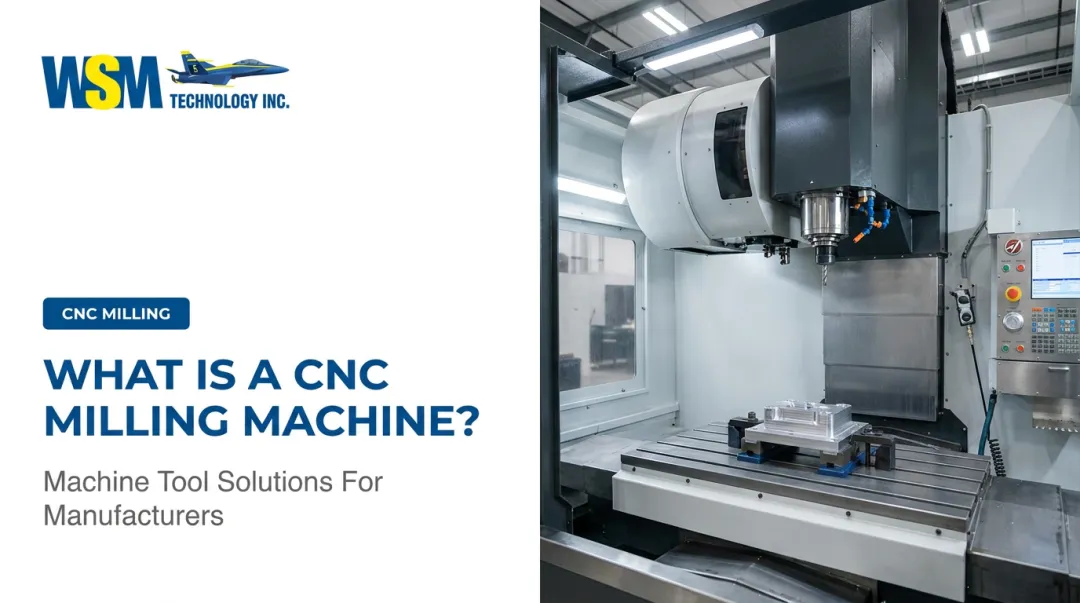
- Vertical machining centers (VMCs): spindle oriented vertically for straightforward setup, well suited to one-sided parts like brackets or plates.
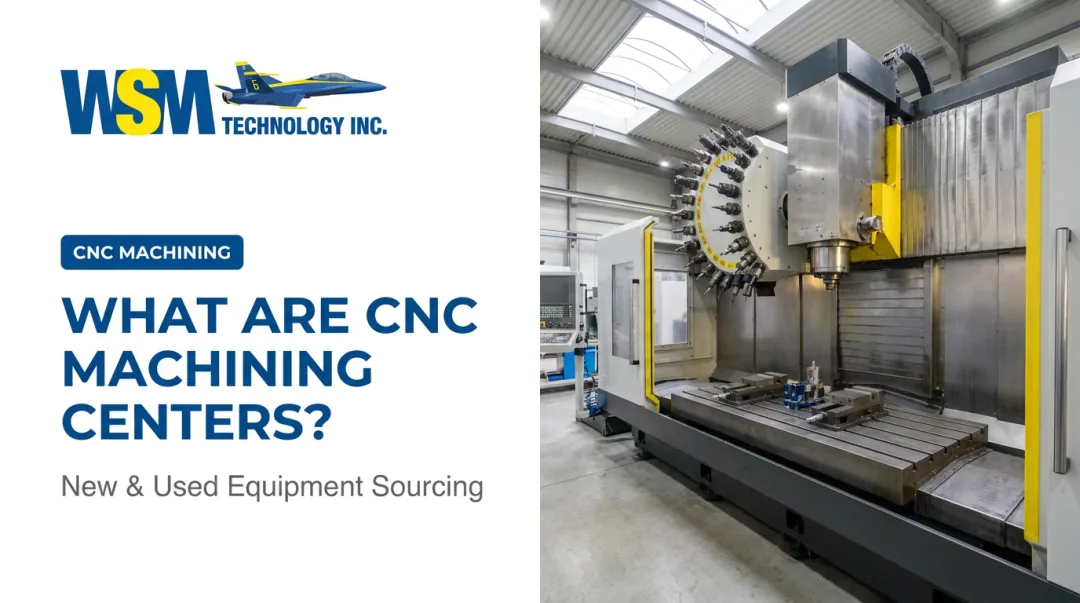
- Horizontal machining centers (HMCs): spindle oriented horizontally, where gravity assists chip evacuation for heavier cutting and multi-sided workpieces.
Multi-axis milling (3, 4, or 5-axis) adds rotary motion for complex, multi-sided geometry without repositioning the part.
WSM Technology represents several brands across this spectrum, from OPS Ingersoll's high-speed machining centers and graphite mills (used for EDM electrode production) to the Roku-Roku Android II. This 3-axis high-speed mill holds ±1-micron accuracy at 60,000 RPM, making it ideal for ultra-precision mold work and jig grinding.
CNC Lathes (Turning Centers)
Lathes flip the setup: the workpiece rotates while a stationary tool cuts against it. That configuration makes turning centers the go-to choice for cylindrical, symmetrical parts (shafts, bushings, fittings) cut at high speed with consistent precision.
WSM Technology's turning lineup includes Schaublin, a Swiss manufacturer with over a century of precision turning experience, and ROMI. ROMI's turning centers and CNC lathes cover standard turning, hard turning of difficult alloys, and combined turn/grind operations on a single platform.
CNC EDM (Electrical Discharge Machining)
EDM skips physical cutting entirely. Instead, it erodes material using controlled electrical sparks between an electrode and the workpiece. The process only works on electrically conductive materials, but it handles hardened metals and intricate geometry that conventional cutting tools can't touch.
Three EDM variants cover different needs:
| EDM Type | How It Works | Best For |
|---|---|---|
| Wire EDM | Charged wire erodes profiles without tool contact | Precise profiles, hard metals |
| Sinker (die-sinking) EDM | Shaped electrode forms cavities | Mold and die cavities, complex detail |
| Micro EDM | Wire/sinker mechanisms scaled to tiny features | Micro molding, micro mechanics |
WSM Technology's EDM portfolio reflects this range directly. Through its Mitsubishi/MC Machinery partnership, the company supplies wire EDM (including the MV1200S with linear shaft motors and intelligent auto-threading) and sinker EDM systems for die work.
Its Sarix line covers micro EDM milling and micro hole drilling for micro molding, aerospace, and textile applications. This range shows how one EDM technology category stretches from mold shops to sub-millimeter mechanics.
Other CNC-Controlled Processes
CNC control also drives cutting methods beyond milling, turning, and EDM:
- Plasma cutting: uses ionized gas to cut electrically conductive metals, well suited to productive cutting of thicker stock like mild steel and stainless steel.
- Waterjet cutting: a cold process with no heat-affected zone, useful when heat could alter material properties.
- CNC routing: handles softer materials like plastics and composites where a rotating cutter suffices.

Benefits of CNC Machining
CNC's biggest advantage is consistency. A CNC machine holds the same tolerance on part 1 and part 10,000, something manual machining struggles to guarantee once operator fatigue enters the picture.
Beyond accuracy, shops running CNC equipment typically see:
- Lower labor overhead since one operator can often oversee multiple running machines
- Less material waste through programmed, optimized tool paths
- Faster cycle times on repeat jobs once a program is proven out
- Safer working conditions with less direct operator contact with cutting tools
There's also a complexity advantage worth calling out. Multi-axis milling and EDM can produce geometries, including undercuts, micro-fine cavities, and hardened-steel details, that traditional cutting simply can't reach. WSM Technology founder Blaise Buholzer has built his career on this idea: optimizing machine utilization and performance is the real payoff of investing in CNC equipment.
Industries & Applications of CNC Machining
CNC precision touches more sectors than most people realize, and the market reflects it.
Grand View Research valued the CNC machining and turning centers market at $25.9 billion in 2023, a footprint most people don't associate with this technology.
Industries leaning heavily on CNC and EDM precision include:
- Mold and die making: sinker EDM and graphite milling produce detailed cavities in hardened tool steel
- Aerospace: tight-tolerance components requiring both EDM and multi-axis milling
- Automotive: production parts plus tooling for molds, casting dies, and forging
- Medical devices: precision components where micron-level consistency isn't optional
- Micro molding and micro mechanics: increasingly reliant on specialized micro EDM as parts shrink and features get finer
That last category deserves a second look. As parts get smaller and more geometrically demanding, standard-scale CNC and EDM technology often can't keep up. Specialized micro EDM equipment, like the Sarix line WSM Technology represents across Ohio, Pennsylvania, West Virginia, Michigan, Indiana, and Kentucky, exists specifically to fill that gap.
Choosing the Right CNC Machine Partner
Buying a CNC or EDM machine is never just an equipment purchase. Installation, training, and ongoing technical support determine whether that machine actually performs to spec once it's on your shop floor.
A good dealer relationship should include:
- Multi-brand access so machine choice is based on your application, not one manufacturer's catalog
- Hands-on evaluation before you commit capital
- Installation and training included, not billed separately after the fact
- Ongoing technical support for programming, maintenance, and troubleshooting
WSM Technology operates this way as a multi-brand dealer representing Mitsubishi/MC Machinery, Sarix, Roku-Roku, Schaublin, ROMI, OPS Ingersoll, Cheto, and Titan. Rather than pushing a single product line, the company matches machine type to the customer's actual part geometry, material, and volume requirements.
Its Demonstration Center in Rootstown, Ohio gives shops a place to run test cuts and time studies before buying. This lets you compare a candidate machine's real cycle times and output quality against your current production, not just a spec sheet. That kind of validation matters whether you're looking at a brand-new five-axis mill or a refurbished wire EDM unit.

If you're evaluating new, used, or refurbished CNC or EDM equipment, work with an experienced regional dealer who can walk your specific application through a demo cut. That extra step, taken before you sign a purchase order, is worth it.
Frequently Asked Questions
What does CNC mean in machining?
CNC stands for Computer Numerical Control — the automated, computer-driven operation of machine tools using pre-programmed software instead of manual controls. It replaced earlier punched-tape NC systems starting in the 1960s and 70s.
What is the difference between CNC machining and manual machining?
CNC machining runs from a programmed file that controls every tool movement, speed, and depth automatically and repeatably. Manual machining relies on an operator physically guiding the cutting tool using handwheels and levers.
What materials can be CNC machined?
Common materials include aluminum, steel, titanium, and various plastics, all machinable across CNC milling, turning, and EDM processes. EDM specifically requires electrically conductive materials, since it cuts using electrical sparks rather than physical contact.
Is CNC machining expensive?
Costs vary widely by machine type, part complexity, and production volume: new five-axis mills and EDM systems can run into six figures, while used or refurbished equipment costs far less. Over time, CNC often lowers total costs through less waste, faster cycles, and fewer scrapped parts.
How do I know which type of CNC machine I need?
The right machine depends on part geometry, material, required tolerance, and production volume: a simple bracket needs different equipment than a hardened mold cavity. Consulting a dealer that offers test cuts or demo evaluations, like WSM Technology's Rootstown center, helps confirm the choice before purchase.
What training is required to operate a CNC machine?
Operators typically combine manufacturer training, on-the-job experience, and certifications such as NIMS credentials for CNC milling and turning. Many equipment dealers also include installation training and advanced programs with the purchase.