
The stakes are real: an ill-matched machine means costly downtime, blown tolerances, or paying for five-axis taper capability you'll never use. The market reflects this urgency. Future Market Insights projects the wire-cutting EDM market growing from $2.68 billion in 2025 to $4.58 billion by 2035, a 5.5% CAGR driven by aerospace complexity, mold and die demand, and Industry 4.0 automation.
This guide breaks down what actually matters when buying a wire EDM machine, so you spend on capability your shop needs, not marketing specs.
Key Takeaways
- Wire EDM cuts conductive metal using spark erosion, not mechanical force
- Machine fit depends on complexity, envelope, generator tech, automation, and total cost
- Burr-free cuts and hardened-alloy capability make wire EDM vital for mold, die, and aerospace work
- A structured decision framework beats brand loyalty, especially with test-cut and training support
What Is a Wire EDM Machine?
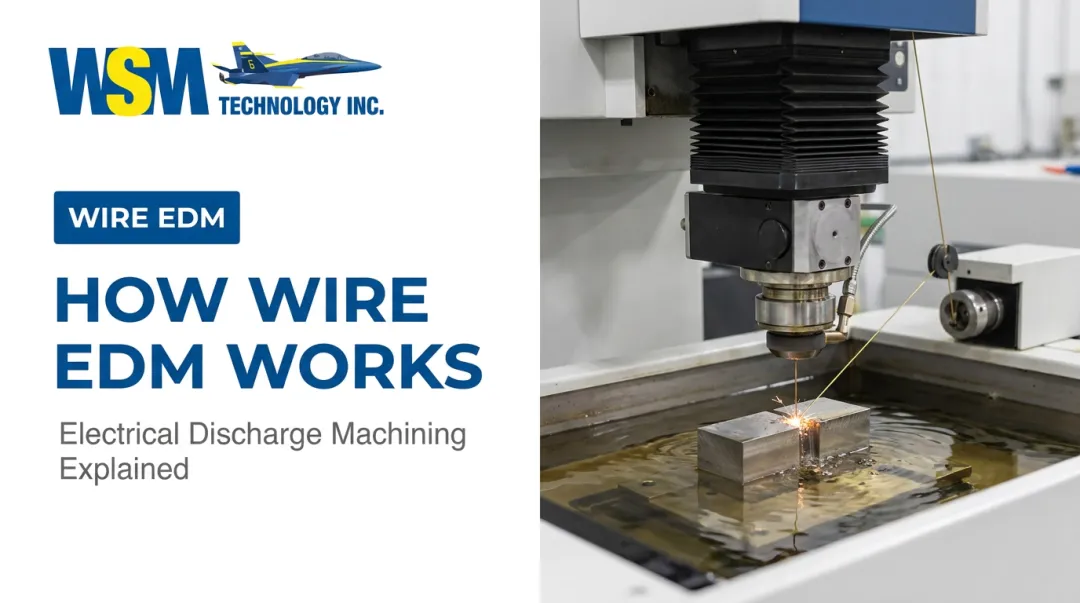
A wire EDM machine is a subtractive manufacturing tool that uses a continuously traveling, electrically charged wire to erode conductive material through rapid spark discharges. The wire never touches the part. Instead, thousands of controlled sparks per second vaporize material along the cut path.
Two dielectric approaches dominate the market:
| Dielectric Type | Key Characteristics |
|---|---|
| Deionized water | Supports high pulse frequencies and fast flushing; common in most production shops |
| Oil | Ionizes more slowly, trading speed for finer finishes and specialist accuracy on carbide and small-detail work |
Machines also split by axis capability. Standard 4-axis machines (X, Y, U, V) handle most mold and die work. Advanced 5-axis machines add Z-axis positioning for complex taper-cutting and 3D profile generation.
Core Components That Determine Performance
Every wire EDM machine's real-world performance comes down to four functional systems working together. Understanding each helps you evaluate specs beyond a sales sheet.
Wire electrode and spool feed system. Wire diameter, material composition, and tension consistency directly affect cut speed and finish quality. Plain brass wire (roughly 63% copper, 37% zinc) is the industry standard, typically rated between 54,000 and 130,000 psi tensile strength. Zinc-coated and multilayer wires cool faster and cut quicker, especially on tall workpieces.
Dielectric fluid and flushing system. Deionized water flushes eroded debris from the kerf while controlling resistivity, which stabilizes the spark gap. Modern systems flush at pressures up to 300 psi. Poor flushing means unstable cuts and slower throughput, regardless of how strong the generator is.
CNC controller and drive system. This is where linear motor and ball screw drives diverge. Linear motor-driven axes eliminate the mechanical backlash and wear inherent to ball screws, improving repeatability across long, unattended runs.
The Mitsubishi MV1200S, available through WSM Technology, illustrates this well: it runs linear shaft motors on both X and Y axes paired with linear glass scales for closed-loop feedback, a setup built for shops that can't afford drift over a 20-hour cut.
Automatic Wire Threading (AWT) system. When wire breaks mid-cut, AWT re-threads automatically instead of waiting for an operator. FANUC's ROBOCUT line specifies automatic threading in as little as 10 seconds, which is what makes true lights-out operation possible overnight.

Benefits of Wire EDM
Wire EDM earns its place in mold, die, aerospace, and precision mechanics shops because it solves problems conventional cutting can't.
- Burr-free finishes — no secondary deburring operation needed on most cuts
- No mechanical cutting force — the non-contact process avoids the clamping and tool-pressure stresses that warp thin or delicate parts
- Hardened and exotic material capability — cuts titanium, carbide, Inconel, and hardened tool steel that dull conventional tooling
- Micron-level tolerances — holds tight dimensional accuracy on complex geometries
- Reduced material waste — thin kerf widths mean less scrap on intricate profiles
One caveat worth knowing before you buy: wire EDM does not produce "zero residual stress," despite what some marketing claims. NASA's 2023 wire-EDM testing on nickel superalloys found tensile residual stress extending roughly 10 to 20 microns below the cut surface. If your application demands stress-free surfaces, discuss finish-pass strategy and recast-layer requirements with your machine partner before you cut. WSM Technology's application engineers can run test cuts to validate finish-pass parameters before you invest.
What to Consider When Choosing the Best Wire EDM Machine
The best wire EDM machine depends on your part mix, volume, and budget, not a one-size-fits-all standard. The factors below connect technical specs to shop-floor outcomes: cycle time, scrap rate, and uptime.
Part Complexity and Precision Requirements
Micron-level accuracy needs should dictate generator quality and axis-control precision, not the other way around. Tighter tolerances and finer surface finish (Ra) requirements demand better pulse control and rigid drive systems. This directly affects first-pass yield, the percentage of parts that pass inspection without rework.
Work Envelope and Part Size
Table size, Z-axis height, and taper-cutting range must match your largest and most complex parts. A machine that can't fit your biggest mold plate means outsourcing that work and losing the margin on it. The KPI here is simple: how much of your quote scope can you actually keep in-house?
Generator Technology and Cutting Speed
Transistor-controlled pulse generators outperform older RC-type systems on speed and finish quality. Laboratory testing on tungsten carbide found transistor-controlled generators delivering 2 to 3 times the machining speed of conventional RC generators, though results vary by material and topology. This affects your parts-per-hour throughput and per-part energy cost directly.
Automation and Unattended Operation Capability
Auto wire threading, submersible tank automation, and robotic part loading extend lights-out running time. A machine that can recover from a wire break at 2 a.m. and keep cutting until your operator arrives changes your entire utilization math. Track this through machine utilization rate and labor cost per part.
Total Cost of Ownership
Purchase price is one line item. Wire consumption, filter and consumable costs, energy use, and maintenance frequency compound over the machine's life. MC Machinery claims its MV Series reduces wire consumption by up to 40% compared to prior generations. That kind of detail changes your cost-per-part math over a five-year ownership window. Request job-specific consumption data before you buy, not a generic brochure figure.
Local Service, Parts Availability, and Training Support
A machine is only as good as the support behind it. Fast OEM parts delivery and on-site service reduce mean time to repair (MTTR) and protect overall equipment effectiveness (OEE). Regional dealers with demo centers (like WSM Technology in Northern Ohio, Western Pennsylvania, and West Virginia) let you validate a machine on your own parts through test cuts and time studies before committing capital.

How WSM Technology Can Help
WSM Technology is the authorized Mitsubishi/MC Machinery wire EDM dealer serving Northern Ohio, Western Pennsylvania, and West Virginia. The team guides shops from initial machine selection through installation and beyond.
You can run real test cuts and time studies on your own parts at WSM's demonstration center at 3393 Industry Rd in Rootstown, Ohio, before committing to a purchase.
This lets you see how a machine like the Mitsubishi MV1200S — with linear shaft motors, linear glass scales, and Mitsubishi M800 control — performs on your actual geometry. It's not a sample part chosen to flatter the machine.
Two team members bring hands-on shop-floor experience to every conversation.
Founder Blaise Buholzer started as an application engineer on wire and die-sinker EDM machines at Charmilles in 1985, later working through R&D, training, and technical sales roles. Phillip Warlop Jr. ran sinker EDM machines and CNC programming at Ohio mold shops for over a decade before moving into plant management.
Beyond selection, WSM differentiates on what happens after the sale:
- Local training and advanced training programs for operators
- Immediate OEM replacement parts through MC Machinery's parts network
- EDM consumables supply (wire, filters, resin tanks) through the affiliated CPG Department
- Both new machines (like the MV1200S and MV2400) and refurbished options through MC Machinery's Encore Group, including used units like the FX10 starting at $14,500

Conclusion
Choosing a wire EDM comes down to matching the machine to your part complexity, production volume, and budget priorities, not chasing the most popular brand. Automation, total cost of ownership, and local support often matter more over five years than the sticker price does on day one.
Production needs change. The machine that fit your shop three years ago might not fit the aerospace contract you're bidding on now. Partnering with WSM Technology for periodic test cuts and setup adjustments keeps that investment performing as your production needs evolve.
Frequently Asked Questions
How much does a new wire EDM machine cost?
Pricing varies widely based on work envelope, generator technology, and automation level, so request a quote based on your specific part requirements rather than comparing list prices across brands.
Is wire EDM faster than waterjet cutting?
Waterjet generally cuts faster on thick material but holds looser tolerances (typically 0.003 to 0.005 inch). Wire EDM trades some speed for micron-level accuracy on conductive materials.
What type of wire is used in a wire EDM machine?
Brass is the most common wire material, though zinc-coated and multilayer wires improve cutting speed and reduce breakage, especially on taller or more demanding cuts.
What is the difference between wire EDM and sinker EDM?
Wire EDM uses a continuously moving wire electrode for thin-kerf, through-cut profiles. Sinker EDM uses a shaped electrode to burn cavities and blind features, like mold cores.
How accurate is a wire EDM machine?
Modern wire EDM machines can hold tolerances within a few microns, depending on machine quality and generator technology, with specialist models pushing even tighter, down to sub-micron positioning.
Should I buy a new or refurbished wire EDM machine?
Refurbished machines offer lower upfront cost with OEM-standard reconditioning and warranty coverage, while new machines offer current technology and typically longer warranty terms. The right choice depends on your production volume and tolerance requirements.