
This guide covers where the FA20 came from, what it can actually do, and how it stacks up against Mitsubishi's current wire EDM lineup. We also pulled in perspective from WSM Technology, a Mitsubishi/MC Machinery dealer based in Rootstown, Ohio, serving shops throughout the region.
Key Takeaways
- FA20-S Advance: Mitsubishi flagship wire EDM platform introduced around 2007
- Advance CNC with ball-screw axes—a generation behind today's linear-motor systems
- Well-maintained units log 10+ years in mold, aerospace, and automotive shops
- Weigh maintenance costs against productivity gains from current Mitsubishi models
What Is the Mitsubishi FA20 Wire EDM?
The Mitsubishi FA20 (FA20-S Advance) is a precision wire EDM built for tool and mold work that needs tight tolerances, unattended runtime, and strong cost-per-part performance.
Mitsubishi introduced the FA-S Advance series at EMO in 2007, with a new-generation Advance control and built-in 3D CAD/CAM. The FA20-S Advance became one of two flagship models that year (alongside the FA10-S Advance), marketed as a "global standard machine for realizing high performance & cost efficiency."
It was not a niche machine. Mitsubishi customer profiles show adoption in demanding shops. EDM Precision Technologies, a UK shop in motorsport, medical, defense, and aerospace, made an FA20-S Advance its eighth Mitsubishi EDM, cutting parts such as titanium brake shims and motor-racing flywheel tooth profiles.
Steinkamp Maschinenbau, a German mold and tooling manufacturer, ran a custom high-wire FA20-S Advance V for injection and foam-mold components.
Where the FA20 Fit in Mitsubishi's Catalog
The FA-S line was positioned specifically for precision tool and mold makers. It sat alongside:
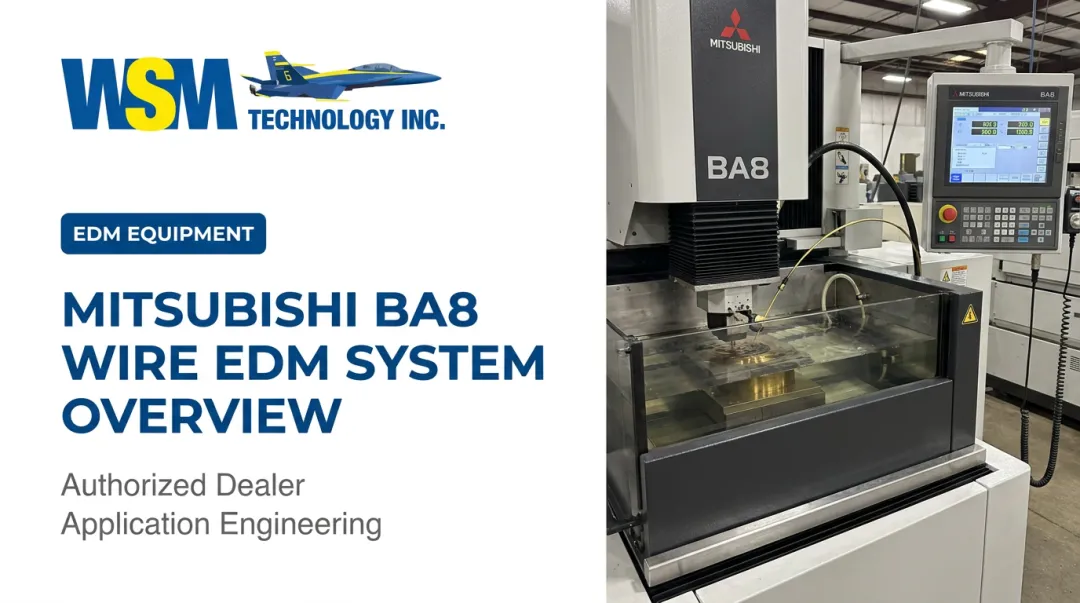
- BA8 — geared toward repeat parts production
- MP series — introduced later for high-accuracy work
- MV series — Mitsubishi's production/high-speed line
The FA20 bridged precision and reliable overnight operation, which is exactly why so many mold shops picked it up.
How Wire EDM Works (Brief Primer)
If you're newer to the technology: wire EDM erodes conductive material with a continuously moving, electrically charged wire. Controlled sparks jump between the wire and workpiece through a dielectric fluid, removing material with high precision and no physical cutting force.
Mitsubishi built its wire-cut line around this process for mold making and precision aircraft and IT parts.
A Reputation Built on Precision and Reliability
WSM Technology founder Blaise Buholzer has worked with wire and sinker EDM since arriving in the US in May 1985 as an application engineer. He later founded WSM as an authorized MC Machinery/Mitsubishi dealer, supporting shops that still run platforms like the FA20.
Plenty of FA20 units are still cutting parts today, more than 15 years after introduction—long service life that tracks with Mitsubishi build quality and sustained shop use.
Key Features & Technical Capabilities of the FA20
The FA20-S Advance combined a large work envelope, anti-electrolysis cutting, and fast automatic threading in one 2007-era platform.

Work Envelope and Dielectric System
- X/Y/Z travels of roughly 500 x 350 x 300 mm (19.7 x 13.8 x 11.8 in) on standard configurations
- Workpiece capacity up to 1050 x 800 x 295 mm (41.3 x 31.5 x 11.6 in) on customer installations
- Taper cutting up to 45 degrees
- Self-cleaning dielectric flushing with Power Master 3D for automatic power and pressure control
Control and Cutting Technology
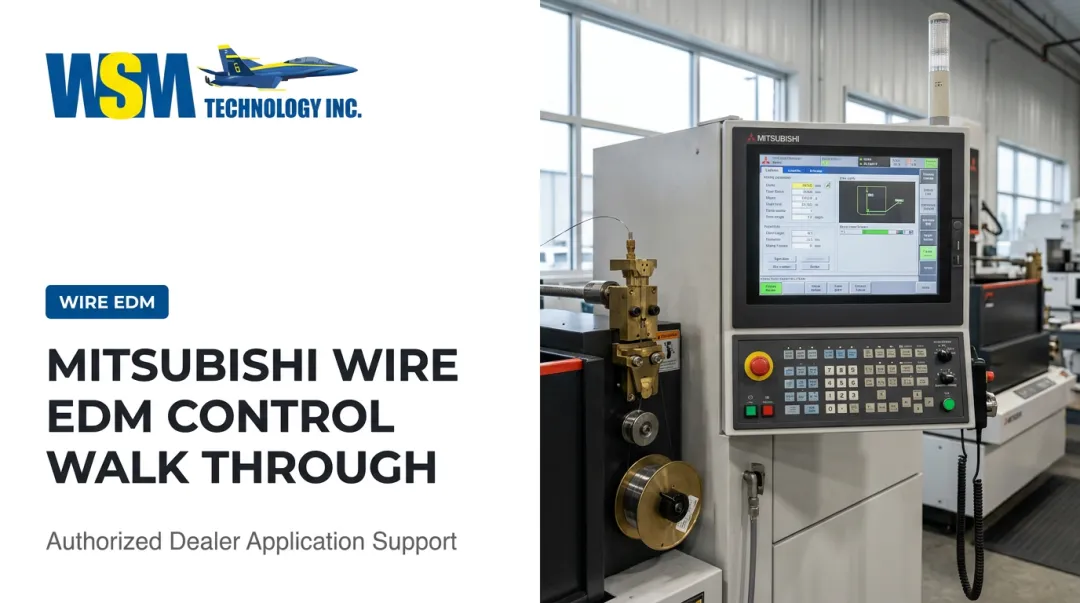
- Touchscreen CNC with 2D/3D program simulation and CAD import
- Anti-electrolysis generator that limits surface corrosion and microcracking
- SL (Step-Less) control to cut cycle time on parts with varying thickness
Threading and Wire Handling
- Automatic Threading System that rethreads in about 10 seconds
- Wire diameters from 0.1 to 0.3 mm
- Multi-pass rough-to-skim strategy for finish quality
Wire selection directly affects cut speed on the FA20. Standard brass covers most jobs; coated or high-speed wire raises cutting rate when the application allows it.
With the high-performance generator option (V-Package), Mitsubishi documented erosion rates up to 500 mm²/min, per Mitsubishi's customer case study on Steinkamp Maschinenbau.

Industries & Applications Suited to the FA20
The FA20 fit shops that needed both tight tolerances and dependable unattended runtime. Core industries included:
- Mold and die making (injection and foam-mold components)
- Aerospace (turbine and structural components)
- Automotive parts and tooling inserts
- Precision mechanics
- Medical components
Common parts included complex profile geometries, precision tooling inserts, and multi-cavity mold components. Shops valued the FA20 because it didn't force a tradeoff — they got tooling-grade precision and the reliability to run overnight without babysitting the machine.
FA20 vs. Today's Mitsubishi Wire EDM Lineup
Here's where the FA20 starts to show its age. The biggest structural difference is the drive system.
| Feature | FA20-S Advance (2007) | Current MV/MP Series |
|---|---|---|
| Axis drive | Ball-screw driven | Non-contact linear/tubular shaft motor |
| Control | Advance CNC touchscreen | Intelligent D-CUBES touchscreen |
| General accuracy | Era-typical, catalog range | Down to ±1 µm (MP series) |
| Threading | Water-beam, ~10 sec | Automatic threader/chopper, faster cycle |
Ball screws introduce backlash and wear over time in a way that linear-motor axes simply don't. That's the core reason accuracy tends to drift on older FA20 units as they age, even with good maintenance.
Mitsubishi's current MP series delivers general pitch accuracy of ±1 µm and angle precision of ±0.01 degrees, according to Mitsubishi Electric's MP series specifications. The MX900 flagship goes further, with positioning variation under 1 µm over 300 mm of travel. That gap shows up on the floor as tighter holdable tolerance and less drift risk as the machine ages.

If you're running an FA20 and wondering how it stacks up on your actual parts, a real test cut on current equipment is the fastest answer. WSM Technology's Demonstration Center in Rootstown, Ohio, is set up for exactly that kind of side-by-side evaluation on current Mitsubishi models.
Keeping Your FA20 Running: Parts, Service & Upgrade Support
Aging FA20 machines tend to show wear in predictable spots:
- Ball screws — backlash here directly affects positioning accuracy
- Wire guides — worn guides cause inconsistent tension and finish quality
- Generator components — degradation here shows up as slower cut speed or rougher surface finish
None of these failures happen overnight. They creep in gradually, so they're easy to miss until a part fails inspection.
Genuine OEM parts and consumables keep results consistent as the machine ages. WSM Technology supplies OEM replacement parts, wire, filters, and resin tanks for Mitsubishi machine owners across its service territory. That supply chain helps an older FA20 keep cutting to spec.

If you're not sure whether your FA20 still meets the tolerances your jobs demand, a periodic performance audit or time study is worth the investment. WSM offers these assessments so shops can decide with real data whether it makes more financial sense to keep servicing the FA20 or start planning an upgrade.
Frequently Asked Questions
Is the Mitsubishi FA20 wire EDM still available new today?
No. Production of the FA20S Advance ended in March 2009, and Mitsubishi ended maintenance support in 2020. WSM Technology, an authorized dealer, can recommend current replacement options based on your accuracy and production needs.
How long do Mitsubishi FA20 wire EDM machines typically last?
Well-maintained FA20 units have delivered well over a decade of reliable service in mold, aerospace, and automotive shops. Actual lifespan depends heavily on upkeep of wear points like ball screws and wire guides.
What is the difference between the FA20 and BA8 Mitsubishi wire EDM models?
The FA20 was positioned for high-precision tool and mold making, while the BA8 was built primarily for repeat parts production. Both launched around the same era but targeted different shop priorities.
Can the Mitsubishi FA20 still hold tight tolerances for aerospace or mold work?
A well-serviced FA20 can still hit tight tolerances. The best way to confirm current performance is a time study, which measures actual cutting accuracy against your specific job requirements.
What is the best wire for an FA20 wire EDM machine?
Standard brass wire handles the vast majority of jobs and remains the workhorse choice. Coated or high-speed wire options cut faster but cost more, making them worthwhile mainly for roughing passes on thicker material.
What signs indicate my FA20 is losing precision and needs service?
Watch for inconsistent surface finish, tolerance drift on repeat parts, and setup times creeping longer than usual. Any of these signals warrant a professional evaluation before quality issues reach the customer.