
Common pain points—stalled programs, collision errors, poor surface finish—usually trace back to controller limitations, not mechanical flaws. A machine with excellent geometry can still underperform if the control can't process toolpaths fast enough or compensate for kinematic error.
This article covers what a 5-axis controller does, the features that separate high-performance systems from basic ones, how leading brands compare, and how to choose the right one for your shop.
Key Takeaways
- 5-axis controllers coordinate simultaneous motion and compensation so complex geometries finish in one setup
- Controller quality drives surface finish, cycle time, and collision avoidance on the floor
- Leading controllers include Mitsubishi, Fanuc, Siemens, and Heidenhain, each with distinct strengths
- Match the controller to part complexity, shop expertise, and the support and training you can actually get
What Does a 5-Axis CNC Controller Actually Do?
The controller coordinates simultaneous interpolation of three linear axes and two rotary axes. The machine's mechanical structure provides the movement; the controller decides how and when each axis moves in sync.
Keeping the Tool Tip on Target
A core function is tool center point control, sometimes called RTCP. As rotary axes swivel a table or spindle, the tool tip would drift off-position without constant correction. Fanuc documents this under G43.4 Tool Center Point Control, while Heidenhain calls its version TCPM. Both do the same job: keep the tool tip locked to the programmed path regardless of rotary motion.
Compensation and Collision Protection
Modern controllers go further than basic interpolation. They include:
- Real-time toolpath compensation — adjusting for small deviations mid-cut
- Kinematic error correction — measuring and correcting rotary/swivel-axis inaccuracy, as with Heidenhain's KinematicsOpt
- Collision avoidance — 3D monitoring of machine components that flags interference before a crash

The controller also translates CAM-generated toolpaths into synchronized servo commands. That translation depends on machine architecture:
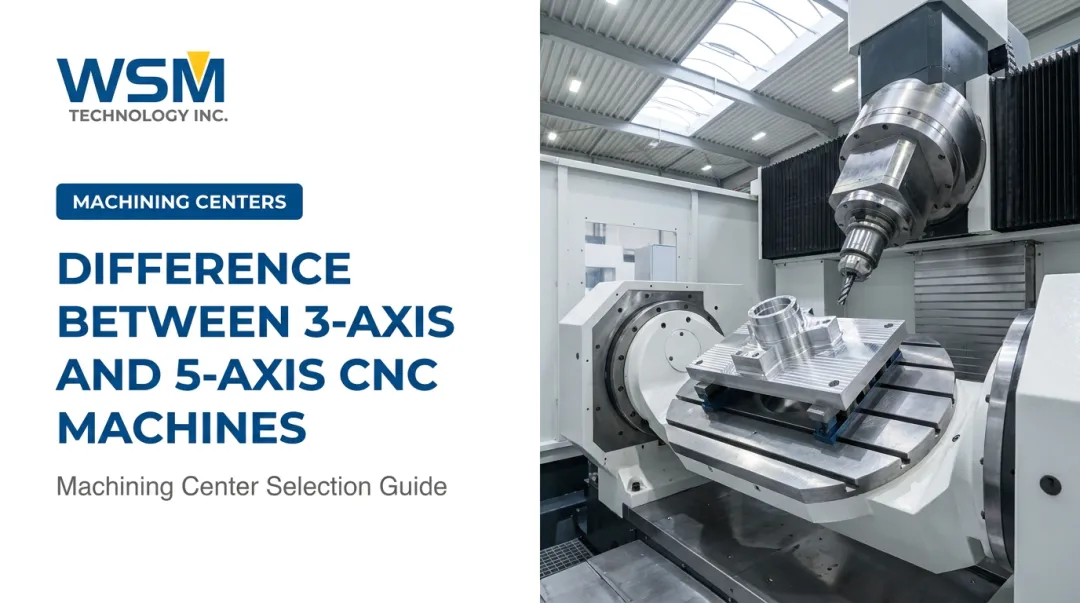
- Table-tilting
- Spindle-tilting
- Combination table/spindle
Each setup needs its own kinematic model programmed into the control.
Key Features That Separate High-Performance Controllers From Basic Ones
Not every 5-axis controller is built the same. The gap between a basic control and a high-performance one shows up in four areas.
Interpolation Speed and Look-Ahead
Faster block processing and deeper look-ahead mean smoother contouring on complex surfaces. Mitsubishi's M850V, for example, publishes a spec of 540,000 blocks per minute, 5,400 look-ahead blocks, and 0.1 ms processing time. Fanuc's AI Contour Control and Smooth Tolerance Control interpret CAM points as a real-time spline for better surface finish and shorter cycle time.

Simulation and Anti-Collision Systems
High-end controllers simulate the full toolpath and flag collisions before the spindle ever touches the part. Heidenhain's Dynamic Collision Monitoring stops axis traversal before impact, while Siemens' Collision Avoidance monitors static machine components in real time.
Thermal and Geometric Compensation
Long production runs generate heat, and heat shifts accuracy. Fanuc's AI thermal-displacement compensation pulls data from multiple sensors to build a correction model. Mitsubishi offers automatic tool-wear compensation based on tool length and shape data.
Operator-Friendly Interfaces
A shop moving from 3-axis to 5-axis work needs an HMI that doesn't require a programming degree. High-performance controls use conversational programming, guided setup screens, and clear multi-axis visualization so operators can check tool orientation without decoding raw G-code. According to Modern Machine Shop, CAM systems can also build 5-axis toolpaths while keeping much of the familiar 3-axis programming context, which shortens the learning curve for rotary-axis work.
Comparing Leading 5-Axis Controller Brands
There's no universal "best" controller. Each major brand leads in different areas.
| Brand | Documented Strengths |
|---|---|
| Mitsubishi | High block-processing speed, strong North American dealer support, tight EDM/milling integration |
| Fanuc | Broad machine-builder compatibility, AI Contour Control, extensive documentation |
| Siemens Sinumerik | Advanced simulation, 5X-ANALYZER kinematic compensation, aerospace/automotive case history |
| Heidenhain | Intuitive conversational programming, TCPM, strong toolroom and prototype fit |

Mold and die shops, aerospace suppliers, and micro-precision houses tend to choose different systems based on programming style and part type.
As a Mitsubishi/MC Machinery dealer with over a decade serving Northern Ohio, Western Pennsylvania, and West Virginia, WSM Technology has seen that shop expertise and dealer support often matter as much as raw controller specs.
Applications Where Controller Capability Makes the Biggest Difference
Controller quality isn't equally important on every job. It matters most where geometry and tolerance stack up.
- Complex surfaces: impellers, blades, and turbine components require tight simultaneous 5-axis coordination to avoid faceting and tool marks
- Mold and die work: five-sided machining in a single setup eliminates re-clamping errors that compound across operations
- Micro mechanics and micro molding: a documented Heidenhain case involved a pacemaker component with 0.004-inch wires passing through 0.005-inch holes, requiring sub-micron compensation accuracy
- Aerospace and automotive: tight tolerances and multi-angle features demand kinematic accuracy that basic controls can't hold over long runs
These are the segments WSM Technology serves across its territory, from mold and die shops to micro mechanics and aerospace suppliers.
How to Choose the Right 5-Axis Controller for Your Shop
Match controller capability to what you actually machine—not brand loyalty.
- Assess part complexity. Does your typical job need continuous 5-axis motion, or does 3+2 positioning (locking two axes during the cut) cover it? Per Modern Machine Shop, simultaneous control costs more and demands more programming skill.
- Check CAM compatibility. Confirm your CAM software's post-processor supports the exact controller model and its TCP conventions.
- Factor in operator training curve. A control with intuitive conversational programming, like Heidenhain's, can shorten the learning path for teams new to 5-axis work.
- Weigh local support. Dealer proximity matters when a controller fault stops production.

Before committing, see the controller run an actual part. WSM Technology's Demonstration Center in Rootstown, Ohio, gives shops the chance to run test cuts and time studies on Mitsubishi-based 5-axis milling and EDM systems before purchase — a practical way to compare technologies rather than rely on spec sheets alone.
Finally, factor in total cost of ownership. That means OEM replacement parts availability and service response time, not just the sticker price. A controller that's cheap to buy but slow to service can cost more in downtime than it saved upfront.
Frequently Asked Questions
What can a 5-axis CNC controller do?
It coordinates simultaneous motion across three linear and two rotary axes, keeps the tool tip accurate through TCP/RTCP functions, avoids collisions in real time, and enables complex surface machining in a single setup.
What is the best 5-axis CNC controller?
There's no single "best" controller; it depends on your application, machine builder compatibility, and shop needs. Mitsubishi, Fanuc, Siemens, and Heidenhain each lead in different areas.
How is a 5-axis controller different from a 3-axis controller?
A 5-axis controller adds rotary-axis interpolation and tool center point control to keep the tip on-path during swivel motion. That adds programming complexity compared with 3-axis work.
Do I need special training to program a 5-axis controller?
Most shops benefit from vendor-led training, especially early on. Modern CAM software has simplified much of the learning curve by handling toolpath generation while operators focus on setup and verification.
Can older 3-axis machines be retrofitted with a 5-axis controller?
Retrofits are technically possible but limited by the machine's mechanical structure. Purpose-built 5-axis machines generally deliver more reliable results than retrofitted setups.
How much does a 5-axis controller upgrade or machine cost?
Pricing varies widely by control sophistication and machine size. As a rough guide, large aluminum 5-axis centers have ranged from under $300,000 to $1.5 million in published benchmarks—get a specific quote, since controller-only upgrade pricing isn't standardized.