
Introduction
Producing a graphite electrode takes roughly three weeks and involves eight or more sequential manufacturing stages — each one affecting the mechanical and electrical properties of the finished part. The process transforms raw carbonaceous materials into precision components that carry extreme electrical currents and withstand temperatures that would destroy most industrial materials.
Most operational guides cover what graphite electrodes do. Few explain how they're made — and why that matters to the people who depend on them.
This guide is written for manufacturing engineers, sinker EDM operators, mold and die shop managers, and procurement teams who want to understand the production process at a working level.
Whether you're sourcing electrodes for an electric arc furnace or specifying graphite stock for precision EDM work, knowing what goes into production directly informs what you should expect from the finished product.
We'll cover raw materials, each manufacturing stage in sequence, the quality factors that separate RP from UHP grades, and how production decisions affect EDM performance specifically.
Key Takeaways
- Needle coke and coal tar pitch are the core raw materials, processed through a weeks-long thermal and mechanical sequence
- Seven stages define production: raw material prep → extrusion → baking → pitch impregnation → rebaking → graphitization → CNC machining
- Graphitization at ~3000°C is the structural transformation that produces true graphite, distinct from simply heated carbon
- Raw material purity and process control determine electrode grade (RP, HP, UHP) — final dimensions alone do not
- EDM-grade graphite uses isostatic pressing rather than extrusion, giving it a fundamentally different grain structure than EAF electrodes
What Are Graphite Electrodes and What Are They Used For?
Graphite electrodes are dense, cylindrical conductors engineered to carry high electrical currents while resisting extreme heat. Unlike ordinary carbon electrodes, their crystalline structure — carbon atoms arranged in hexagonal sheets — delivers exceptional electrical conductivity, thermal conductivity, and comparatively low thermal expansion.
Two Primary Industrial Applications
Electric arc furnace (EAF) steelmaking accounts for the largest share of global demand. Graphite electrodes generate the arc that melts scrap steel at approximately 1,600°C (per Tokai Carbon), consuming roughly 4.5 kg per ton of liquid steel produced — a figure that drove global production to 1.1 million tons in 2021, per the European Carbon and Graphite Association.
The demands of sinker EDM machining are fundamentally different. Electrodes are machined to exact cavity geometries, then used to erode hardened metal workpieces into precise shapes through controlled electrical sparking. Bulk current-carrying capacity matters far less here; dimensional tolerance and grain-level material consistency are what determine results.
Grade Overview
Three main grades exist, each the direct result of raw material selection and process control:
| Grade | Bulk Density | Electrical Resistivity | CTE |
|---|---|---|---|
| RP (Regular Power) | ~1.50–1.70 g/cm³ | ~6.0–8.5 μΩ·m | ~0.8–1.8 × 10⁻⁶/°C |
| HP (High Power) | ~1.65–1.75 g/cm³ | ~5.5–6.5 μΩ·m | ~1.2–1.7 × 10⁻⁶/°C |
| UHP (Ultra-High Power) | ~1.65–1.78 g/cm³ | ~4.2–6.5 μΩ·m | ~0.5–1.5 × 10⁻⁶/°C |
Values based on manufacturer specifications from HEG Ltd. and Tokai Carbon.
Understanding these grades — and what the production process does to achieve them — is the foundation for every decision that follows.
Raw Materials Behind Graphite Electrode Production
Needle Coke: The Critical Input
Needle coke is the primary raw material — and the one that determines electrode grade ceiling more than any other factor. It's a highly crystalline carbon derived from either petroleum or coal tar, characterized by:
- Directional pores and cracks aligned with the longitudinal axis
- Low coefficient of thermal expansion (CTE)
- High electrical conductivity
- Real density around 2.14 g/cm³
Research from Nippon Steel's Technical Report No. 134 describes super-premium needle coke with CTE as low as 3–4 × 10⁻⁷/°C, sulfur content of 0.4–0.5%, and ash of 0.1–0.2%. The mixing ratio in electrode production is roughly 75% needle coke to 25% binder pitch.
Before blending, raw needle coke is calcined at approximately 1,400°C to remove volatile matter and reduce hydrogen concentration to about 0.05%. Skip or rush this step, and variability compounds through every downstream stage.
Coal Tar Pitch: The Binder
Coal tar pitch holds the coke particles together during forming and baking. Its quality is measured by softening point, coking value (carbon yield), and impurity content.
For specialty graphite applications, softening temperatures typically fall between 150 and 200°C.
Pitch plays two roles in production:
- Binder pitch — mixed with coke during forming (typically ~56% carbon yield, ~10% quinoline insolubles)
- Impregnation pitch — introduced after baking to fill open pores (typically ~2% quinoline insolubles)
The difference matters: impregnation pitch needs to flow easily into pores under pressure, so lower quinoline insolubles are required.
Supplementary Materials
Beyond needle coke and pitch, a few additional inputs come into play depending on electrode grade:
- Petroleum coke — sometimes blended with needle coke to reduce cost in standard-grade electrodes
- Silicon carbide additives — used selectively to modify specific mechanical or thermal properties
Neither substitution is appropriate for UHP-grade electrodes. At that tier, raw material purity directly controls final resistivity and CTE — there's no compensating for it downstream.
How Graphite Electrodes Are Made: Step-by-Step Manufacturing Process
The full production cycle spans several weeks. Each stage builds on the last — shortcut any step, and defects accumulate invisibly until the electrode fails under operating conditions.

Step 1: Raw Material Preparation and Blending
Calcined needle coke is crushed, ground, and sieved to precise particle size distributions. These sized fractions are then blended with coal tar pitch in controlled proportions and mixed under heat to form a homogeneous paste. Particle size distribution affects how densely the material packs during extrusion and how uniformly it responds to baking.
Step 2: Extrusion
The heated paste is forced through a die under high pressure, producing cylindrical "green" (unfired) electrode blanks. Extrusion direction determines grain orientation in the finished electrode — a direct consequence for anisotropic properties like thermal expansion and electrical resistivity along different axes.
Step 3: Baking (Primary Heat Treatment)
Green electrodes are loaded into ring furnaces and slowly heated to approximately 1,000°C over a controlled schedule lasting roughly one month. The key word is slowly. Resonac explicitly warns that shortening baking time causes cracks.
The process carbonizes the pitch binder, expelling volatile compounds and binding coke particles into a rigid carbon structure. A 2022 study on graphite blocks found that increasing the carbonization heating rate from 1 to 9°C/min:
- Decreased flexural strength by 18.7%
- Decreased compressive strength by 24.1%
- Raised electrical resistivity from 49.96 to 59.44 μΩ·m
- Created merged pores and cracks at rates of 5°C/min or higher
The physics of volatile expulsion set the schedule. Manufacturing timelines don't.
Step 4: Pitch Impregnation
Baking drives off volatiles, and the byproduct is open porosity. To restore density and mechanical strength, electrodes go into an autoclave where liquid pitch is forced into those pores under vacuum and pressure. This step is repeated multiple times for electrode joints (pins) to achieve optimal density before the graphitization stage.
Step 5: Rebaking
Impregnated electrodes undergo a second heat treatment below 800°C for approximately one week. The heat carbonizes the newly introduced pitch, further densifying the structure. Skipping this step isn't an option — unprocessed pitch introduced into a 3,000°C furnace would cause immediate, serious problems.
Step 6: Graphitization
This is the defining step. Electrodes are subjected to electric Joule heating that raises temperatures to approximately 3,000°C. At this temperature, the disordered carbon atoms reorganize into an ordered hexagonal graphite crystal lattice.
The change runs deeper than heat treatment alone:
- Electrical conductivity improves dramatically
- Thermal conductivity increases significantly
- Coefficient of thermal expansion decreases
The result is true crystalline graphite — structurally distinct from the amorphous carbon that entered the furnace.
As GrafTech states directly: baked electrodes are amorphous carbon; graphitization above 3,000°C restructures them into crystalline graphite. Depending on furnace type, this stage takes one week to one month, per Resonac.

Step 7: Precision Machining and Inspection
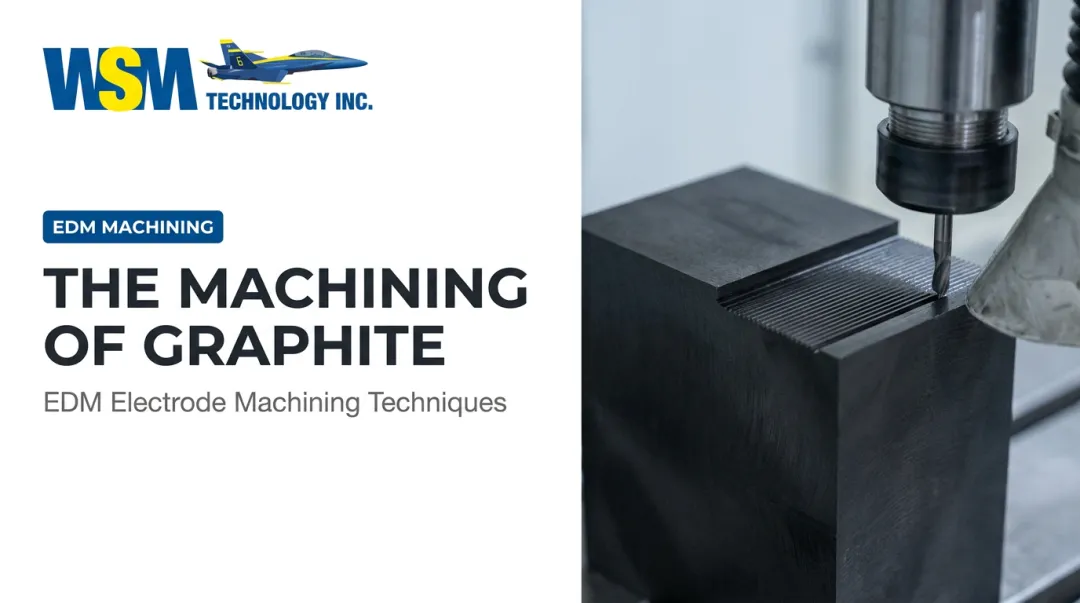
Graphitized electrode bodies and nipple joints are machined using CNC equipment. Resonac documents tolerances as fine as 1/1000 mm for finished electrodes. Surface finish, thread geometry on pin joints, and diameter tolerances all determine whether electrodes connect securely and perform reliably in service.
After machining, electrodes undergo property measurements — electrical resistivity, bulk density, flexural strength, and CTE — plus visual inspection before shipment.
Key Factors That Affect Graphite Electrode Quality
Electrode grade isn't assigned arbitrarily — it's the outcome of four variables that interact throughout the production process. Understanding them helps you evaluate supplier specs and match electrode grade to your EDM application's actual demands.
Raw material purity: Sulfur content, ash content, and crystallite size of needle coke are the primary determinants of final resistivity and CTE. Higher-purity needle coke produces lower CTE and better conductivity — verify material certifications before sourcing, because no downstream process recovers what inferior coke costs you.
Thermal cycle control: Temperature ramp rate, peak temperature, hold time, and cooling schedule during baking and graphitization govern internal stress, porosity, and crystalline structure. Deviations here are the most common cause of cracking, inconsistent density, and batch-to-batch performance variation.
Impregnation cycles: The number of pitch impregnation cycles determines bulk density and mechanical strength. Higher density reduces porosity and improves the electrode's ability to handle higher current densities without fracture — particularly relevant for UHP grades.
Final machining precision: For EDM applications, geometric accuracy — taper, concentricity, surface finish — translates directly to dimensional accuracy in the machined workpiece. A documented tolerance of 1/1000 mm reflects what precision sinker EDM work actually demands.

Graphite Electrodes in EDM Machining: What Manufacturers Should Know
Sinker EDM electrodes and EAF electrodes share a name and basic material — that's roughly where the similarity ends.
Why EDM Graphite Differs from EAF Graphite
EAF electrodes are large, extruded cylinders consumed at the furnace tip. EDM electrodes are precision-machined to specific cavity geometries and used to erode exact shapes into hardened metal through controlled sparking. The production quality of the graphite stock — density uniformity, grain size, isotropy — directly determines:
- Wear rate during spark erosion
- Corner retention on fine details
- Surface finish achievable on the workpiece
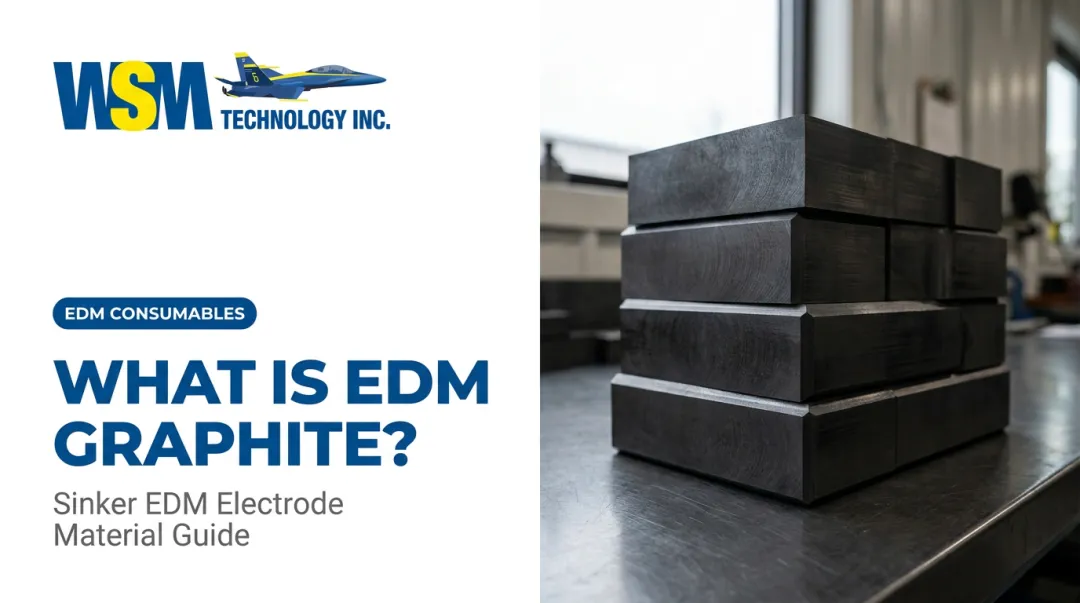
EDM-grade graphite is typically isostatically pressed, not extruded. Isostatic pressing produces a more uniform, fine-grained structure with isotropic properties suited to complex 3D cavity work. Mersen describes EDM graphite as an isotropic material with grain size from a few microns to about 20 microns.

Selecting EDM Graphite Grade
When specifying graphite for EDM electrode stock, look for grades categorized by grain size:
| Grain Class | Typical Use | Surface Finish Capability |
|---|---|---|
| Ultra-fine (<1 μm) | High-detail, thin-wall features | Up to 0.4 Ra (μm) |
| Fine (~4–5 μm) | Standard mold cavities | Good detail and finish |
| Medium (~10 μm) | Roughing, faster metal removal | Higher electrode wear |
Mersen's data confirms that finer grain sizes deliver better corner retention and surface finish; coarser grades remove metal faster but with greater electrode wear. Poco/Entegris data shows graphite can achieve electrode wear of less than 1% in roughing operations, and that 95% of EDM electrodes in the United States are graphite.
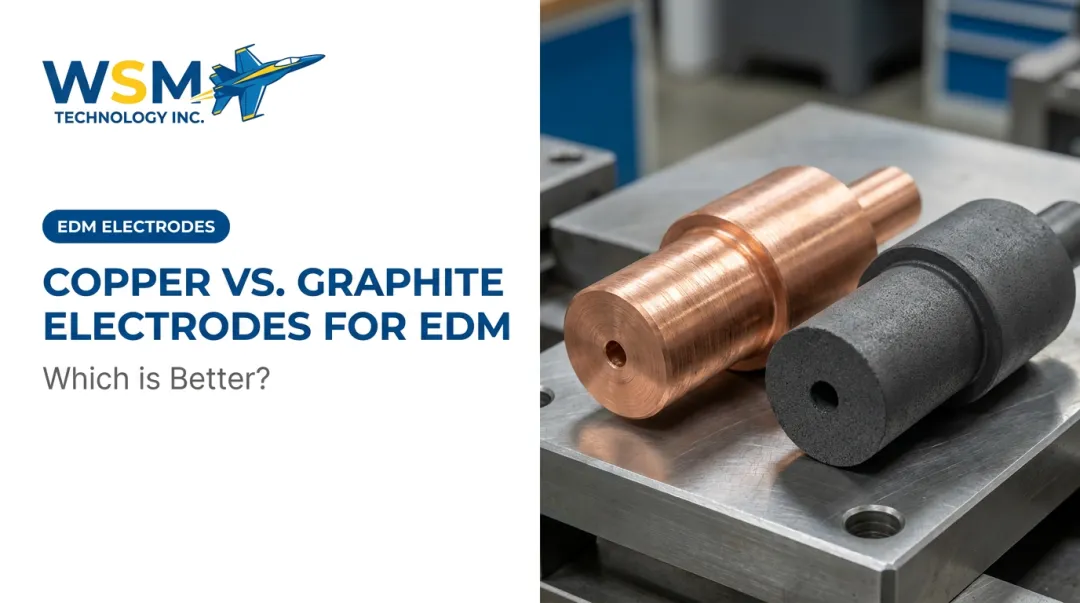
Compared to copper, graphite offers roughly 1/5 to 1/10 the cutting resistance and is 1/5 the weight — meaningful advantages when machining complex, multi-cavity electrode geometries.
WSM Technology's Role in EDM Electrode Workflows
For manufacturers running sinker EDM operations across Northern Ohio, Western Pennsylvania, and West Virginia, WSM Technology supports the full electrode workflow — from Mitsubishi sinker EDM machines and OPS Ingersoll graphite mills used to machine electrode blanks, to EDM consumables including wire, filters, and related supplies. The team brings hands-on mold shop experience: Office Manager John Riegler spent over 15 years running sinker EDM machines in a production mold shop before joining WSM. That background shapes how they approach application questions — not from a catalog, but from the floor. Contact WSM Technology at (330) 962-8308 or sales@wsmtechnology.com for application-specific guidance.
Common Misconceptions About Graphite Electrode Production
"All graphite electrodes are essentially the same material."
They span a wide spectrum. RP through UHP grades have distinct raw material inputs, production steps, and performance characteristics. Extruded EAF electrodes and isostatically pressed EDM graphite are different products made by different processes.
Using the wrong grade in a high-power EAF or a fine-detail EDM application leads to premature failure, poor surface finish, or scrapped workpieces — outcomes that are entirely avoidable with the right material selection.
"Graphitization is just high-temperature heating."
Graphitization is a structural transformation, not just a heat cycle. Without reaching and sustaining approximately 3,000°C, the material remains amorphous carbon — not graphite. Carbon and graphite have fundamentally different electrical and thermal performance. The temperature threshold isn't a recommendation; it's the physical requirement for the atomic reorganization to occur.
"Faster production cycles don't affect quality if the end temperature is correct."
Rushed baking ramp rates are a leading cause of internal cracking and porosity that may not be visible externally. These defects manifest as electrode fracture or inconsistent spark erosion under operating conditions. Production timelines are set by the physics of volatile byproduct expulsion and crystal development — not manufacturing convenience.
Frequently Asked Questions
What is the process of making graphite electrodes?
Needle coke and coal tar pitch are blended and extruded into cylindrical green blanks, then baked to ~1,000°C to carbonize the binder. Electrodes are then pitch-impregnated to fill pores, rebaked, and finally graphitized at ~3,000°C to form the crystalline graphite structure. CNC machining and inspection complete the process.
Can electrodes be made of graphite?
Yes. Graphite is one of the most effective electrode materials due to its high electrical conductivity, thermal resistance, and machinability. It's used in both large-scale EAF steelmaking and precision sinker EDM, though the grade, forming method, and grain structure differ significantly between these two applications.
Where does the US get most of its graphite for electrode production?
According to the USGS Mineral Commodity Summaries 2026, the US had no domestic natural graphite production in 2025 and imported approximately 79,000 tons. Leading import sources for 2021–2024 were China (46%), Canada (13%), Mozambique (13%), and Mexico (12%). Resonac Graphite America and Tokai Carbon GE are the only two domestic producers of finished large graphite electrodes.
What is the difference between graphite electrodes and carbon electrodes?
Carbon electrodes are fired to ~1,000°C and retain an amorphous carbon structure. Graphite electrodes undergo an additional graphitization step at ~3,000°C that reorganizes carbon atoms into an ordered hexagonal lattice, producing superior electrical conductivity, lower thermal expansion, and higher oxidation resistance.
How long does it take to produce a graphite electrode?
The full cycle typically takes several weeks to over a month. The baking stage alone takes approximately one month due to controlled heating and cooling requirements. Graphitization adds one week to one month depending on furnace type. These timelines are driven by the material's thermal requirements and cannot be compressed without compromising electrode quality.