
This explanation is written for machine shop owners, toolmakers, and manufacturing engineers in mold/die, aerospace, medical, and automotive industries, where tight tolerances and complex geometries aren't optional. Wire EDM gets referenced constantly in these shops, yet how sparks, dielectric fluid, and wire tension actually interact to produce a clean cut is often misunderstood.
This article walks through how the process works step-by-step, what factors affect your results, and when Wire EDM should — or shouldn't — be your first choice.
TL;DR
- Wire EDM uses a thin brass or coated wire electrode, guided by CNC, to erode conductive material with electrical sparks
- Excels at intricate 2D/tapered profiles, sharp internal corners, and tight tolerances in hardened metals, without mechanical stress
- Wire type, dielectric fluid quality, and part thickness directly affect speed and finish
- Common in mold/die, aerospace, medical device, and precision tooling work
- Not suited for non-conductive materials, deep 3D cavities, or high-volume bulk removal
What Is Wire EDM?
Wire EDM is a non-contact thermal erosion process. A continuously fed wire electrode and the workpiece sit submerged in or flushed with deionized water. Pulsed voltage generates sparks that melt and vaporize material.
The result: a precisely cut profile that matches a CNC-programmed path, achieved through thousands of controlled electrical discharges per second rather than mechanical cutting force.
Wire EDM and sinker EDM do different jobs:
- Sinker (die-sink) EDM: A shaped solid electrode forms cavities in the workpiece
- Wire EDM: A moving wire makes through-cuts along a programmed profile

Why Wire EDM Is Used in Precision Manufacturing
Mold/die, aerospace, and medical device manufacturers need tight tolerances, burr-free edges, and the ability to machine hardened conductive materials that conventional cutting tools chew through in a hurry. Wire EDM answers that need directly.
Because there's no mechanical cutting force, there's no part distortion. That makes it ideal for:
- Thin walls and fragile features that would flex or crack under a cutting tool
- Post-heat-treatment machining, since hardened parts don't need to be softened first
- Sharp internal corners that milling simply can't reach
Without Wire EDM, shops typically run into three problems:
- Accelerated tool wear on hardened steels
- Warping in thin parts from cutting forces
- Inability to hit sharp internal geometry
That's why it's industry best practice (not a regulatory requirement) for tool and die work, extrusion dies, and complex prototype geometries.
Modern wire EDM equipment can cut a 3-inch-thick carbide workpiece to +/-0.0001 inch accuracy with a 5-microinch Ra surface finish, though getting to that finish level may take six or seven skim passes.
Getting there consistently depends on properly maintained, calibrated equipment and trained operators. WSM Technology provides turnkey Wire EDM solutions, including Mitsubishi machines, installation, and training, to help shops hit that utilization and performance ceiling instead of leaving capability on the table.
How Wire EDM Works (Conceptual Flow)
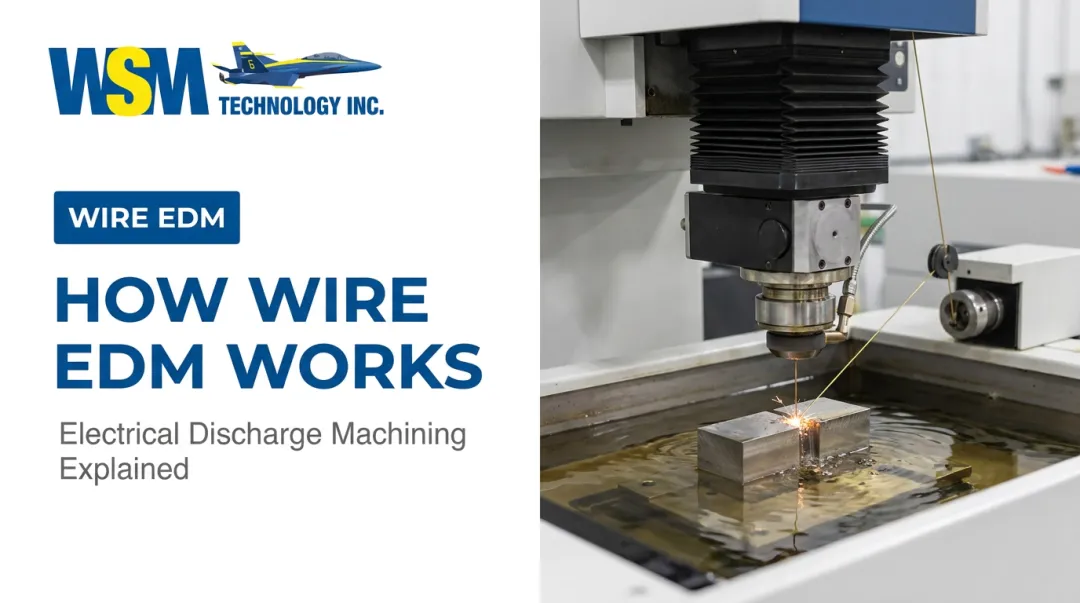
A thin wire electrode moves along a CNC-programmed path while pulsed voltage generates sparks between wire and workpiece. Those sparks erode material, and dielectric fluid flushes the debris away.
What goes into the process:
- A conductive workpiece
- Spooled wire electrode
- Deionized water as dielectric
- A CNC program defining the cut path
When voltage exceeds the dielectric's breakdown point, a plasma channel forms and melts or vaporizes microscopic amounts of material. That cycle repeats hundreds of thousands of times per second, and individual sparks reach roughly 15,000 to 21,000 degrees Fahrenheit.
Wire tension, feed rate, pulse frequency/power, and multi-axis (X, Y, U, V) motion all control accuracy and speed. The result is a workpiece shaped to the programmed profile, with a narrow kerf, minimal heat-affected zone, and a smooth finish.

Step 1: Preparation
Operators clamp and align the workpiece with precision fixtures first. For an internal feature, they drill a start hole; otherwise the cut begins from an edge.
Step 2: Wire Threading and Positioning
The wire threads through the start hole, automatically on most modern machines and manually on older ones. Contact sensing or spark alignment then positions the electrode with precision.
Step 3: Cutting and Finishing Passes
The CNC program guides a rough cut first. One or more skim passes follow at reduced power, refining tolerance and surface finish before operators remove the finished slug.

Where Wire EDM Is Applied and Key Factors That Affect Results
Wire EDM shows up wherever tight tolerances meet hardened or hard-to-machine materials:
- Mold and die making
- Extrusion dies
- Aerospace turbine components, including turbine blades and jet-engine "fir trees"
- Surgical instruments
- Precision gears (though wire EDM's perpendicular cutting orientation limits helix gear geometry)
It's typically used in production and tooling stages, often after heat treatment, since it avoids the distortion that would otherwise undo that hardening.
The trigger is usually a specific need: tight tolerances, hardened materials, complex 2D or tapered profiles, or features other methods can't touch. This is job- and part-specific work, though it may repeat across a production run.
What Determines Cut Quality and Cycle Time
Several variables interact to determine cut quality and cycle time:
- Wire material/diameter and workpiece conductivity: these drive spark stability and cutting speed
- Dielectric fluid quality and flow: affects debris removal and surface finish
- Machine rigidity, CNC precision, and wire tension systems: determine how consistently the machine holds its programmed path
- Part thickness and geometry: dictate how many passes and how much cycle time you'll need
- Industry-specific tolerance requirements: aerospace and medical work often demand extra skim passes to hit spec

Shops evaluating new equipment can validate these variables on their own parts before buying. Hands-on test cuts and time studies, like those offered at WSM Technology's demonstration center in Rootstown, Ohio, let a shop confirm cut quality and cycle time before committing to a purchase.
Common Issues, Misconceptions, and When Wire EDM May Not Be Appropriate
Misconception: Wire EDM cuts perfectly square internal corners. It doesn't. Wire diameter and spark gap always leave a small radius. A 0.010-inch brass wire, for example, needs cutter compensation near 0.005 inch plus the spark gap. That geometry can't produce a true 90-degree internal corner.
Misconception: Hardness determines cutting speed. Not quite. Conductivity and thermal properties are the bigger drivers. A hard material can still cut efficiently if it's conductive; a low-conductivity material can slow things down regardless of hardness.
Misconception: Wire EDM can replace CNC milling. It's built for 2D and tapered profiles, not deep 3D cavities. Teams that oversimplify this end up forcing geometry that a mill or sinker EDM would handle better.
When Wire EDM isn't the right call:
- Non-conductive materials (plastics, composites, ceramics) — the process requires a conductive workpiece
- High-volume bulk material removal — it's precise, not fast at removing mass
- Deep 3D contouring — better suited to milling or sinker EDM
- Simple through-holes — standard drilling is faster when EDM precision isn't required
Frequently Asked Questions
What is wire electrical discharge machining (EDM)?
Wire EDM is a thermal, non-contact machining process that uses a continuously fed wire electrode to erode conductive material through controlled electrical sparks, guided by a CNC-programmed path.
What are the main components of an EDM machine?
Core components include the wire electrode and feed system, work table, CNC control, power supply, dielectric fluid tank, and a filtration/recycling system for the deionized water.
What types of EDM machines are there?
The three main types are Wire EDM (through-cut profiles), sinker/die-sink EDM (shaped electrode for cavities), and small hole drilling EDM (tubular electrode for holes).
What is wire EDM used for?
Common applications include mold and die work, aerospace turbine parts, medical instruments, surgical tools, and high-tolerance precision tooling.
Which materials cannot be machined by wire EDM?
Only electrically conductive materials can be cut with Wire EDM. Non-conductive materials like most plastics, composites, and ceramics aren't compatible with standard wire EDM.
How thick can wire EDM cut?
Capacity is model-specific. Some machines cut workpieces over 12 inches thick, but thicker sections need slower speeds and extra skim passes to hold tolerance.