
CNC (computer numerical control) machines guide cutting tools using programmed code instead of a human hand on the dial. That shift, from manual to automated, changed what shops could produce and how consistently they could produce it.
Many shops struggle with a different problem now: too many machine options and not enough clarity on which type fits their parts. This article breaks down the major CNC machine categories, what each does best, and how to match one to your production needs.
Key Takeaways
- CNC machines automate cutting and shaping through programmed instructions, improving accuracy over manual methods
- Main types include mills, lathes, EDM machines, routers, and plasma/laser cutters for different geometries and materials
- The right choice depends on part complexity, material, volume, and budget, not the newest technology
- Test cuts and time studies at a demonstration facility can validate a machine choice before you commit
What Is a CNC Machine and Why Does It Matter in Manufacturing?
A CNC machine is a machine tool guided by computer code, commonly G-code and M-code, that controls movement, speed, and tool paths without a human hand adjusting each pass. The computer, not the operator, decides where the tool goes next.
ISO 2806 formally defines this as computerized numerical control: a computer managing machine functions directly. That distinction matters because it separates the control layer (CNC) from the process (milling, turning, EDM, and so on) — a framework we'll use throughout this article.
CNC machines show up across:
- Mold and die making
- Aerospace component manufacturing
- Automotive parts production
- Medical device manufacturing
Why does it matter? Without CNC, shops face:
- Inconsistent tolerances
- Slower cycle times
- Higher scrap rates
- Quality that hinges on whoever is running the machine that day
NIST's research on integrated CAM/CNC systems points to reduced issue-resolution time, lower process-planning costs, and better cycle times through automatic parameter optimization.
For most shops, CNC is an investment in throughput and repeatability.
Types of CNC Machines
CNC machines are built around different mechanisms: a rotating tool, a rotating workpiece, spark erosion with no mechanical contact, or thermal cutting with a plasma arc or laser. Each mechanism suits different jobs, materials, and tolerance requirements.
Most shops don't rely on just one type. A mold and die shop, for instance, often runs milling machines alongside sinker EDM to complete a single cavity.
CNC Milling Machines
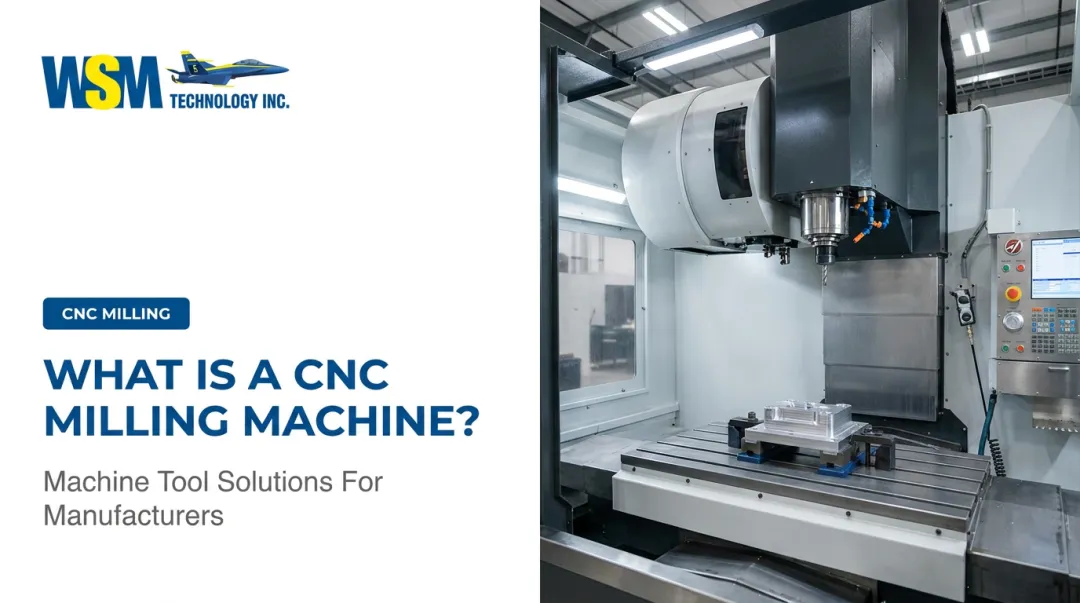
A rotating cutting tool removes material from a stationary or moving workpiece. Configurations range from basic 3-axis setups to 5-axis and beyond for complex geometries.
What makes milling versatile: it cuts flat, angled, and contoured surfaces from nearly any direction. Haas notes that simultaneous 5-axis motion reduces operations, cycle time, and setups while improving accuracy, since the tool reaches multiple faces without repositioning the part.
Best suited for:
- Mold and die components
- Prototypes
- Parts needing slots, pockets, or complex 3D contours
Limitations: Higher-axis machines demand skilled programming and a larger capital investment. A 3-axis mill is often the smarter buy for simpler prismatic parts.
WSM Technology represents Jingdiao for high-speed 3-axis and 5-axis mills, along with Roku-Roku's ANDROID II line. That platform holds ±1-micron accuracy at 60,000 RPM, which matters for mold, aerospace, and medical work where tolerance stacks add up.

CNC Lathes / Turning Centers
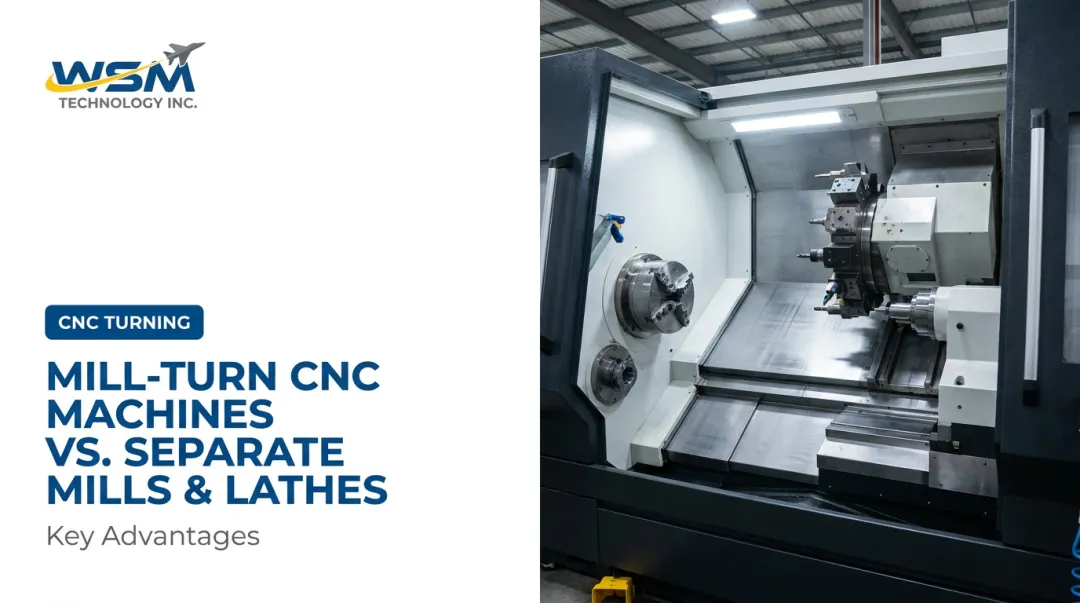
Here the workpiece rotates while a stationary tool shapes it. That's the opposite setup from milling, and it's optimized for round, symmetrical parts rather than flat or irregular ones.
Best suited for:
- Shafts and bushings
- Fittings
- Rotationally symmetric automotive components
SME notes that turning covers everything from slender shafts to turbine shafts, with modern turning centers adding live tooling, C-axis, and subspindles to complete more operations in a single setup.
Limitations: Not suited to non-cylindrical or highly asymmetric geometries. That's milling's job.
WSM's turning lineup includes Hembrug hard-turning machines, Schaublin precision lathes, and Romi turning centers.
CNC EDM Machines (Wire and Sinker)
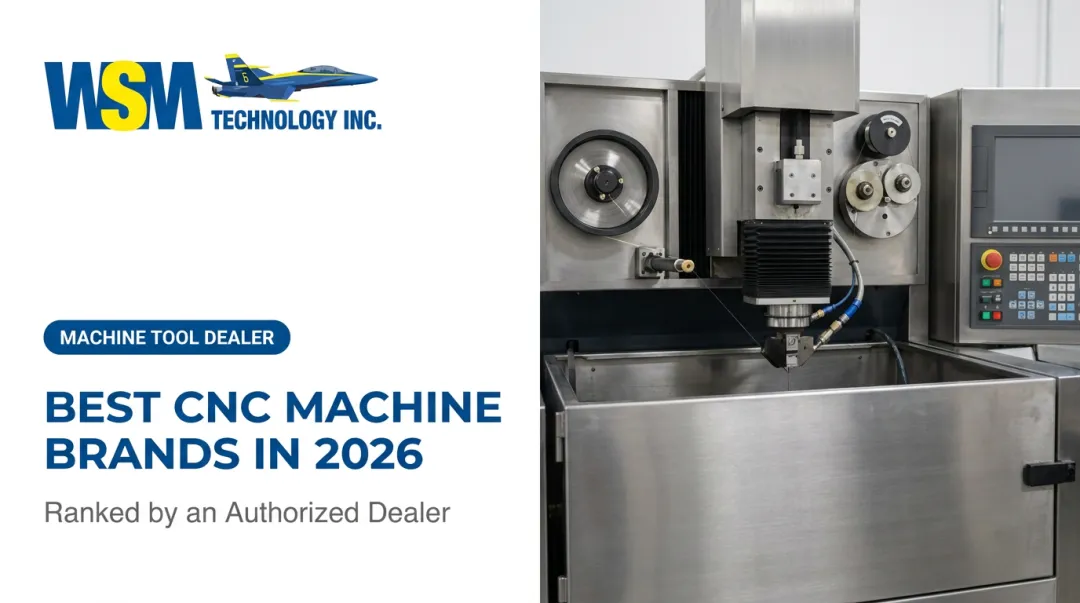
EDM removes material through controlled electrical discharges between an electrode and a conductive workpiece submerged in dielectric fluid. No mechanical cutting force touches the part.
That's the key difference: because there's no cutting force, EDM can machine extremely hard materials and delicate, intricate features that would chip or deform under a mill.
Two main types:
- Wire EDM: feeds a thin wire through the workpiece for through-profiles
- Sinker EDM: uses a shaped electrode to create cavities and blind details
Best suited for:
- Hardened tool steels
- Micro-machining
- Mold and die cavities with sharp internal corners
WSM Technology supplies Mitsubishi wire EDM (including the MV1200S and MV2400) and Sarix Micro EDM equipment for fine cavities, micro features, and hardened-steel mold components.

Limitations: Makino notes EDM may run slower than conventional machining, and it only works on conductive materials.
CNC Routers
Built on a similar principle to milling, but designed for larger, flatter workpieces and softer materials. Routers prioritize speed and work-envelope size over the rigidity needed for hard metals.
Best suited for:
- Wood, plastics, and foam
- Thin sheet metal
- Signage, furniture, and composite parts
Limitations: Lower rigidity rules out hard metals and tight-tolerance metal parts.
CNC Plasma and Laser Cutters
These use a plasma torch or focused laser beam to cut through sheet material: no mechanical tool, no spark erosion, only concentrated heat.
Best suited for: fast 2D profile cutting of sheet stock, not 3D features.
Hypertherm's cut charts show a 45A plasma unit cutting about 0.08 in (2 mm) mild steel at roughly 219 IPM (5,560 mm/min). That rate is fast, but it shifts with material, thickness, and consumable condition.

Limitations: No pockets, no depth, no 3D contours. If a part needs a cavity, this isn't the machine.
How to Choose the Right Type of CNC Machine
The "right" machine depends on the parts you actually produce, not on whatever's newest at a trade show.
Factors to weigh:
- Part geometry — flat, cylindrical, or intricate 3D/micro features
- Material — hardness, type, and how it machines
- Production volume — batch size and required cycle time
- Budget — machine cost plus tooling and ongoing maintenance
- Operator skill — current capability and available training
- Long-term flexibility — how your part mix may change
Modern Machine Shop's buying guidance backs this up directly: consider part size, fixture weight, and future capacity before locking in a model.

Working with a regional dealer that offers demonstration capabilities helps validate the decision before you write a check. WSM Technology's Rootstown, Ohio facility runs test cuts and time studies so shops can compare technologies on their own parts rather than guessing from a spec sheet.
What to Check Before Finalizing a CNC Machine Purchase
Before you commit, pressure-test the decision against these failure modes — they still catch experienced shops:
- Over-buying axis count. A 5-axis machine looks impressive, but if your parts don't need multi-sided access in one setup, a 3-axis mill does the job for less.
- Underestimating EDM cycle times. EDM is unmatched on hardness, but it's not fast. Factor that into your throughput math.
- Mismatching machine class to the duty. A high-speed graphite mill, a heavy cutting center, and a hard-turning lathe are built for different loads — buy for the work, not the category label.
- Skipping total cost of ownership. Tooling, consumables, and training add up. EDM wire, filters, and resin tanks are recurring costs that a sticker price won't show you.
- Buying based on brand familiarity alone. The lathe you know isn't automatically the right lathe for a new part family.
Conclusion
CNC machines drive modern precision manufacturing, from mold and die shops to aerospace and medical device production. Milling, turning, EDM, routing, and plasma/laser cutting each solve a different problem. Most shops end up running several types side by side to cover their full part mix.
Understanding those differences is what drives better equipment decisions. Pair that knowledge with a dealer that can run test cuts, time studies, and training—support WSM Technology provides from its Rootstown, Ohio demonstration center—and shops get stronger long-term performance from every machine on the floor.
Frequently Asked Questions
What exactly is machining?
Machining is a subtractive manufacturing process that removes material from a workpiece to create a finished part. Common tools include mills, lathes, and drills, each removing material through a different cutting action.
What are the different types of machining machines?
The primary types are mills, lathes, EDM machines, routers, and grinders. Each suits different materials and geometries, from cylindrical shafts to hardened mold cavities.
What is the most common type of CNC machine used in mold and die shops?
CNC milling machines and sinker/wire EDM machines dominate mold and die work. Milling handles the bulk material removal, while EDM produces fine cavities and sharp internal corners milling can't reach.
How do I know if I need a 3-axis or 5-axis CNC mill?
It comes down to part complexity — specifically, how many angles or sides need machining in a single setup. If your parts require multi-sided access without repositioning, 5-axis pays for itself in reduced setups.
Can one shop use multiple types of CNC machines together?
Yes. Many shops combine milling, turning, and EDM to complete parts requiring different processes. Mold shops commonly run milling for cavity roughing and EDM for fine detail work.
How much does a CNC machine typically cost?
Costs range from roughly $65,000 for basic mills and lathes to several hundred thousand dollars for advanced multi-axis or EDM systems. The final number depends heavily on configuration, tooling, and installation requirements.