
That's the gap precision micro-machining fills. It's not about making tiny parts — it's about achieving extremely fine features or tolerances on parts of any size, from a mold cavity to an aerospace fuel nozzle. This guide breaks down what precision micro actually means, how the processes work, where it's used, and what to look for in a manufacturing partner.
Key Takeaways
- Precision micro means features and tolerances in micrometers—often smaller than a human hair
- Core processes include Micro-EDM, micro-milling, micro-turning, and micro-drilling
- Mold/die, aerospace, and micro molding depend on it for tight-tolerance micro-scale parts
- Repeatable accuracy depends on the right equipment and an experienced partner
What Is Precision Micro, Exactly?
Precision micro-machining is the fabrication of features using tools and geometries in the 1 to 500-micrometer range — sometimes even smaller. One widely cited review puts micro-milling tools as small as 10 micrometers in diameter, with typical micro-mills running 100–500 micrometers across.
The CIRP Criteria
Researchers Dornfeld, Min, and Takeuchi established a framework (referenced in a 2020 process review) that defines "micro" by more than just size:
- Tool diameter and feed below 1 mm
- Chip thickness comparable to the tool's edge radius
- Material grain size relative to the cut being made
When grain size approaches the thickness of material being removed, normal cutting behavior breaks down. Below a certain point, the tool can actually plow instead of cut.
A Common Misconception
That scale effect is why "micro" is about the feature being cut, not the size of the workpiece. Many assume precision micro only applies to small parts. Not true. A mold weighing several hundred pounds might still need a texture pattern or venting channel measured in microns. Precision micro describes the feature, not the part.
How It Compares to Conventional Machining
Once you are working at feature scale, shop-floor variables that barely register in conventional work start to dominate results:
| Factor | Conventional Machining | Precision Micro |
|---|---|---|
| Typical tolerance | ±0.005" or looser | ±0.001" or tighter |
| Tool wear sensitivity | Moderate | Extreme — small edge loss changes results |
| Vibration sensitivity | Manageable | Critical — even building vibration matters |
| Thermal sensitivity | Low impact | High impact |

A peer-reviewed micro-milling review reports dimensional accuracy under 1 micrometer in controlled conditions. That figure is an achievable benchmark in the right setup; real results still track material, geometry, and equipment.
How Precision Micro Machining Works
Precision micro splits into two main categories: mechanical processes that cut with a physical tool, and thermal processes that erode material without contact.
Mechanical Micro-Machining
Micro-milling, micro-turning, and micro-drilling all use geometrically defined cutting edges at a fraction of normal scale. Tungsten carbide is the go-to tool material for stiffness and wear resistance, though diamond tooling shows up for harder substrates.
The catch: smaller tools deflect and break far more easily. A 2024 study on micro-milling stability found that fracture occurs once cutting stress exceeds the tool's material strength , and at micro scale that margin is thin.
Micro-EDM: Erosion Without Contact
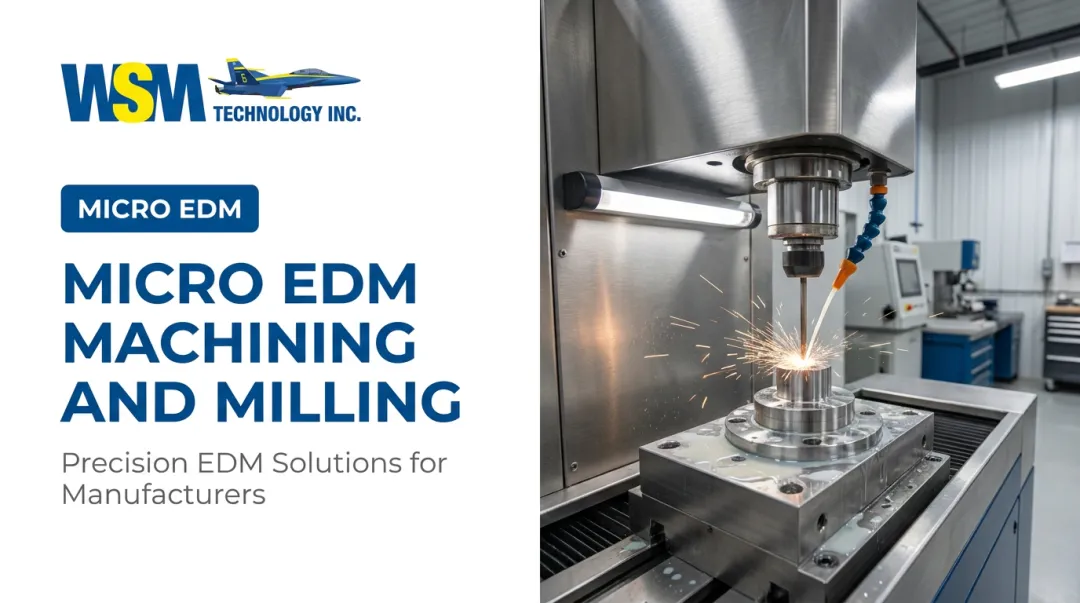
Micro-EDM works differently. Instead of cutting, it uses controlled electrical discharges (sparks) between an electrode and a conductive workpiece submerged in dielectric fluid. Each spark vaporizes a tiny bit of material. No mechanical force means no tool deflection or chatter.
This makes Micro-EDM ideal for:
- Hard, conductive materials that resist cutting tools
- Intricate internal geometries standard tools can't reach
- Features where zero mechanical stress on the workpiece matters
The tradeoff is electrode wear , since both the tool and workpiece participate in the discharge, and debris removal, which affects finish quality.

What the Equipment Needs
Precision micro demands machine platforms built differently from standard CNC equipment:
- Extreme rigidity to resist even microscopic flex
- High-speed, high-precision spindles with minimal runout
- Thermal stability : heat expansion at this scale ruins tolerances
- Vibration dampening, since ambient shop vibration can register as machining error
Makino's engineering guidance offers a useful rule of thumb: your system should be 10 times more accurate than your target tolerance. Chasing ±0.0002" means your machine needs roughly half-a-micron precision at the system level.
Two more constraints sit on top of the machine itself:
- Tool size caps feature size: you can't cut a 50-micron slot with a 100-micron tool
- Toolpath precision is mandatory: miniature tools break easily, and sloppy programming snaps them before a single part is finished

Match the process and the platform to the feature, or the tolerance budget disappears before the first cut.
Where Precision Micro Machining Is Used
Mold, Die, and Micro Molding Applications
Micro-EDM handles mold work where conventional tooling simply can't fit. Fine venting channels, textured cavity surfaces, and small cooling features often require electrode-based erosion rather than a cutting tool. Technical reviews list micro-injection molds and stamping tools among the standard micro-EDM applications.
Aerospace, Medical, and Automotive Applications
- Aerospace: fuel injector nozzles, sensor housings, flow-control components
- Medical: surgical instruments, implants, cardiovascular and orthopedic devices in titanium and PEEK
- Automotive: actuator components, fuel-injection parts, airbag sensor elements
SME identifies medical, aerospace, and automotive as core micromanufacturing sectors, citing biomedical growth of 16% annually in earlier industry tracking. That earlier growth still points to sustained demand across these segments.
Benefits and Limitations
Benefits:
- Superior surface finish, down to sub-micron form accuracy in controlled setups
- High repeatability for demanding tolerance callouts
- EDM access to hard-to-machine, conductive materials
- Non-contact erosion with no cutting-force-related part distortion
Limitations:
- Miniature tools break easily under stress
- Extreme tolerances mean longer cycle times
- Electrode wear affects consistency in EDM work
- Specialized, calibrated equipment only — not general-purpose machines
Those tradeoffs are why precision micro work rarely succeeds on a standard mill or general-purpose EDM. The tolerance window is too tight, and the machine was never built for that class of work.
Choosing the Right Precision Micro Machining Partner
A shop evaluating precision micro capability should look for:
- Dedicated micro-EDM or micro-milling equipment, not general-purpose machines pressed into service
- Test-cut and demonstration capability to prove out a process before committing
- Technical training and application support for staff running the equipment
- A reliable consumables supply chain for ongoing production
WSM Technology, based in Rootstown, Ohio, represents Sarix Micro EDM equipment (a Swiss platform in production since 1993) for shops across Northern Ohio, Western Pennsylvania, and West Virginia. The Sarix line supports 3D micro-EDM milling, micro-hole EDM drilling, and high-production hole drilling, aimed at micro molding, aerospace, textile, micro-mechanics, and automotive applications.

WSM's Demonstration Center in Rootstown lets shops run test cuts and time studies before buying, a practical way to validate a process on your actual geometry rather than trusting a spec sheet alone. Installation, user training, and technical support come with the purchase.
For ongoing production, consumables matter as much as the machine. WSM's CPG Department supplies EDM wire, filters, and resin tanks, while its Encore Group affiliation supports refurbished machine service and OEM parts, keeping micro-EDM lines running without long supply gaps.
WSM's team brings direct shop-floor background to these conversations:
- Blaise Buholzer (Founder) completed a four-year precision-mechanics apprenticeship in Switzerland, then spent decades as an EDM application engineer and trainer
- Phillip Warlop Jr. (Sales) ran sinker EDM machines and programmed injection molds for years before moving into plant management
That mix of hands-on machining and equipment expertise shapes how they advise shops evaluating micro-EDM investments.
Frequently Asked Questions
What is the difference between micro-machining and precision machining?
Precision machining refers broadly to repeatable, tight-tolerance work. Micro-machining specifically involves tools and features in the micrometer range. The two overlap significantly, but not every precision job is micro-scale.
What tolerances can precision micro-machining achieve?
Many precision micro-machining processes can hold tolerances of ±0.001 inch or tighter, depending heavily on material, geometry, and equipment. Always confirm achievable tolerance with your specific machine and part, not a general industry figure.
What materials work best for precision micro-machining?
Stainless steel, titanium, tool steel, and select engineering plastics are common choices. Micro-EDM specifically requires electrically conductive materials, since it removes material through electrical discharge.
Is Micro-EDM better than micro-milling for small features?
Micro-EDM excels with conductive materials and complex internal geometries where cutting forces would cause problems. Micro-milling handles a broader range of materials and works well for external, 3D-cut features.
How small can precision micro-machined features be?
Features can range from a few micrometers up to under 500 micrometers — well below the width of a human hair, which averages around 70 micrometers.
Who uses precision micro-machining services?
Mold and die makers, medical device manufacturers, aerospace suppliers, and automotive component producers are the primary users, alongside micro molding and micro-mechanics shops.