
Introduction
Every mold shop eventually hits the same wall: CNC milling gets you 80% of the way through a mold build, then stops cold. Blind pockets with no tool-exit path, internal corners tighter than any practical end mill — these aren't edge cases.
Deep narrow ribs where tool deflection compounds with every inch of depth are routine features in injection mold design. Standard rotary tooling has no answer for them.
Sinker EDM was built specifically for this problem. It erodes metal through controlled electrical discharge rather than mechanical cutting, producing cavity geometry that rotary tooling cannot reach. It does this in fully hardened tool steel, after heat treatment, with no distortion risk.
This guide covers how sinker EDM fits into the mold build sequence, electrode selection, comparisons with wire EDM and CNC milling, and what to evaluate when choosing a machine.
Key Takeaways
- Sinker EDM erodes cavities with a shaped electrode and controlled sparks: no mechanical contact, no cutting forces, no distortion
- Blind cavities, deep ribs, sharp internal corners, and textured surfaces are standard sinker EDM territory — not CNC
- Graphite electrodes cut faster; copper electrodes finish finer; most mold jobs require both
- Modern sinker EDM holds ±0.002–0.004 mm tolerances and achieves near-mirror finishes, cutting hand polishing time
- Sinker EDM and wire EDM are complementary: cavity work typically needs sinker, exterior profiles need wire
How Sinker EDM Works in Plastic Injection Mold Manufacturing
The Core Process
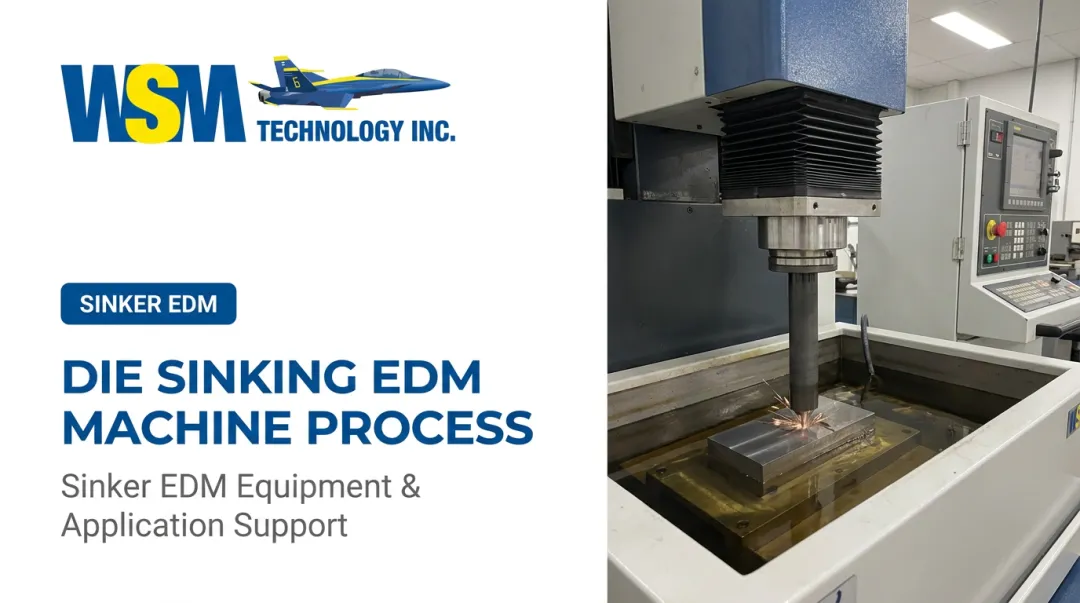
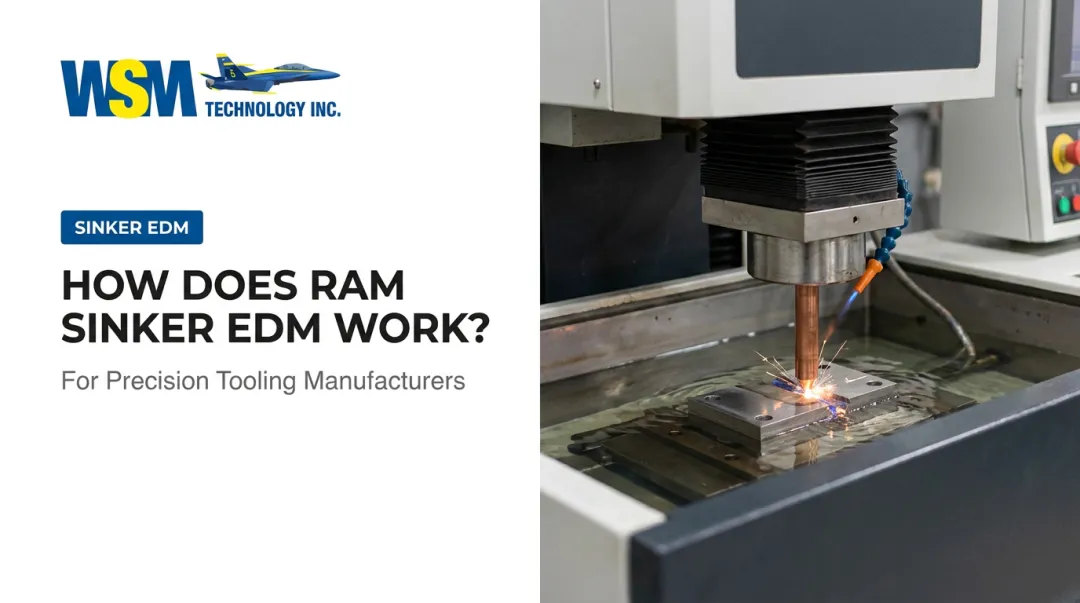
A shaped electrode — graphite or copper — advances toward the hardened mold steel workpiece. Both are submerged in dielectric fluid. Controlled electrical discharges across a precise spark gap erode the workpiece without any physical contact between electrode and steel.
The numbers are striking: at 20 microseconds on and 30 microseconds off, the EDM process generates 20,000 discharge cycles per second. Each micro-spark removes a tiny amount of material. Cumulatively, those sparks burn the electrode's inverse shape into the steel with geometry that mechanical tooling cannot replicate.
Why Non-Contact Machining Matters for Mold Work
No cutting forces means no deflection, no mechanical stress, and no distortion of fine mold features. CNC end mills flex under load — that deflection increases with tool length and workpiece hardness.
In hardened tool steel above roughly 60 HRC, hard milling requires specialized tooling, very stable machine conditions, and geometry that allows proper tool access. For deep, narrow, or complex cavity features, those conditions are rarely met simultaneously.
Sinker EDM sidesteps the problem entirely. The electrode doesn't touch the workpiece.
Dielectric Fluid: More Than Just Coolant
Dielectric fluid does three things in a sinker EDM operation:
- Controls spark geometry: ionizes momentarily during each discharge, then de-ionizes to reset the gap
- Cools the work zone: limits heat buildup during thousands of discharge cycles per second
- Flushes eroded particles from the cutting zone, preventing re-deposition on the cavity surface
Contaminated or poorly managed dielectric directly degrades cavity accuracy. Maintaining proper fluid cleanliness — through adequate filtration and regular filter and resin tank replacement — is not optional for precision mold work.
The Post-Heat Treatment Advantage
Conventional mold shops face a difficult choice: machine cavities before hardening, then accept whatever dimensional change heat treatment introduces. According to ASM International, size change in most tool steels during heat treatment runs 0.05% to 0.10%, with some grades seeing machining allowances of 0.15% to 0.30% depending on grade and geometry. That's real dimensional drift — enough to push a precision cavity out of tolerance.
Sinker EDM eliminates this problem. Finish the cavity geometry after the steel is fully hardened. Heat treatment distortion becomes irrelevant to the final cavity dimensions.
Where Sinker EDM Fits in the Mold Build Sequence
The standard mold build sequence looks like this:
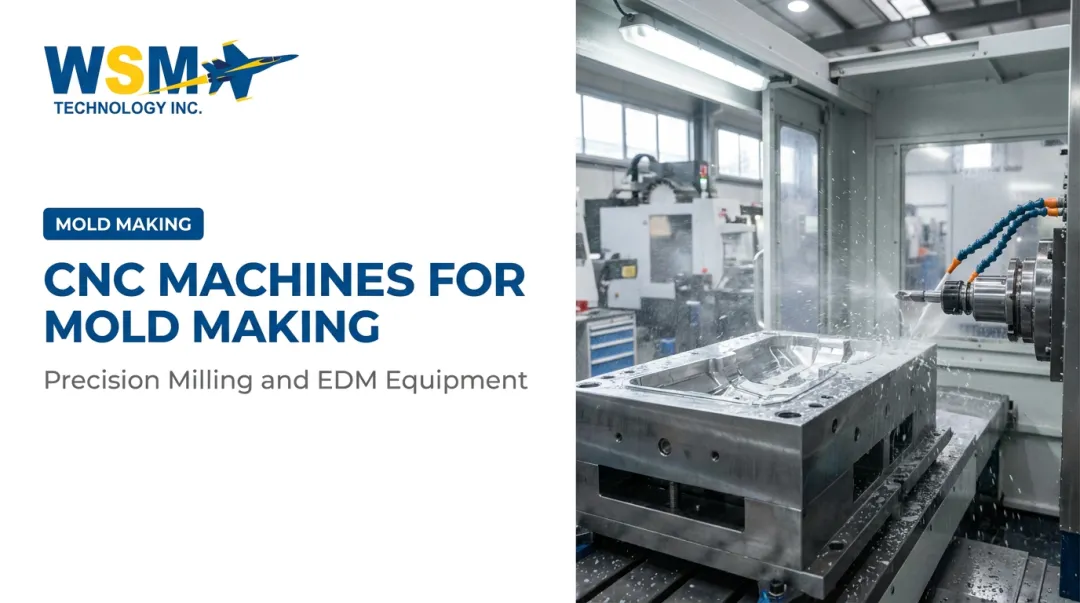
- CNC roughing removes bulk material quickly and cost-effectively
- Sinker EDM handles finish geometry and features CNC cannot reach
- Hand polishing is minimal — EDM surface quality often meets spec without it

Sinker EDM isn't competing with CNC milling. It picks up where milling stops.
Key Applications of Sinker EDM in Injection Mold Manufacturing
Blind Cavities and Deep Ribs
Blind cavities — pockets with no through-cut — are the defining application for sinker EDM. A CNC end mill cannot exit a blind pocket, and deflection increases dramatically as depth-to-diameter ratio climbs.
Real-world example: Redoe Mold, working with Makino sinker EDM technology, burned a rib 0.027 inches wide to 1.6 inches deep — an aspect ratio that makes CNC milling impractical. A sinker EDM electrode plunges directly to final depth, holding geometry without deflection, regardless of how narrow or deep the feature is.
Sharp Internal Corners
Every rotating end mill leaves a radius in any internal corner equal to at least half the tool diameter. That's physics: you cannot cut a sharper internal corner than the tool's radius.
Injection molds for snap fits, living hinges, and interlocking features routinely require internal corner radii far smaller than any practical end mill allows. Sinker EDM electrodes, machined from fine-grain graphite grades like POCO's EDM-3, which can be machined to 0.1 mm or less in thickness, produce sharp internal geometry that rotary tooling cannot achieve. The geometry is simply impossible with a spinning cutter.
Mold Surface Texturing
Sinker EDM can burn specific surface texture directly into a mold cavity by adjusting discharge energy and pulse parameters. This produces:
- Matte finishes for non-reflective plastic part appearances
- Stipple and grip patterns for consumer product surfaces
- Controlled roughness values matched to part functional requirements
Achieving texture in the same EDM operation that forms the cavity geometry eliminates secondary chemical etching in many cases , cutting process steps and lead time without adding a separate operation.
Mold Repair and Cavity Modification
This application is frequently overlooked. When a production mold needs a cavity modification — adding a rib, adjusting a boss, correcting a dimension after sampling — sinker EDM allows controlled metal removal in exactly the right area without disturbing surrounding geometry.
Weld-based repair follows the same logic:
- Apply a tooling weld to the damaged mold section
- Machine the weld area back to precise dimensions with sinker EDM
Because the electrode never contacts the workpiece, there's no risk of distorting the surrounding cavity geometry during the remachining step.
Gate, Runner, and Core Detail Work
Gate land areas, sub-gate pockets, lifter and slide pockets, and small core pin details all share one characteristic: tight tolerances in complex, confined geometry. These features directly affect plastic flow, part quality, and cycle time.
Getting them right the first time matters. Sinker EDM's accuracy in hardened steel is well-suited to finishing these details after the mold reaches full working hardness, avoiding the dimensional risk of machining soft and hardening later.
Sinker EDM vs. Wire EDM vs. CNC Milling: Which Does Your Mold Need?
The Fundamental Distinction
Each process has a defined role in mold manufacturing. Choosing between them should be a feature-by-feature decision, not a blanket shop preference.
| CNC Milling | Wire EDM | Sinker EDM | |
|---|---|---|---|
| Geometry type | Open surfaces, pockets with tool access | Through-profiles, 2D contours | 3D blind cavities, enclosed geometry |
| Hardness capability | Practical limit ~60 HRC with specialized tooling | Not affected by hardness | Not affected by hardness |
| Tooling prep required | Standard toolpaths, standard cutters | Wire threading through start hole | Shaped electrode must be machined first |
| Best use case | Bulk material removal, open geometry | Insert pockets, punch profiles, precision through-holes | Blind cavities, deep ribs, sharp corners, textured surfaces |

The Wire EDM vs. Sinker EDM Distinction
Wire EDM requires a through-hole to thread the wire — it cannot produce a blind cavity under any circumstances. It cuts through-profiles and 2D contours with exceptional accuracy.
Sinker EDM creates fully enclosed, blind, three-dimensional impressions.
A mold core will often require both: sinker EDM to form the cavity profile, wire EDM to cut the external profile or insert pocket. These processes work sequentially, not interchangeably. Shops that understand this distinction plan their electrode and fixturing strategy before the first chip falls.
The Hardness Boundary
Mold steel hardness drives process selection more than most shops plan for. Common injection mold steels span a wide range:
- P20 — supplied pre-hardened at 28–32 HRC (within hard milling range)
- H13 — commonly used in the 44–52 HRC range after heat treatment
- S7 — can attain 58–60 HRC
- D2 — a deep-hardening cold-work steel that reaches similar hardness levels
Hard milling tools from manufacturers like Seco are designed for 48–65 HRC, and Kennametal categorizes hard-machining end mills up through "above 60 HRC." The tooling exists, but geometry constraints, depth-to-diameter ratios, and feature access still force sinker EDM into most production mold workflows — hardness alone doesn't determine the process, but it narrows the options fast.
The Economic Decision Point
For features CNC can produce, milling is faster and cheaper per unit of material removed. The decision to use sinker EDM should be driven by three questions:
- Can CNC reach it? (geometry access, depth-to-diameter ratio, blind vs. through)
- Can CNC cut it reliably at this hardness? (tool life, deflection risk at depth)
- Can CNC hold the required tolerance and surface finish? (Ra requirement, corner radius spec)

If the answer to any of these is no, sinker EDM is the right process for that feature.
Electrode Selection and Operational Considerations
Graphite vs. Copper: Choosing for Mold Work
The choice of electrode material shapes the entire burn strategy.
Graphite electrodes:
- Withstand extreme heat without deforming
- Machine quickly on CNC mills, lowering electrode fabrication time
- Preferred for roughing large cavities and deep ribs where material removal rate is the priority
- Generate fine abrasive dust during milling — dedicated vacuum extraction at the source is required to prevent contaminating other equipment
Copper and copper-tungsten electrodes:
- Lower wear rates during the burn
- Superior surface finish capability, particularly on finishing passes
- Higher electrode material cost and longer machining time to fabricate
- The right choice when Ra value and dimensional accuracy are the priority
Most mold jobs require both. Plan a multi-electrode strategy before the burn cycle begins: rough in graphite, finish in copper. Designing this sequence upfront, rather than improvising after the rough burn, is the mark of a disciplined mold shop workflow. That planning also means accounting for what happens to your electrode — and your workpiece surface — during the burn itself.

Managing Electrode Wear and Recast Layer
Electrode wear is unavoidable. Every spark removes a small amount of electrode material alongside the workpiece, and uncompensated wear undersizes the cavity as the burn progresses. Modern CNC sinker EDM controls address this through adaptive wear compensation — calculating expected wear and adjusting Z-axis depth in real time to maintain target cavity dimensions.
The recast layer — sometimes called the white layer — is a less visible problem with lasting consequences. Rapid melting and re-solidification at the eroded surface creates a thin, brittle zone.
In production injection molds that undergo repeated thermal cycling, this layer can crack, leading to premature surface failure and reduced mold life.
Research published in Procedia CIRP confirms that white-layer thickness increases with discharge energy — meaning roughing passes produce thicker recast layers than finishing passes. Operational practices that minimize recast layer thickness:
- Optimized dielectric flushing pressure
- Low discharge energy on final finishing passes
- Consistent dielectric fluid maintenance to prevent contamination
Key Features to Evaluate When Selecting a Sinker EDM Machine
Generator Technology
The generator is the most important differentiator between sinker EDM machines. It controls spark energy, frequency, and pulse shape — and its intelligence determines how well the machine handles real-world burn conditions.
Look for adaptive generators that adjust parameters in real time based on gap conditions. This prevents short circuits, reduces electrode wear, and maintains dimensional accuracy through long unmanned burn cycles. Mitsubishi's generator technology, for example, incorporates AI adaptive control to improve performance and electrode wear management, with advanced circuit options including nano-pulse capability for ultra-fine surface finishes.
Automation and Thermal Stability
Automatic tool changers (ATC) allow a machine to run multiple electrode passes unattended — rough, semi-finish, and finish stages — through a complete cycle without operator presence. For mold shops, this means a full cavity burn can run overnight and be ready for inspection in the morning.
Thermal stability features are non-negotiable for micron-level accuracy across multi-hour burns:
- Dielectric temperature control systems regulate fluid temperature to prevent thermal drift
- Glass scale linear encoders on all axes eliminate mechanical errors from leadscrew thermal expansion
- These systems maintain accuracy across burn cycles that last hours, not minutes

Working with WSM Technology
WSM Technology is an authorized dealer for Mitsubishi sinker EDM machines, serving mold shops across Northern Ohio, Western Pennsylvania, and West Virginia. Their Demonstration Center in Rootstown, Ohio allows mold shop owners to run test cuts on actual workpiece materials before purchasing — a meaningful advantage over buying based on spec sheets alone.
The WSM team brings genuine mold shop experience to these evaluations. Office Manager John Riegler spent over 15 years running sinker EDM in a production mold shop before joining WSM. Sales representative Phillip Warlop Jr. ran sinker EDM machines at Portage Mold & Die and later programmed all components of plastic injection and rubber compression molds at Monitor Mold & Machine.
When they're advising on electrode strategy or burn parameters, it's experience speaking — not sales material.
WSM offers:
- New and refurbished Mitsubishi sinker EDM machines
- EDM consumables — filters and resin tanks — through the affiliated CPG Department
- Direct access to the team for application-specific guidance
Reach them at (330) 962-8308 or sales@wsmtechnology.com to discuss your mold application.
Frequently Asked Questions
What are the capabilities of a sinker EDM machine for plastic injection molds?
Sinker EDM produces blind cavities, internal corners with very tight radii, deep narrow ribs, textured surfaces, and precise geometry in fully hardened mold steels — all features that CNC milling cannot reliably achieve. Modern machines hold tolerances of ±0.002–0.004 mm and achieve surface finishes down to Ra 0.2 μm.
What is the difference between sinker EDM and wire EDM for mold making?
Sinker EDM uses a shaped electrode to create 3D blind cavity geometry; wire EDM uses a continuous brass wire to cut through-profiles and 2D contours, requiring a through-hole. Both appear in mold building, but for entirely different features — they work sequentially on the same mold, not as alternatives to each other.
What electrode material is best for plastic injection mold cavities?
Graphite is preferred for roughing large cavities at higher material removal rates. Copper or copper-tungsten is used for finishing passes where surface finish (Ra) and dimensional precision are the priority. Mold jobs typically use both in a planned rough-to-finish sequence.
Can sinker EDM be used to repair or modify an existing injection mold?
Yes. Sinker EDM is a standard tool for mold repair. It handles steel weld repairs back to precise dimensions and controlled cavity modifications for engineering changes — without disturbing the surrounding mold geometry.
How long does it take to EDM a plastic injection mold cavity?
Cycle time depends on cavity volume, electrode design, and required surface finish — roughing is faster, while fine finishes require slower, lower-energy passes. Complex cavities can span hours to multiple days across several electrode sequences.
What surface finish can sinker EDM achieve on a plastic injection mold?
Sinker EDM can produce surface finishes ranging from matte and stippled textures down to near-mirror finishes of Ra 0.2 μm. This range often eliminates or substantially reduces the hand polishing labor required after machining.