
Key Takeaways
- Natural granite beds offer a coefficient of thermal expansion roughly 30–55% lower than gray cast iron, making them a superior thermal reference for precision grinding.
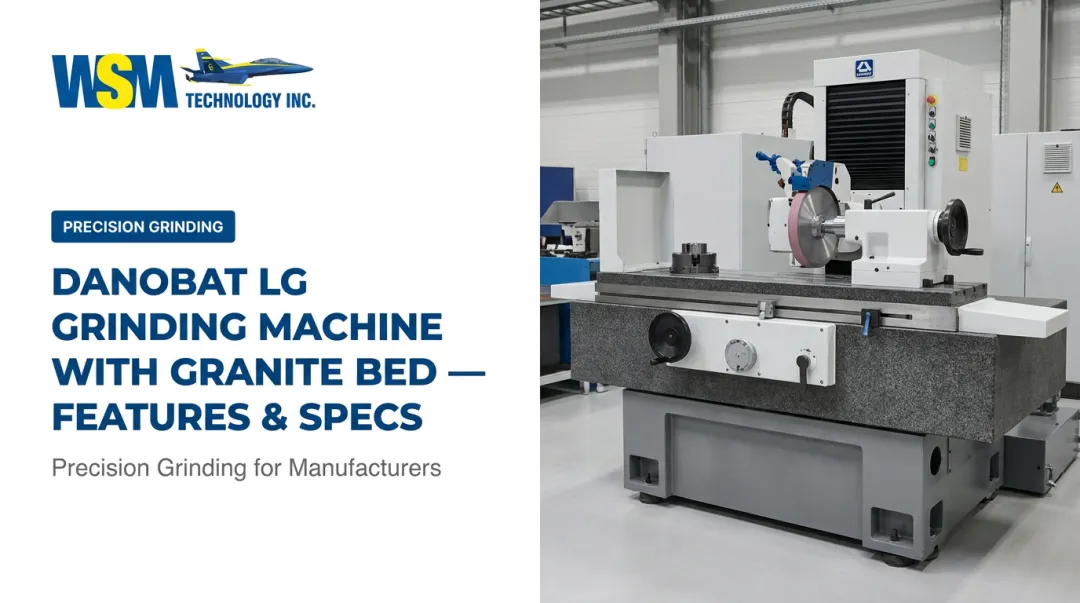
- DANOBAT integrates granite beds in the LG series, ESTARTA centerless grinder, and CG compact production grinder to support sub-micron repeatability.
- Granite's stress-free, stable structure pairs directly with linear motors and optical scales to govern real-world positioning accuracy.
- Aerospace match grinding tolerances typically fall within 1 micron, making granite bed stability essential rather than optional in those supply chains.
- WSM Technology serves mold shops, automotive suppliers, and precision manufacturers across Northern Ohio, Western Pennsylvania, and West Virginia with DANOBAT grinding solutions.
What Is a Granite Machine Bed and Why Does It Matter in Grinding?
The machine bed — sometimes called the base or structure — is the geometric foundation that supports every moving axis, spindle, and workholding component on a grinding machine. Its material properties set the ceiling on achievable tolerance and surface finish, regardless of how sophisticated the control system or spindle is above it.
The Physical Case for Granite
Natural granite offers four material characteristics that make it particularly well-suited to precision grinding platforms:
- Low thermal expansion — NIST measurements of domestic granites place the coefficient of thermal expansion (CTE) at 4.8 to 8.3 × 10⁻⁶/°C (average 6.2 × 10⁻⁶/°C) across a –20 to +60°C range. Gray cast iron measures around 10.8 µm/m·°C by comparison.
- No residual stress — Unlike cast iron or welded steel frames, solid granite has no internal stresses from casting, welding, or heat treatment. The block maintains its geometry throughout the machine's service life without progressive distortion.
- Inherent vibration damping — DANOBAT states that both its LG and ESTARTA machines benefit from the natural granite bed's vibration damping properties. This damping absorbs high-frequency cutting forces before they reach the workpiece.
- Electrical non-conductivity — Eliminates stray current concerns in precision grinding environments where sensitive measurement systems operate near the cutting zone.
Why Vibration Damping Matters Specifically in Grinding
Of the four properties listed above, vibration damping deserves closer attention because its effect is direct and measurable. Grinding involves repetitive, high-frequency cutting forces at the wheel-workpiece interface. Any vibration that travels through the bed shows up as chatter marks, roundness scatter, or surface finish degradation.
A bed material that absorbs these micro-vibrations, rather than transmitting or amplifying them, removes one of the most persistent sources of part-to-part variation in high-production environments.
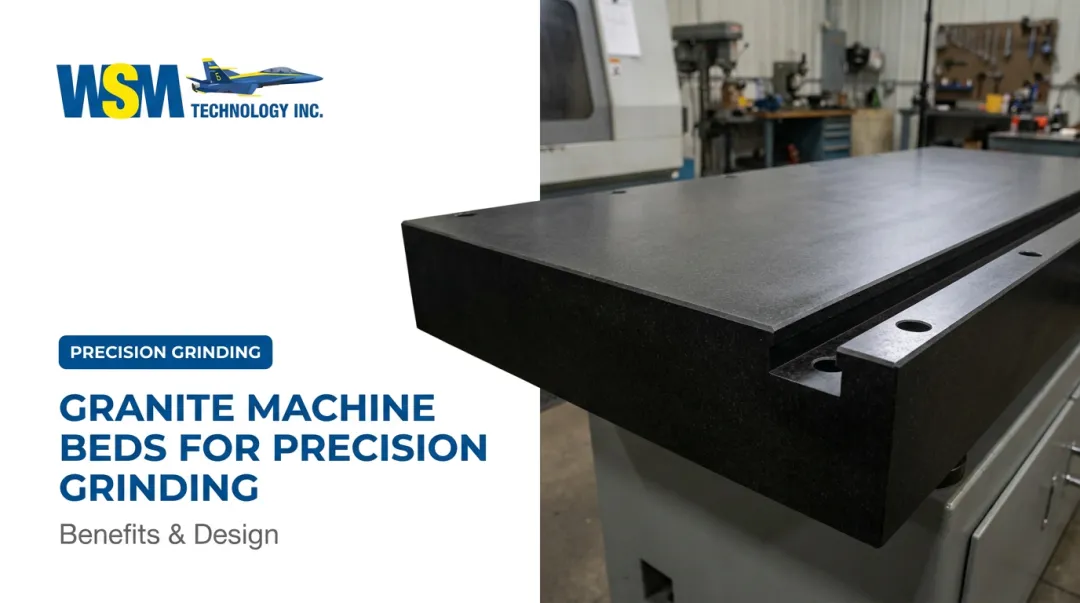
DANOBAT sources natural granite blocks lapped or precision-ground flat, then mounts all guideways and structural elements directly to that surface — so dimensional stability starts at the foundation, not as an afterthought.
Granite Beds vs. Cast Iron and Polymer Concrete
Three structural materials dominate precision grinding machine design. Each involves trade-offs worth understanding before specifying a machine.
Material Comparison
| Property | Natural Granite | Gray Cast Iron | Polymer/Epoxy Granite |
|---|---|---|---|
| CTE (µm/m·°C) | 4.8–8.3 (NIST avg. 6.2) | 10.8 | 12–17 (varies by formulation) |
| Vibration damping | Outstanding (DANOBAT qualitative) | Moderate — tends to ring | High (qualitative) |
| Long-term stability | Excellent — used in precision metrology | Requires stress relief; can creep | Good — composite material |
| Compressive strength | High (not independently verified here) | Established machine-tool standard | ~130–160 N/mm² (Schneeberger/EPUMENT) |
| Design flexibility | Low — block form only | High — castable to complex shapes | High — castable with embedded inserts |

Sources: Engineering ToolBox CTE data; Schneeberger mineral casting; EPUMENT mineral casting.
What the Numbers Mean in Practice
For a 1-meter machine structure subjected to a 1°C ambient temperature change:
- Natural granite grows approximately 4.8–8.4 µm
- Gray cast iron grows approximately 10.8 µm
- Polymer granite grows approximately 12–17 µm
That difference compounds across a production shift. A 3°C swing through the day, which is common in uncontrolled shop environments, translates to positional drift two to three times larger in a cast iron machine than in its granite-bed equivalent.
Natural Granite vs. Polymer Granite
Polymer granite (epoxy granite or mineral casting) offers excellent vibration damping and allows complex base geometries to be cast rather than carved. Its CTE is actually higher than natural granite, though, and its performance relies on consistent bonding throughout the casting — a process variable that natural stone eliminates entirely.
DANOBAT's LG, ESTARTA, and CG machines specify natural granite, chosen for its dimensional stability, high compressive strength, and proven track record in ultra-precision grinding environments.
Natural granite beds are heavier and costlier to manufacture than cast iron housings. That's a deliberate engineering trade-off: shops grinding tight-tolerance components in aerospace, medical, or tooling applications get measurably better thermal stability in return, which shows up directly in part-to-part consistency over a full production shift.
Key Performance Benefits of DANOBAT Granite Bed Grinding Machines
Thermal Stability and Geometric Consistency
Granite's low CTE means the bed acts as a passive thermal reference — it changes dimension slowly and predictably as shop temperature fluctuates. DANOBAT builds on this passive foundation with active thermal management on dynamic heat sources: cooled electro-spindles, hydrostatic oil temperature control, and cooled optical scales on linear motor axes. The granite handles ambient drift; active cooling handles cutting heat.
Surface Finish and Roundness Through Damping
The combination of granite's inherent damping and, in several models, additional engineered damping systems allows DANOBAT machines to operate at wheel peripheral speeds up to 120 m/s (with a technical maximum of 140 m/s on the LG series) while minimizing vibration transfer to the workpiece. The DANOBAT IRD-400, for example, is documented as capable of reaching 0.5 µm roundness deviations in round contours — a figure cited in DANOBAT's own 2018 BIMU release.
The Linear Motor and Optical Scale Synergy
Granite beds deliver their full value only when paired with:
- Linear direct-drive motors — No mechanical transmission elements means no backlash, no wear, and no compliance between drive command and actual slide movement.
- Optical or glass scales — Position feedback measured directly at the structural reference, not inferred through a ballscrew.
The granite bed keeps the scale reference dimensionally stable; the linear motors eliminate mechanical error sources between drive and slide. Together, the LG series achieves published accuracy of ±1.5 µm with 1 µm positioning repeatability.

Reduced Maintenance Burden
Because granite doesn't wear, corrode, or fatigue like metal structures, the geometric reference remains stable throughout the machine's service life. DANOBAT compounds this advantage across its lineup:
- ESTARTA centerless grinder replaces hydraulic elements with electric actuators — 32% fewer components overall
- LG series linear motor drives operate with no mechanical contact and no wear
- Spindle bearings are lifetime-greased, eliminating scheduled relubrication
- Fewer consumables and longer service intervals throughout machine life
DANOBAT Grinding Machine Models Featuring Granite Beds
Natural granite beds are a design specification — not an optional upgrade — on the following DANOBAT machine families. Note that the PG and WT series specify stress-relieved pearlitic cast iron and should not be confused with the granite-bed lines described here.
LG Series: High-Precision External Cylindrical Grinding
The LG series is DANOBAT's ultra-precision external cylindrical grinding platform. Its granite bed pairs with linear motors and optical scales to deliver:
- ±1.5 µm accuracy, 1 µm positioning repeatability
- Cooled electro-spindles reaching 120 m/s peripheral speed (140 m/s technical maximum), covering both conventional abrasive and superabrasive CBN ranges
- CNC-controlled follow-up steady rest on the LG-1000 variant — reliable only because the granite bed prevents geometric reference shift under varying workpiece weight or cutting force
Typical part applications include precision hydraulic components, automotive cams and drivetrain parts, cutting tools, and eccentric diameter components.
ESTARTA: High-Rigidity Centerless Grinding
The ESTARTA centerless grinder combines a granite bed with linear motors, a novel damping system, and a drive head with additional support that eliminates cantilever flex. Key specifications:
- Maximum wheel peripheral speed: 120 m/s
- Wheel widths up to 650 mm, workpiece diameters up to 250 mm
- Spindle power up to 110 kW
- Hydraulic elements replaced by electric actuators — 32% fewer components, lower fluid consumption, more sensitive movement response
Throughfeed at very high speeds amplifies structural resonance in centerless grinding more than in almost any other process. The granite base absorbs those dynamic forces before they produce roundness or diameter errors in the part.
CG: Compact High-Production Grinding
The CG is DANOBAT's compact production grinder, built on a natural granite bed for high-volume external grinding where floor space is limited but tolerances are not. Key specifications:
- Direct-drive workhead and linear motors for responsive, low-maintenance motion control
- Integrated measuring units for in-process feedback
- Wheel capacity up to 24 inches at speeds up to 15,750 sfpm
This combination makes the CG well suited for production environments that need consistent dimensional output across large part runs without the footprint of a full-scale cylindrical grinder.
Industries and Applications That Benefit Most from Granite Bed Grinding
Sub-micron and single-micron repeatability enabled by granite beds moves from "nice to have" to "required" in four manufacturing sectors:
- Aerospace — United Grinding notes that match grinding tolerances for valve seats and lifters are typically within 1 micron. Turbine components, landing gear parts, and actuator components all fall into this range.
- Automotive and hydraulics — Hydraulic valves, fuel system components, cam profiles, and bearing seats demand consistent diameter and roundness across long production runs. Thermal drift in a cast iron machine forces mid-run dimensional corrections; granite bed stability eliminates that interruption.
- Bearing manufacturing — Bearing rings and raceways where roundness directly determines noise, heat, and service life. SKF's waviness and roundness analyzer operates with spindle runout better than 0.02 µm — measuring parts that require geometric control at that same scale.
- Mold and die — Complex die geometries requiring coordinate grinding to radius contours at or below 0.5 µm depend on a bed that doesn't shift between setups.
- Precision hydraulics, medical devices, and cutting tools — Surface finish consistency across long runs is non-negotiable. Any mid-run dimensional variation means scrapped parts or interrupted cycles.

WSM Technology works with manufacturers across Northern Ohio, Western Pennsylvania, and West Virginia in exactly these sectors — mold and die shops, automotive suppliers, and precision mechanics operations. Contact WSM for application-specific consultation and test cuts to confirm whether a DANOBAT granite bed machine meets your tolerance and cycle time requirements.
Frequently Asked Questions
Why do precision grinding machines use granite beds instead of cast iron?
Granite offers a coefficient of thermal expansion roughly half that of gray cast iron, no internal residual stress from manufacturing, and superior vibration absorption. These three properties combine to produce tighter tolerances and more consistent part quality over long production runs — particularly in environments where shop temperature fluctuates during a shift.
Which DANOBAT grinding machines feature granite beds?
The LG series (external cylindrical grinding), the ESTARTA centerless grinder, and the CG compact high-production grinder all specify natural granite beds as a core structural component. The PG and WT series use stress-relieved pearlitic cast iron and should not be listed as granite-bed machines.
How does a granite bed improve grinding accuracy?
Granite maintains geometric stability under both thermal fluctuation and cutting-force vibration, preventing the bed from becoming a source of positional error. This allows linear motors and optical scales to deliver their full positioning precision to the workpiece — rather than correcting for drift in the structural reference beneath them.
Does a granite bed require special maintenance or environmental conditions?
Natural granite requires no lubrication, no treatment, and is not susceptible to corrosion. Precision machines using granite beds are best operated in temperature-controlled environments. DANOBAT supplements the granite's passive thermal stability with active cooling on spindles, hydrostatic oil systems, and optical scales to address dynamic heat sources.
What is the difference between natural granite and polymer granite beds?
Natural granite is a quarried stone block with high compressive strength and a long track record in ultra-precision grinding and metrology. Polymer (epoxy) granite is a composite cast material offering design flexibility and high vibration damping, but its CTE runs higher — typically 12 to 17 µm/m·°C compared to natural granite's lower range. DANOBAT's referenced machines use natural granite for dimensional stability in high-precision applications.
Are DANOBAT granite bed grinding machines suitable for aerospace and automotive applications?
Yes. The LG series and ESTARTA target these sectors directly, meeting sub-micron roundness and surface finish requirements for hydraulic components, bearing seats, turbine parts, and precision drivetrain components. Aerospace match grinding tolerances typically fall within 1 micron, and these machines are built to sustain that range across production volumes.