
Introduction
Walk into any mold shop, aerospace supplier, or medical device manufacturer, and you'll likely find a wire EDM machine running unattended overnight. Wire erosion has become the go-to method for cutting hardened tool steel, carbide, and exotic alloys without ever touching the part with a cutting tool.
The market reflects that reliance. Global wire-cutting EDM machine revenue is projected to grow from $2.68 billion in 2025 to $4.58 billion by 2035, a 5.5% CAGR, according to Future Market Insights.
Yet plenty of shops still use "wire erosion," "wire EDM," and "spark erosion" as if they're identical terms. That mix-up leads to sharp internal corners nobody can actually cut, or tolerance callouts the machine can't hit. This guide breaks down what wire erosion really is, stage by stage.
Key Takeaways
- Wire erosion uses electrical sparks, not mechanical force, to erode conductive material along a set path
- Deionized water controls the spark gap, cools the cut, and flushes away debris
- The process runs in four stages: threading, sparking, gap regulation, and finished output
- Best suited for hardened, thick, or intricate parts where milling and grinding fall short
- Precision can reach single-digit micron ranges on high-end machines with skim passes
What Is Wire Erosion?
Wire erosion is a thermal, non-contact machining process. A continuously fed thin metal wire, usually brass, acts as an electrode. It generates controlled electrical discharges that erode a conductive workpiece along a CNC-programmed path — no cutting force, no tool wear from mechanical contact.
That distinction matters because traditional cutting tools struggle with fully hardened materials. A mill or grinder pushing against a 62 HRC tool steel block generates mechanical stress, tool deflection, and rapid tool wear.
Wire erosion sidesteps all of it. SME's EDM study guide describes the wire as never touching the work at all, with a servo system holding it roughly 0.001 inches away.
Wire Erosion vs. Sinker EDM vs. Spark Erosion
This is where terminology gets muddy. Here's the practical breakdown:
| Term | What it actually means |
|---|---|
| Wire erosion / Wire EDM | Continuously fed wire cuts 2D and tapered profiles through the part |
| Sinker EDM (die-sink) | A shaped electrode plunges into the workpiece to form a cavity |
| Spark erosion | Used industry-wide for both processes, not exclusively a sinker term |
Manufacturers themselves aren't consistent. Makino uses "spark erosion" for EDM generally, while FANUC Europe calls its wire process "Wire Cutting EDM." If a supplier says "spark erosion," ask which machine type they mean.
Submerged vs. Coaxial Flushing
Most modern wire EDM machines submerge the workpiece fully in dielectric fluid rather than relying on nozzle-fed coaxial flushing. Per Sodick's comparison, submerged cutting starts at optimal power immediately because the fluid environment stays consistent: no ramp-up period while a fluid "umbrella" forms around the wire.
The result: fewer wire breaks, faster cuts, and steadier surface finish, especially on parts with varying height or cavities.

How Does Wire Erosion Work?
Wire erosion runs through a defined sequence: thread the wire, erode material, regulate the gap in real time, and produce a finished profile. Each stage shapes the final speed, accuracy, and finish.
Initiation
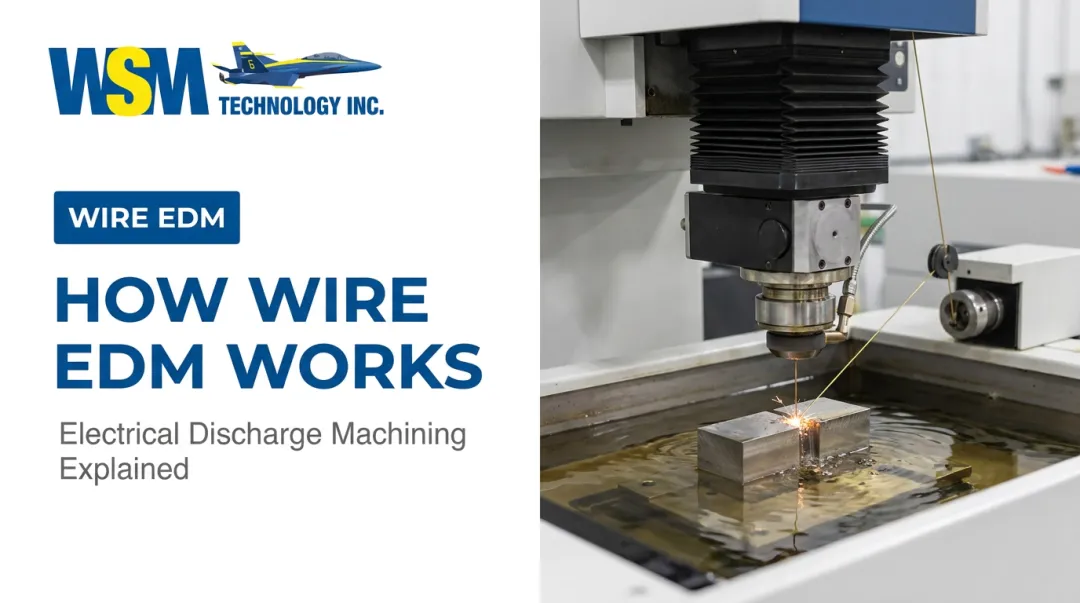
The wire path typically starts through a wire start hole (WSH), often pre-drilled using fast-hole EDM. The wire feeds from a spool, passing between upper and lower guide heads before threading through that hole.
On modern CNC wire EDM machines, this threading step is largely automated. Mitsubishi's Intelligent Auto-Threader, built into machines like the MV1200S that WSM Technology stocks for demo at its Rootstown facility, re-threads the wire automatically after a break.
This matters most during multi-cavity jobs, where manual re-threading would otherwise eat production hours. Workpiece alignment and fixturing, however, remain manual steps.
Common bottleneck: Wire breakage during threading. Worn guide pins or incorrect tension stalls the machine until an operator manually re-threads it, which is exactly the kind of downtime automated threaders were built to eliminate.
Core Operation
Once threaded, the actual erosion begins. A high-voltage pulse between the wire (cathode) and the workpiece (anode) causes dielectric breakdown: a plasma channel forms, a spark fires, and a microscopic amount of material melts or vaporizes.
The wire moves continuously along X-Y (and often U-V) axes under CNC control. Thousands of discharges fire per second, progressively cutting a kerf slightly wider than the wire itself.
Three variables directly affect how fast and how precisely that kerf gets cut:
- Wire diameter: thinner wire allows tighter internal corners but cuts slower
- Material conductivity: higher conductivity generally supports faster erosion
- Workpiece thickness: thicker material means more surface area per pass, slowing throughput
On cutting speed, GF's CUT P Pro brochure lists a maximum rate of 400 mm²/min (37.7 in²/hr) for that model. Actual throughput on any given job depends heavily on wire, flushing, and material; there's no single steel-versus-carbide number that applies across machines.
Wire diameter also sets a floor on how tight an internal corner can be. Modern Machine Shop reports that 0.0008-inch wire produces a 0.00044-inch corner radius, useful context when a part print calls for a sharper inside corner than the wire can physically trace.
Regulation / Control
The machine doesn't just fire sparks blindly. A servo system continuously adjusts wire feed and table movement based on real-time discharge feedback, keeping a constant spark gap throughout the cut.
Dielectric fluid, typically deionized water, plays two roles simultaneously:
- Insulates the gap until voltage reaches the critical threshold needed for a spark
- Flushes molten debris away through a filtration and recycling system
If flushing falls short, debris builds up in the gap, a condition machinists call "brassing up." That causes repeated strikes in the same spot, which can short-circuit the cut or snap the wire outright. Filter maintenance directly affects how fast a machine can safely run.
This is one reason WSM Technology stocks filters and resin tanks through its consumables line: worn filtration hardware causes gradual performance loss long before it triggers a visible failure.
Output / Result
The finished profile comes out with a matte finish and a thin recast layer from localized melting. Most parts need no secondary deburring; SME describes EDM as capable of producing burr-free edges, though a recast and heat-affected layer still exists at a microscopic level.
Recast thickness varies by material, but Cutting Tool Engineering cites modern figures around 0.0002 inches or less on well-tuned machines. Multiple skim cuts, progressively finer passes after the initial rough cut, tighten both dimensional accuracy and surface finish.
GF's CUT X series claims ±2 micron pitch and contour accuracy on its high-end platform, per its 2022 release. Real-world results depend on wire type, machine calibration, and how many skim passes the job justifies.
Eroded dies, molds, and punches typically go straight into production or assembly, with no extra finishing pass required.

Where Wire Erosion Is Used
Wire erosion usually sits toward the back end of a manufacturing workflow — after rough stock prep, cutting the final precision profile into dies, punches, extrusion tools, and mold components.
It performs best under specific conditions:
- Hardened or pre-heat-treated conductive materials that would wreck a standard end mill
- Tight 2D or tapered profiles where mechanical force would distort the part
- Thin-to-medium thickness stock
- Jobs where zero mechanical cutting force is a hard requirement
Industry adoption varies by tolerance and material demand:
- Aerospace: turbine components and landing gear parts
- Medical: surgical instruments and orthopedic implant manufacturing
- Automotive: stamping dies and punches
- Mold & die shops: the single most common application across the trade

For features finer than standard wire erosion can reach, micro wire EDM platforms fill the gap. Sarix Micro EDM, a Swiss manufacturer WSM Technology represents across Ohio, Pennsylvania, West Virginia, Michigan, Indiana, and Kentucky, fills that niche. It's built for micro molding and micro mechanics work, where feature sizes drop well below what a standard wire EDM setup can hold.
Shops evaluating whether a job needs standard wire EDM or micro EDM capability can run a test cut at WSM's Rootstown demonstration center to see actual results before committing.
Conclusion
Wire erosion is a staged, non-contact thermal process: threading, sparking, gap regulation, and a finished output with a recast layer. Understanding each stage sets realistic expectations for speed, tolerance, and finish before a job ever gets programmed.
Choosing the right wire type, machine, and dielectric maintenance schedule reduces downtime and scrap more than any single machine upgrade. If you're weighing whether wire erosion fits your next job, WSM Technology can help.
Founder Blaise Buholzer started his career as an application engineer on wire and die-sinker EDM machines. His team now offers test cuts and time studies at the Rootstown demo center to evaluate performance on your actual parts.
Frequently Asked Questions
What is wire erosion?
Wire erosion is a non-contact machining process that uses electrical discharges between a thin wire electrode and a conductive workpiece to remove material. No physical cutting force is involved at any point.
What is the difference between spark erosion and wire erosion?
"Spark erosion" is used broadly across the industry for both wire and sinker EDM. Wire erosion specifically refers to the continuously fed wire process used for 2D and tapered profile cutting.
What is the difference between CNC and EDM?
CNC describes computer-controlled motion, not a removal method — wire EDM machines are themselves CNC-controlled. The real contrast is mechanical cutting (mills, using physical force) versus EDM (electrical discharges, no contact).
Is wire erosion the same as wire EDM?
Yes. "Wire erosion," "wire EDM," "wire burning," and "wire cutting" are used interchangeably across the industry to describe the same process.
What materials can be cut using wire erosion?
Any electrically conductive material works, including hardened tool steel, titanium, carbide, and graphite. Non-conductive materials like plastics or ceramics cannot be processed this way.
How precise is wire erosion machining?
High-end machines can achieve accuracy in the single-digit micron range, with some manufacturers citing figures around ±2 microns. Actual results depend on wire diameter, machine calibration, and how many skim passes the job runs.