
These aren't edge cases. They're the direct consequence of letting a process gap reach the finished product.
Precision machining for aerospace and medical isn't dangerous because the technology is inherently unpredictable. It's high-risk because the materials are actively hostile to conventional approaches, the regulatory consequences of nonconformance are severe, and most failures trace back to skipped checks and process shortcuts — not catastrophic machine failures.
This article covers where those risks concentrate, how they compound, and what disciplined shops do to stay ahead of them.
Key Takeaways
- Aerospace and medical machining operates under near-zero defect tolerance — risk management is process discipline, not a separate workstream
- Titanium's thermal conductivity (6.7 W/m·K) is roughly 4% that of aluminum, making heat management a non-negotiable process input
- AS9100 and ISO 13485 compliance failures carry consequences equal to — or greater than — the physical machining risk itself
- Most precision machining failures in regulated industries trace back to skipped checks, worn tooling, or improper setups
- Validated processes, in-process inspection, and correct machine selection form the primary defense against defects and compliance failures
Why Precision Machining for Aerospace and Medical Carries Elevated Risk
The Zero-Defect Expectation
General manufacturing tolerates a small defect rate as a cost of doing business. Aerospace and medical don't. A cracked airframe bracket or an out-of-tolerance implant is a safety event, not a rework event. The cost of disciplined process control is predictable and bounded; the cost of a nonconforming part reaching a patient or aircraft is not.
The Regulatory Layer
Three standards govern most of this work:
- AS9100 Rev D — aerospace quality management; clause 8.7 requires formal control, documentation, and disposition of all nonconforming outputs
- ISO 13485:2016 / FDA QMSR — the FDA's Quality Management System Regulation incorporated ISO 13485 by reference, effective February 2, 2026; rework on nonconforming medical product must meet device file requirements before distribution
- AS9102 — First Article Inspection requirements that apply to new or changed parts, demanding documented evidence that the production process can make conforming hardware
A failed feature doesn't just get re-machined. It triggers documented control, formal disposition, corrective action review, and potentially customer or regulatory notification.
Material-Driven Risk
Ti-6Al-4V has a thermal conductivity of 6.7 W/m·K — roughly 41% of 304 stainless steel and about 4% of 6061-T6 aluminum, according to ASM/MatWeb material data. Heat generated at the cutting zone stays there, accelerating tool wear, altering surface microstructure, and creating dimensional instability that passes visual inspection and fails under measurement.

Traceability Risk
Every part in a regulated production run must carry complete documentation: material certification, machining parameters, tooling records, and inspection results. A single documentation gap can invalidate an entire production lot — not because the parts are bad, but because conformance cannot be proven.
Critical Risks in Precision Machining Operations
Risks in this environment fall across four overlapping categories: process, setup, operational, and environmental. Controlling one without the others leaves real exposure in the system.
Process and Compliance Risk
Grade selection matters more than most shops treat it. Grade 5 Ti-6Al-4V and Grade 23 Ti-6Al-4V ELI are not interchangeable. FDA recognizes ASTM F136-13 specifically for wrought annealed ELI alloy in surgical implant applications, with tighter interstitial limits than Grade 5. Running Grade 5 parameters on Grade 23 material — or vice versa — introduces dimensional drift, surface integrity failures, and residual stress even when the part looks correct.
Work hardening compounds that exposure. When feed rates are too low or tools make multiple passes without adequate engagement, the titanium surface hardens — each subsequent cut becomes more destructive to both the tool and dimensional integrity. Kennametal describes this as rubbing instead of cutting: it increases heat and accelerates the problem with every pass.
Residual stress and warping are well-documented in thin-wall titanium components. A 2022 CIRP Journal study confirms that both bulk and machining-induced residual stresses drive measurable distortion in aerospace parts — distortion that can appear hours or days after the part leaves the machine, after it's been cleaned, measured, and staged for shipment.
Risks During Machine Setup and Workholding
Inadequate fixturing is one of the most underestimated risk sources in precision work. Vibration transferred into a titanium workpiece degrades surface finish, causes tolerance deviation, and can introduce micro-fractures in fatigue-critical components. In aerospace, those fractures aren't detectable by visual inspection.
Tooling selection at setup compounds this. General-purpose carbide without appropriate coatings on titanium accelerates heat buildup at the cutting edge. Sandvik identifies a PVD-coated carbide grade optimized specifically for titanium milling, with a thin coating enabling sharp cutting edges. Seco notes TiAlN coatings offer higher thermal stability for high-heat applications.

Using the wrong coating isn't just a tool-life issue. In medical applications, surface contamination from tool degradation is a disqualifying defect.
Risks During Active Machining
Thermal risk dominates titanium operations. Because titanium retains heat at the cutting zone rather than dissipating it through chips, cutting speed and coolant delivery aren't preferences — they're process controls.
Sandvik cites modern CNC high-pressure coolant systems in the 70–100 bar range, with some systems reaching 1,000 bar, and reports tool life gains up to 50% with precision coolant delivery compared to conventional flood approaches. Nozzle aim and filtration matter as much as pressure.
Titanium fine particles and metallic dust generated during high-speed operations present a genuine fire hazard — even though solid titanium stock is not combustible as supplied. These are active safety requirements, not optional precautions:
- Continuous chip evacuation during high-speed cuts
- Disciplined housekeeping to prevent dust accumulation
- Proper extinguishing media specified in the SDS
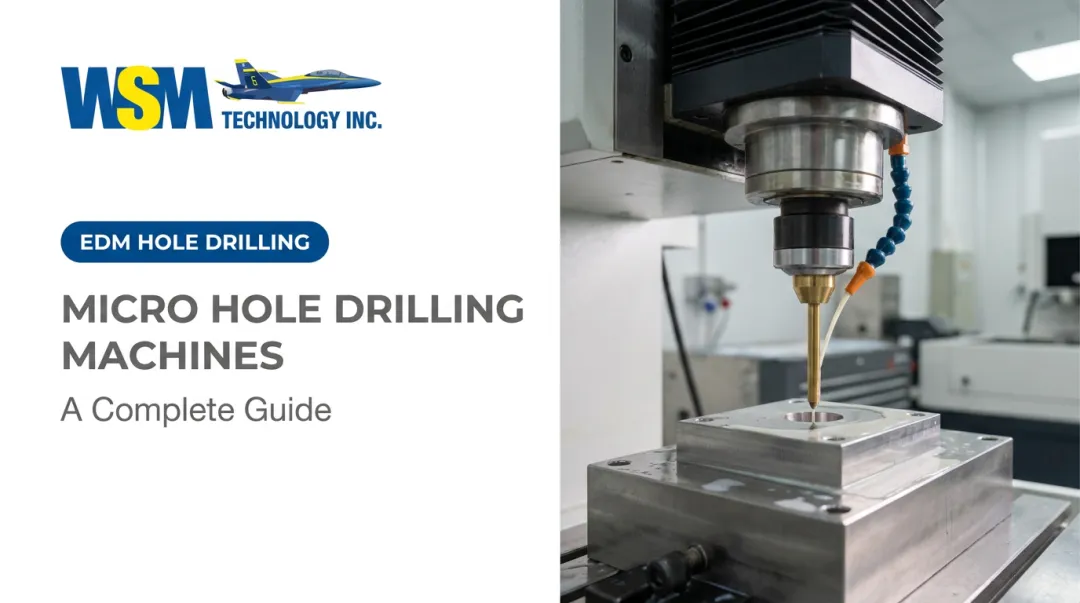
Where thermal distortion is unacceptable — tight-tolerance features in titanium or hardened alloys — Electrical Discharge Machining offers a different path. According to Modern Machine Shop, wire EDM exerts no cutting force and introduces no residual stress. WSM Technology carries Mitsubishi Wire EDM platforms (including the MV1200S and MV2400) and Sarix Micro EDM systems suited to aerospace and medical work, including micro-feature EDM drilling and milling where conventional tooling cannot reach.
Environmental Factors That Amplify Machining Risk
NIST establishes 20°C as the reference temperature for dimensional measurement. For a 100mm Ti-6Al-4V feature with a CTE of approximately 8.6 µm/m·°C, a 3°C temperature swing shifts that feature by roughly 0.0026mm — enough to move a tight-tolerance feature out of spec. Climate control in inspection and finishing areas isn't a lab formality; it's a measurement control.
Medical manufacturing adds another layer: cross-contamination. ASTM F86-21 explicitly notes that iron particles and other foreign material can become embedded in implant surfaces during processing. Segregating materials, tools, abrasives, and cleaning paths for implant titanium — and documenting cleaning validation — is a compliance requirement, not a housekeeping preference.
Risk Mitigation: Best Practices for Safer Precision Machining
Validate Processes Before Production
Test cuts, CAM simulation, and time studies on representative material catch the largest category of unknown process risk before it reaches production. This matters most when introducing a new titanium grade or transitioning between machine platforms.
WSM Technology's demonstration center in Rootstown, Ohio supports exactly this kind of validation: customers can run their actual application on the machine before committing to production.
Manage Tooling with Defined Replacement Intervals
Running tools to failure in titanium doesn't just produce scrap — a worn tool work-hardens the surface, making every subsequent cut more destructive. Implement defined tool life limits with inspection checkpoints throughout the run, not just at setup and final inspection.
Key tooling controls:
- Specify tool grade, coating, and edge prep in the job plan
- Set replacement triggers based on tool life data, not visual assessment
- Document tooling records as part of the job traveler for traceability
Match Coolant Strategy to the Operation
Three approaches apply in aerospace and medical work:
| Approach | Best Application |
|---|---|
| High-pressure through-spindle | Titanium roughing; primary heat and chip management |
| Flood coolant | General finishing and semi-finish passes |
| Minimum quantity lubrication (MQL) | Finishing operations where flood is impractical |

The ROMI D1000 vertical machining center available through WSM Technology includes a 100 PSI through-spindle coolant system as standard, along with a chip conveyor — both directly relevant to titanium roughing.
Use In-Process CMM Inspection, Not Just Final Inspection
CMM verification at defined intervals during production — not only at the end of the run — catches dimensional drift before it becomes a full-lot compliance event. This supports AS9100 clause 8.7 and ISO 13485 traceability requirements. Renishaw probing and tool measurement systems built into machines like the Roku-Roku Android II — which includes a Renishaw OMP400 part probe — integrate in-process inspection into the cycle itself, catching drift that final inspection alone would miss.
Common Precision Machining Mistakes That Lead to Part Failure
Three process failures account for the majority of preventable part rejections in aerospace and medical machining:
- Skipping material and tooling verification at job setup. Assuming a titanium stock certificate matches the required alloy grade — or that a tool that looks fine is within spec — is a compliance failure waiting to happen. Material verification and tooling inspection are the first checkpoint between a good lot and a scrapped one.
- Bypassing in-process inspection under schedule pressure. This is one of the most common causes of full-lot scrap and regulatory findings. The time saved by compressing inspection intervals never offsets the rework hours, documentation burden, and customer impact when a nonconformance surfaces downstream.
- Ignoring early warning signs of tool wear. Changes in chip color, cutting sound, or surface finish during a titanium operation are reliable indicators of thermal overload or tool degradation. Running through those signals doesn't save time — it turns a tooling cost into a rejected part and a potential compliance event.

Conclusion
Risk management in precision machining for aerospace and medical isn't a separate program — it's what disciplined process control looks like in practice. Controlling heat, managing tooling systematically, validating setups before production, and maintaining documentation aren't compliance obligations stacked on top of the work. They are the work.
WSM Technology supports manufacturers across Northern Ohio, Western Pennsylvania, and West Virginia with test cuts, time studies, and application engineering to validate machining processes before production begins. Whether the challenge involves a new titanium grade, a platform transition, or EDM for a tight-tolerance feature, the team draws on decades of precision manufacturing experience across aerospace and medical work.
Contact WSM Technology to discuss your next machining challenge.
Frequently Asked Questions
Does titanium warp during machining?
Yes. Residual internal stress introduced during improper machining — particularly when axial depth isn't varied between cuts or heat isn't managed — can cause titanium workpieces to warp hours after machining is complete. Roughing strategy, stress relief, and planned semi-finish sequences all reduce this risk.
Is titanium used in the medical industry?
Medical manufacturers rely on titanium for implants, bone screws, surgical instruments, and joint prostheses because of its biocompatibility, corrosion resistance, and strength-to-weight ratio. Grade 23 (Ti-6Al-4V ELI), recognized under ASTM F136, is the preferred grade for implant applications due to its tighter interstitial limits.
What are the biggest risks of precision machining in aerospace manufacturing?
The primary risks are out-of-tolerance parts, compliance failures under AS9100, thermal distortion in difficult alloys, and documentation gaps — any of which can ground a component before it reaches the aircraft. The FAA's $5.4M penalty against Boeing illustrates how far downstream a nonconforming machined part can travel before consequences materialize.
What happens if a precision machined part fails inspection in a regulated industry?
A failed part triggers nonconformance control, segregation from production stock, documented disposition, and corrective action review. Severe cases place a hold on the full production lot and require customer or regulatory notification.
How does EDM reduce machining risks when working with titanium?
EDM removes material through electrical discharge rather than cutting force, eliminating mechanical stress, heat transfer to the workpiece, and work-hardening risk — making it the right choice for tight-tolerance titanium features where conventional milling would introduce distortion.
What safety precautions should machinists take when machining titanium?
Manage chips continuously, use appropriate coolant at the cutting zone, wear proper PPE, and never run worn tooling. Titanium swarf and dust present a combustion hazard. Chip evacuation and housekeeping practices should be specified in the process plan, not left to operator discretion.