
Introduction
Ask any moldmaker how they get a 0.3mm vent hole through hardened D2 steel, and they won't reach for a drill press. They'll point to an EDM hole popper.
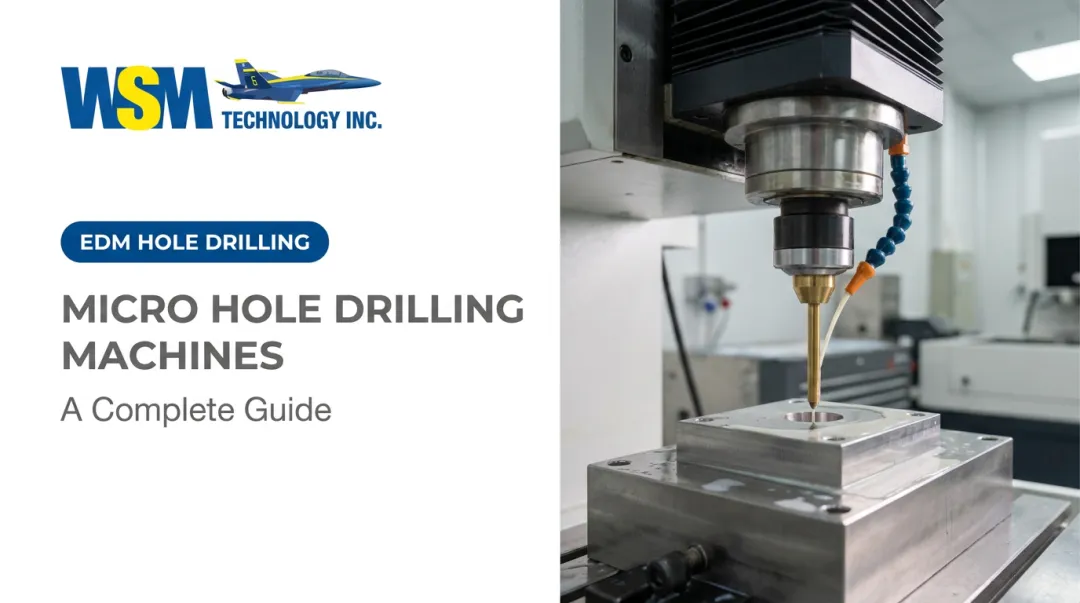
Small hole EDM drilling is a non-contact process. It uses electrical discharge through a rotating tubular electrode to erode small, deep, precise holes in conductive materials — no cutting force, no tool deflection.
This matters most for mold and die makers, aerospace component manufacturers, and micro-molding shops working with hardened tool steel, titanium, or carbide. Conventional drills snap, wander, or wear out fast in these materials, especially at aspect ratios beyond what a standard twist drill can handle.
Despite these challenges, shop talk mentions EDM hole drilling constantly but rarely explains it well. This article covers how it actually works, what drives hole quality, and when it's the wrong tool for the job.
Key Takeaways
- Electrical sparks erode material instead of mechanical force, so EDM machines hardened, hard-to-cut conductive metals
- Best suited for sub-1mm to a few-millimeter holes too small, deep, or hard for twist drills
- Hole quality hinges on discharge energy, electrode condition, and flushing, not feed pressure
- Material, geometry, and volume, not preference, determine whether EDM or conventional drilling wins
What Is Small Hole EDM Drilling?
Small hole EDM drilling is a specialized branch of electrical discharge machining. A rotating, hollow tubular electrode erodes material to form narrow, deep holes in electrically conductive workpieces.
The goal: a precise, straight hole in a hard or delicate part, achieved without mechanical force or risking a broken tool.
It's easy to confuse with the other two EDM processes, but they solve different problems:
- Wire EDM threads a continuously fed wire through the part to cut profiles or shapes
- Sinker EDM uses a shaped electrode to burn cavities and detailed forms
- Small hole EDM drilling uses a spinning tube electrode with internal flushing to bore round holes
Conventional drilling and small hole EDM drilling rely on entirely different mechanics. The difference comes down to what drives the cut:
- Conventional drilling depends on tool rigidity, spindle speed, and cutting force
- Small hole EDM drilling depends on electrical parameters and flushing efficiency instead
- There's no chip load or traditional feed rate, just controlled sparks and a steady flow of dielectric fluid clearing debris from the gap

Why & Where Small Hole EDM Drilling Is Used
Shops turn to EDM drilling when hardened tool steel, titanium, or carbide parts make conventional drilling unreliable. According to Canadian Metalworking's EDM Hole Drilling guide, EDM can machine hardened metal at 70 HRC or higher — well past what most drill bits tolerate without snapping.
Aspect ratio is the other deciding factor. Makino's technology-selection guide reports oil dielectric systems typically reach up to 150:1 length-to-diameter with tolerances near ±0.005mm, while water dielectric can push past 300:1 but trades some accuracy for depth.
What precision shops actually need:
- Consistent tolerance across the full depth of the hole
- Zero tool deflection on hardened or curved surfaces
- Repeatable results on materials that would destroy a twist drill
When shops force conventional drilling into these jobs anyway, the results are predictable: broken bits, drift, scrapped parts, and lost cycle time re-fixturing broken tooling. EDM drilling works as a practical fallback for hard-material, small-diameter work rather than a first-choice shortcut.
In mold-making and aerospace, EDM drilling has become an operational necessity. Shops can't produce parts made from hardened tool steel or heat-resistant alloys any other reliable way.
Common Applications of Small Hole EDM Drilling
- Mold venting and ejector-pin holes in hardened tool steel that drills can't reach reliably
- Wire EDM starter holes, letting the wire thread through thick or already-hardened stock before profile cutting begins
- Aerospace turbine blade and fuel nozzle cooling holes in heat-resistant alloys like Inconel
- Broken tap and drill removal, pulling failed tooling out of a part without damaging the surrounding material
How Small Hole EDM Drilling Works
At a high level: the electrode and workpiece connect to a power source, separated by dielectric fluid. Controlled sparks jump the gap, eroding material as the electrode advances into the part.
Three things drive the process:
- Electrode material: typically brass or copper tube, occasionally tungsten for very small or wear-critical holes
- Dielectric fluid: deionized water for speed and depth, oil for tighter accuracy
- Electrical parameters: pulse timing, discharge energy, and flushing pressure
Each discharge melts and vaporizes a microscopic amount of material. Repeated thousands of times per second, this gradual erosion forms the hole without a single mechanical cutting edge touching the part. The tradeoff: a thin recast layer forms on the hole wall from resolidified material, which some aerospace applications finish-trim with lower-energy passes.
Step 1: Electrode Selection and Setup
Electrode material and diameter get chosen based on target hole size and workpiece material. Smaller holes typically call for brass or copper tube electrodes; harder or more wear-sensitive jobs may use tungsten. The electrode is aligned precisely with the workpiece before any discharge starts, since misalignment at this stage carries through the entire cut.
Step 2: Discharge and Flushing
Sparks progressively erode the material while dielectric fluid pumps through the hollow electrode center, clearing debris and preventing short-circuits. Flushing pressure directly affects depth stability. Too little pressure, and debris accumulates in the gap, causing arcing and pitting instead of clean erosion.
Step 3: Hole Completion and Compensation
Electrode wear happens continuously during the cut, and Canadian Metalworking reports wear rates ranging from 50% to 250% depending on the electrode-to-work material pairing, with smaller electrodes wearing faster. Machines compensate for this in real time to hold consistent diameter, and taper is minimized as depth increases by managing flushing and discharge energy together.

Key Factors, Common Issues, and When EDM Drilling May Not Be the Right Choice
Key Factors That Affect Hole Quality
- Material conductivity and hardness: only electrically conductive materials can be processed; hardness itself has little bearing on cycle stability
- Aspect ratio and electrode size: these govern how far a stable discharge can be sustained before flushing becomes the limiting factor
- Flushing efficiency and dielectric type: directly influence straightness and debris evacuation, especially in deep holes
- Machine precision and control: equipment quality matters most here. Machines like the Sarix Micro EDM line, available through WSM Technology, are built for precise discharge and flushing control in sub-millimeter hole work
Common Issues and Misconceptions
A frequent mix-up: people confuse small hole EDM drilling with wire EDM cutting. They use different electrode setups entirely and solve different problems: one bores round holes, the other cuts profiles.
Another misconception is that EDM drilling is always faster or more accurate than conventional drilling. It isn't. CTE's fast-hole EDM overview notes that speed is a primary determinant of precision: running for maximum speed sacrifices tolerance. The process trades speed for stability in hard or deep-hole jobs, not the other way around.
Speed isn't the only variable that gets misread as a problem. Taper or oversized holes are often blamed on machine error, but in reality, they're usually the expected result of electrode wear and reduced flushing efficiency at depth, not a malfunction.
When Small Hole EDM Drilling May Not Be Appropriate
EDM drilling isn't the right call in every scenario:
- Non-conductive materials: plastics and standard composites can't be EDM drilled at all, since the process requires electrical conductivity
- High-volume standard-size holes in soft materials: conventional drilling stays faster and cheaper here
- Holes above roughly 0.25 inches in diameter: CTE notes conventional drilling or sinker EDM is generally more practical past this point
- Default use without necessity: if the material and hole size would allow safe conventional drilling, EDM drilling is likely overkill

Conclusion
Small hole EDM drilling is a non-contact, spark-erosion process for creating precise, deep, small-diameter holes in conductive materials that conventional drills can't reliably handle. Understanding how it actually works, not just what it produces, helps shops select the right equipment and troubleshoot problems on the floor instead of guessing.
Choosing the right machine matters just as much as the process itself. WSM Technology's Demonstration Center in Rootstown, Ohio lets you test-cut parts on Sarix Micro EDM and Mitsubishi EDM equipment before committing to a solution. It's a practical way to confirm a machine handles your specific material and hole geometry before it's on your shop floor.
Frequently Asked Questions
What is EDM in drilling?
EDM (Electrical Discharge Machining) drilling uses controlled electrical sparks between a tubular electrode and a conductive workpiece to erode material and form holes. The process involves no mechanical cutting force.
Can you drill holes with wire EDM?
Wire EDM is primarily a cutting process, not a drilling one. It typically needs a starter hole, often made through small hole EDM drilling first, to let the wire pass through thick or hardened stock.
What is the minimum hole size for EDM?
Minimum diameters as small as roughly 0.1mm are achievable on specialized micro EDM equipment. Actual minimums depend heavily on electrode size and the specific machine's capability.
What is the tolerance of EDM drilling?
Tolerances vary by hole depth and diameter, but fast-hole work commonly achieves around ±0.0005 inch. Real-world results hinge on flushing consistency and electrode wear compensation.
What is EDM drilling used for?
Common applications include mold cooling and venting holes, aerospace turbine and fuel nozzle cooling holes, wire EDM starter holes, and removing broken taps or drill bits from parts.
How long does EDM drilling typically take per hole?
Cycle times run slower than conventional drilling since material removal depends on repeated discharges rather than cutting. Deeper or smaller-diameter holes need longer, more controlled cycles to maintain accuracy.